School of Law, UPES, Dehradun
Ranked #18 amongst Institutions in India by NIRF | Get Upto 100% Scholarships | Spot Admissions via CUET


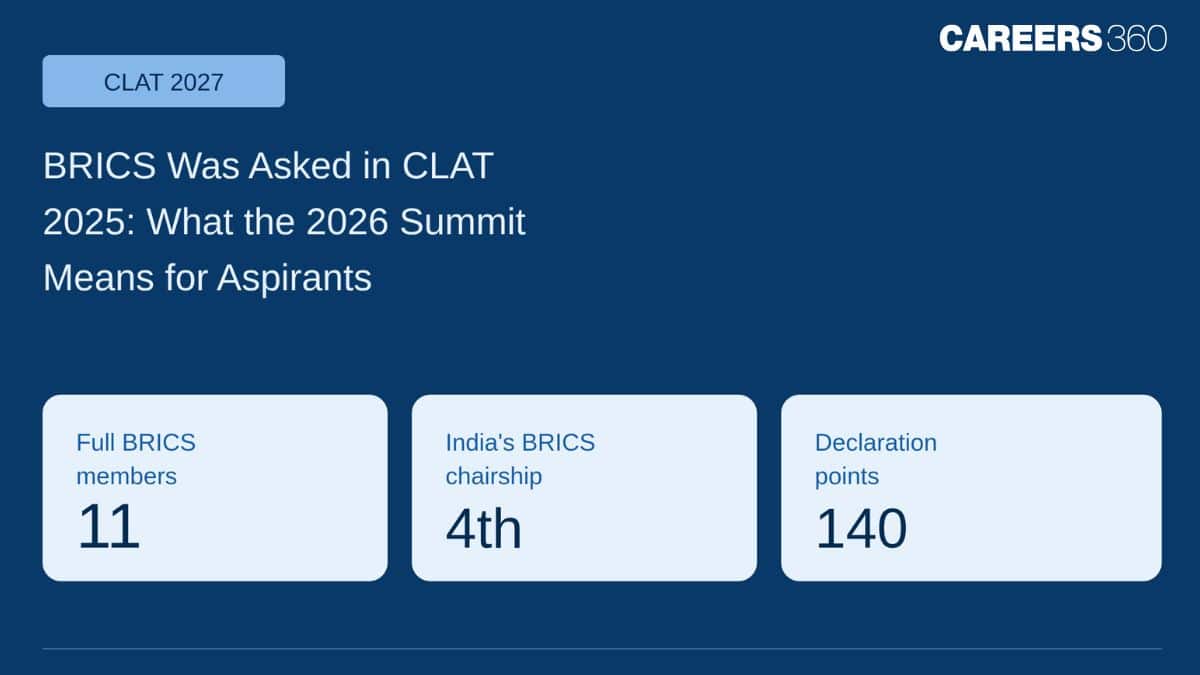
BRICS was directly tested in the CLAT 2025 current affairs and general knowledge section. The passage was based on a Reuters report on the 16th BRICS Summit in Kazan. With the 18th BRICS Summit held in New Delhi on September 12 and 13, 2026, the topic becomes relevant again for CLAT 2027 aspirants. The 2026 summit marked India's fourth BRICS chairship, after its previous chairships in 2012, 2016 and 2021. The BRICS 2026 theme was “Building for Resilience, Innovation, Cooperation and Sustainability,” and it concluded with the adoption of the New Delhi Declaration.
Topic | What to remember |
18th BRICS Summit | New Delhi, September 12-13, 2026 |
Chair | India |
Theme | Building for Resilience, Innovation, Cooperation and Sustainability |
Declaration | New Delhi Declaration |
Full members | 11 (Brazil, Russia, India, China, South Africa, Egypt, Ethiopia, Indonesia, Iran, United Arab Emirates, Saudi Arabia) |
Partner countries | 10 (Belarus, Bolivia, Kazakhstan, Cuba, Nigeria, Malaysia, Thailand, Vietnam, Uganda and Uzbekistan) |
Next chair | China, 2027 |
Payment cooperation | Cross-border payments and local-currency settlement |
Common BRICS currency | Not launched |
Risk Lab | Proposed at GIFT City |
Grain Exchange | Proposed BRICS grain trading platform |
AGRIN | Agricultural cooperation network |
Digital initiative | BRICS Digital Public Infrastructure Repository |
UN reform | Greater representation for developing countries |
African proposals | Ezulwini Consensus and Sirte Declaration |
Terrorism | Condemnation of April 22, 2025 J&K attack |
WTO | Support for Ethiopia and Iran's accession bids |
The New Delhi Declaration covered finance, trade, agriculture, technology, global governance, climate change, health and security. These are the decisions and proposals that stand out from the 140-point declaration:
The BRICS countries agreed to continue work on cross-border payments and improve the interoperability of payment and messaging systems. The BRICS Payment Task Force will take forward work on payment mechanisms, while members will explore greater use of local currencies in trade and investment.
The declaration does not announce the creation of a common BRICS currency. The focus remains on making cross-border transactions easier and reducing some of the difficulties associated with existing international payment systems.
Ranked #18 amongst Institutions in India by NIRF | Get Upto 100% Scholarships | Spot Admissions via CUET
Scholars’ Round Deadline: 14th Nov’26 | Earn upto 50% merit Scholarship + 10% for top performers | EFMD Accredited | AACSB (USA) & AMDISA Member | Highest CTC 28 LPA
India's proposal for a BRICS Risk Lab at GIFT City International Financial Services Centre (IFSC) in Gujarat was also discussed.
The proposed facility is intended to support cooperation on financial risks and emerging challenges affecting BRICS economies. The declaration records members' interest in taking the proposal forward.
The summit backed further work on the proposed BRICS Grain Exchange, with a target of developing the platform by 2027.
The initiative is linked to agricultural trade and food security. It is intended to improve cooperation in grain markets and address issues related to agricultural supply chains and food availability.
The idea was first proposed in 2023, making the 2026 discussion part of a longer effort to build a BRICS mechanism for agricultural trade.
The declaration welcomed BRICS AGRIN, a voluntary and non-binding cooperation mechanism in agriculture.
It covers areas such as agro-inputs, genetic resources, agricultural information and cooperation among agricultural institutions. The initiative is connected with food security and efforts to strengthen agricultural cooperation within the grouping.
Digital cooperation received a separate focus at the summit. BRICS proposed a Digital Public Infrastructure Repository to facilitate the exchange of knowledge and experience among member countries.
The declaration also supports pilot projects and cooperation on digital public infrastructure, linking the initiative with digital transformation, economic development and delivery of public services.
BRICS reiterated its support for reform of the United Nations and the UN Security Council to make global institutions more representative of developing countries. The New Delhi Declaration referred to the Ezulwini Consensus and the Sirte Declaration, which set out the African position on representation in a reformed UN Security Council.
China and Russia reiterated their support for the aspirations of India and Brazil to play a greater role in the United Nations, including the Security Council. The issue is significant for India because UN Security Council reform and permanent membership have been longstanding elements of India's foreign policy.
Global governance was one of the central themes of India's BRICS chairship. India proposed a 10-point roadmap for reforming global governance, based on three principles: representation, responsiveness and rule-making. The proposal seeks greater participation of developing countries in international decision-making.
The declaration also called for greater representation of emerging markets and developing economies in international financial institutions. BRICS countries backed efforts to reform major institutions, including the International Monetary Fund (IMF), the World Bank and the World Trade Organisation (WTO). The broader objective is to make global institutions more representative of the changing distribution of economic and political influence.
The following passages cover the key developments from the BRICS 2026 Summit. Candidates can also answer the questions given along with the CLAT 2027 practice passages:
All 11 member countries have endorsed the New Delhi Declaration, which outlines 140 points in a document of 45 pages, during the 18th BRICS Summit in New Delhi on 13 September 2026. There were reportedly discussions and negotiations with diplomats until the early morning hours regarding wording for the West Asia conflict before there was a compromise was accepted by Iran and the UAE, and the language was adopted by consensus. The statement urges "restraint", "dialogue and respect for international law", and "condemnation" of the 2025 attack in Pahalgam, among other things, which is classified as "cross-border terrorism".
In economics, leaders have requested the payment task force to advance with the development of interoperable platforms for trade in local currencies, with no mention of a common BRICS currency. They also have a vision of launching a BRICS Grain Exchange by 2027, which was first envisioned in 2023. India, which chairs the grouping for the fourth time, said it was looking to make the emerging strength of BRICS a reality. Today the bloc accounts for about 40 per cent of the world's GDP. China will be the next host of the summit in 2027.
Q1. Which of the following was announced at the BRICS 2026 Summit?
(A) A common BRICS currency
(B) Steps to advance interoperable local-currency payment systems
(C) Admission of new full members
(D) A plan to end the West Asia conflict
Q2. How was the New Delhi Declaration adopted?
(A) By majority vote after Iran and the UAE disagreed
(B) By consensus after Iran and the UAE agreed to a compromise
(C) Without discussing the West Asia conflict
(D) After China withdrew its objections on terrorism
Q3. What does the passage suggest about BRICS and currencies?
(A) BRICS plans to replace the dollar with a single currency
(B) BRICS is promoting settlements in national currencies instead of a common currency
(C) BRICS has stopped focusing on trade cooperation
(D) BRICS has dropped its focus on food security
Q4. Which country will host the next BRICS Summit?
(A) Brazil
(B) Russia
(C) China
(D) South Africa
Q5. What is correct about the BRICS Grain Exchange?
(A) It was launched at the New Delhi Summit
(B) It is targeted for launch by 2027 and was first proposed in 2023
(C) It was proposed by India in 2026
(D) The proposal has been cancelled
The membership of BRICS has expanded from 5 to 11 countries, with 10 others becoming Partner Countries in 2025. The supporters believe that the expansion would provide a more united voice for the Global South in reforming institutions like the IMF, the World Bank and the WTO. India took the Chair to present a 10-point agenda for changing the way global governance is done, based on three principles: Representation, Responsiveness and Rule-making. It spoke of a goal of "shifting the international system from a 'pyramid of privilege' to a 'platform of partnership'.
Sceptics respond that a 140-point declaration and dozens of new initiatives create a long list of intentions, not a clear programme of work. They note that members differ sharply on major questions, and that the compromise needed between Iran and the UAE shows how hard consensus can be. In their view, the real test will be whether the initiatives, from payment systems to a grain exchange, are implemented on schedule, not how many are announced.
Q1. The "3Rs" in India's governance-reform roadmap are:
(A) Regulation, Reform, Recovery
(B) Representation, Responsiveness, Rule-making
(C) Resilience, Renewal, Reciprocity
(D) Rights, Responsibility, Reform
Q2. Which critique of BRICS does the passage attribute to sceptics?
(A) The bloc is too small to matter
(B) A very broad declaration may not translate into implemented outcomes
(C) BRICS has no interest in the WTO
(D) India is opposed to expansion
Q3. Which institutions does the passage say supporters want BRICS to help reform?
(A) IMF and World Bank only
(B) WTO only
(C) IMF, World Bank and WTO
(D) UN Security Council only
Q4. The Iran-UAE compromise is used in the passage to show:
(A) That the summit failed
(B) That consensus among diverse members can be difficult
(C) That BRICS has a formal treaty and secretariat
(D) That the declaration was imposed on members
Q5. The phrase "pyramid of privilege" to "platform of partnership" suggests the speaker wants an international system that is:
(A) More hierarchical
(B) More equal and cooperative
(C) Smaller in membership
(D) Focused only on trade
The summit also had a cultural side. Delegates were served dishes featuring Gucchi, a rare mushroom found in Himalayan forests, and were given Koraput coffee from Odisha, a gesture meant to promote local products. On the diplomatic side, BRICS backed the Ezulwini Consensus and the Sirte Declaration, which call for African representation in a reformed UN Security Council. China and Russia also expressed support for the aspirations of India and Brazil in that process.
Q1. Gucchi is best described as:
(A) A fungus
(B) A fruit
(C) A grain
(D) A spice
Q2. Koraput coffee comes from which state?
(A) Karnataka
(B) Kerala
(C) Tamil Nadu
(D) Odisha
Q3. The Ezulwini Consensus and the Sirte Declaration concern:
(A) Climate finance
(B) African representation in a reformed UN Security Council
(C) WTO accession
(D) Digital public infrastructure
Answer Key
Passage 1: Q1 (B), Q2 (B), Q3 (B), Q4 (C), Q5 (B)
Passage 2: Q1 (B), Q2 (B), Q3 (C), Q4 (B), Q5 (B)
Passage 3: Q1 (A), Q2 (D), Q3 (B)

On Question asked by student community
Hello Student,
Here are the Careers360 CLAT 2027 Mock Test Resources for your exam preparation.
1. Online CLAT Mock Test
2. CLAT Mock Tests and Solutions
Hello student,
CLAT 2027 aspirants can access these monthly current affairs compilations for regular revision. Use these resources to stay updated with important events and topics for CLAT 2027.
|
Particular |
Download PDF |
|
CLAT Current Affairs- August Month (2026) |
|
|
CLAT Current Affairs- |
If you have only two months, use a highly structured plan: daily current affairs, English reading, legal reasoning practice, logical reasoning sets, basic quantitative practice and regular full-length mocks. Spend as much time analysing incorrect questions as taking the mock itself. Consistency during these two months can make a substantial
You can download the CLAT previous years' question papers from here:
https://law.careers360.com/articles/clat-previous-year-question-papers
https://law.careers360.com/download/clat-sample-papers-previous-years
For CLAT 2027 UG, candidates need to have passed Class 12/equivalent with at least 45% marks, or 40% for SC/ST/PwD candidates.
In your situation, having an RT in an additional subject but subsequently passing the required qualification through an improvement examination does not automatically make you ineligible. However, the important

Ranked #18 amongst Institutions in India by NIRF | Get Upto 100% Scholarships | Spot Admissions via CUET
Scholars’ Round Deadline: 14th Nov’26 | Earn upto 50% merit Scholarship + 10% for top performers | EFMD Accredited | AACSB (USA) & AMDISA Member | Highest CTC 28 LPA
Moot Court | Mock trials | Legal Aid Clinic | Recruiting Partners: FICCI, TCS, Adani, Trilegal, and many others
NAAC A+ Accredited University
BA LLB, BBA LLB, or BCom LLB and LLB | LLM 1 Year – 4 Specializations | Approved by BCI | Highest CTC 9 LPA
Grade 'A+' Accredited by NAAC | Ranked 33rd in India by NIRF