
Search Colleges, Exams, Schools & more


Login
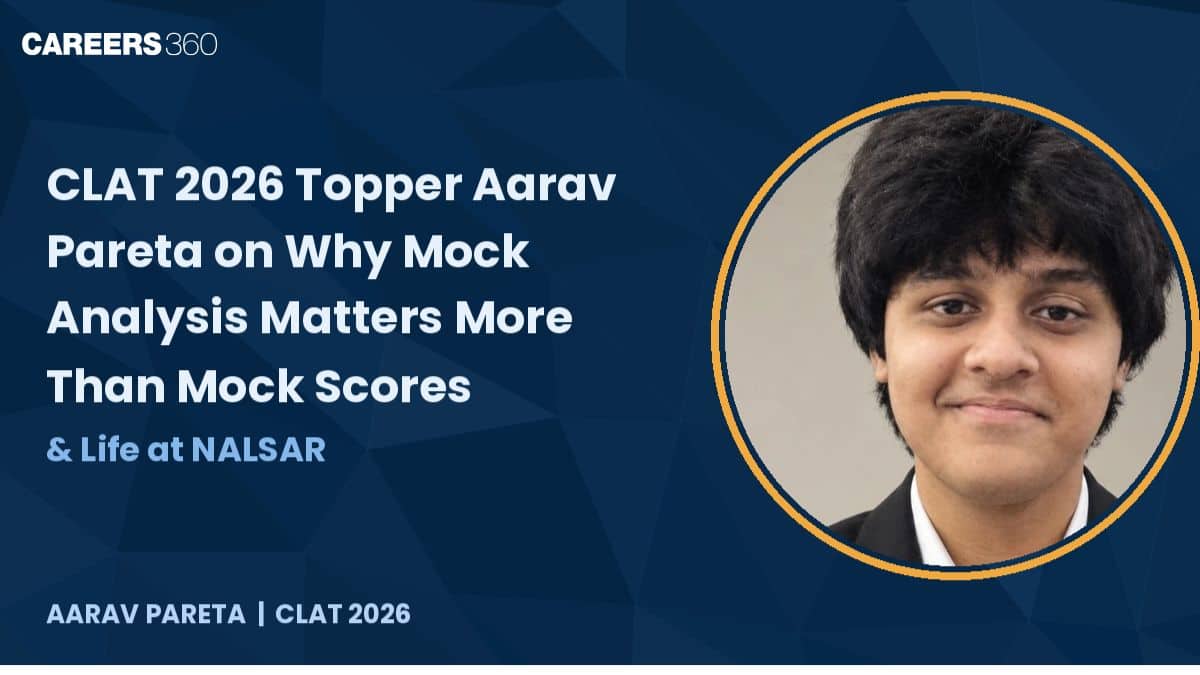
CLAT 2026 Topper Aarav Pareta on Why Mock Analysis Matters More Than Mock Scores and Life at NALSAR
Aarav Pareta, a first-year BA LLB (Hons) student at NALSAR, prepared for CLAT with a Humanities background, dedicating half his study time to GK and attempting around three CLAT mocks tests a week. But his biggest takeaway from CLAT was not about attempting more mocks. Aarav believes mock analysis should go beyond checking mistakes and involve changing the way you approach the next paper. In this interview with Careers360, he also talks about filtering CLAT Current Affairs and GK, the advantage of a Humanities background and what surprised him about academic life at NALSAR.
Careers360: Coming from a Humanities background, did it shape the way you approached CLAT’s comprehension-heavy format, particularly reading and reasoning?
Aarav: Yeah, honestly, I think Humanities does give you an advantage in terms of providing familiarity with the kind of content on which CLAT passages generally are based, for example, economics, political science, etc. This advantage is nothing of great significance, though; the only upside is that you get familiarity with the theoretical concepts used in the passages, which sometimes might not be explained that well in the passage itself.
Careers360: What did your CLAT preparation look like in the final few months, and what changed most as the exam approached?
Aarav: I focused more on mocks and GK. To give a more accurate idea, I tried to write at least three mocks a week, and I devoted some time each day to study and revise GK, with the revision part taking most of my time.
Careers360: For aspirants who are constantly tracking mock scores and ranks, what helped you focus on improving rather than just chasing numbers?
Aarav: Sometimes you have to approach a mock result with more aspects beyond just the number. I believe that even if I scored less in a mock, that mock could give me more takeaways when compared to a mock in which I scored well. So in other words, regardless of a person scoring good/bad, they should spend an equal amount of time analysing the mocks.
Careers360: With five subjects in CLAT, how did you decide what to prioritise? Did you focus more on weak areas or maximise your strengths?
Aarav: My top priority was, of course, GK, because it is undoubtedly the most volume-heavy subject. The rest of the subjects require cognitive ability, which is built through practice, so essentially I spent half of my time on GK and the other half on other subjects. My main priority was always focusing more on weak areas, but I took out time to maximise my strengths as well.
Careers360: How did you approach Current Affairs and GK? How did you filter what was actually worth studying from the huge amount of news available?
Aarav: I followed monthly magazines that my coaching institution provided. When one analyses past years' sections of GK, it can provide a rough idea as to what the important topics can look like every year. Additionally, a student can consult their mentor as well for the same topic.
Careers360: Now that you are at NALSAR, what is one thing about life at a top NLU that was completely different from what you imagined?
Aarav: The academic rigour that one gets exposed to is unmatched. I am in my first semester, so I am a victim of the same right now. However, NALSAR has many things beyond academics as well, which are often sufficient to take some stress off your mind.
Careers360: Looking back at your CLAT preparation, what is one strategy or resource you would change if you had to prepare again?
Aarav: I would personally place more emphasis on analysing my mocks compared to the way I did in my CLAT preparation. Sometimes one feels that only checking your mistakes and finding a solution to them is sufficient to qualify as mock analysis. However, an analysis should be a much deeper practice which requires the adjustment of your cognitive thinking and trying to figure out an amendment in one’s way to approach for the next mock, if needed.
Articles
Related Stories
|
Upcoming Law Exams

Certifications By Top Providers
Explore Top Universities Across Globe
Popular Courses and Specializations
Popular Degrees
List of colleges accepting CLAT
Browse Law Colleges by State
Questions related to CLAT
On Question asked by student community
Have a question related to CLAT ?
Hello Student,
Here are the Careers360 CLAT 2027 Mock Test Resources for your exam preparation.
1. Online CLAT Mock Test
2. CLAT Mock Tests and Solutions
Hello student,
CLAT 2027 aspirants can access these monthly current affairs compilations for regular revision. Use these resources to stay updated with important events and topics for CLAT 2027.
CLAT 2027 Current Affairs - Monthly Compilations
|
Particular |
Download PDF |
|
CLAT Current Affairs- August Month (2026) |
|
|
CLAT Current Affairs- |
If you have only two months, use a highly structured plan: daily current affairs, English reading, legal reasoning practice, logical reasoning sets, basic quantitative practice and regular full-length mocks. Spend as much time analysing incorrect questions as taking the mock itself. Consistency during these two months can make a substantial
You can download the CLAT previous years' question papers from here:
https://law.careers360.com/articles/clat-previous-year-question-papers
https://law.careers360.com/download/clat-sample-papers-previous-years
For CLAT 2027 UG, candidates need to have passed Class 12/equivalent with at least 45% marks, or 40% for SC/ST/PwD candidates.
In your situation, having an RT in an additional subject but subsequently passing the required qualification through an improvement examination does not automatically make you ineligible. However, the important

Applications for Admissions are open.
Ranked #18 amongst Institutions in India by NIRF | Get Upto 100% Scholarships | Spot Admissions via CUET
Woxsen University, Hyderabad
ApplyScholars’ Round Deadline: 14th Nov’26 | Earn upto 50% merit Scholarship + 10% for top performers | EFMD Accredited | AACSB (USA) & AMDISA Member | Highest CTC 28 LPA
KCC Institute of Legal and Higher Education, Greater Noida
ApplyLaw Admissions 2026 Open | Avail Merit-Based Scholarships
SRM School of Law, Kattankulathur
ApplyNAAC A++ Accredited | Ranked #11 by NIRF
School of Law and Governance, Vishwakarma University, Pune
ApplyLaw Admissions Open 2026 | #2nd in India by The World University Rankings for Innovation | 200+ Collaborations | 700+ Industry Recruiters
WPU School of Law, Pune
ApplyLaw Application Open 2027 | International Students from 30 countries | Merit-Based Scholarship worth Rs. 50 Crores | 100,000+ Alumni Globally.
CLAT Notifications
Never miss CLAT update
Get timely CLAT updates directly to your inbox. Stay informed!