School of Law, UPES, Dehradun
Ranked #18 amongst Institutions in India by NIRF | Get Upto 100% Scholarships | Spot Admissions via CUET


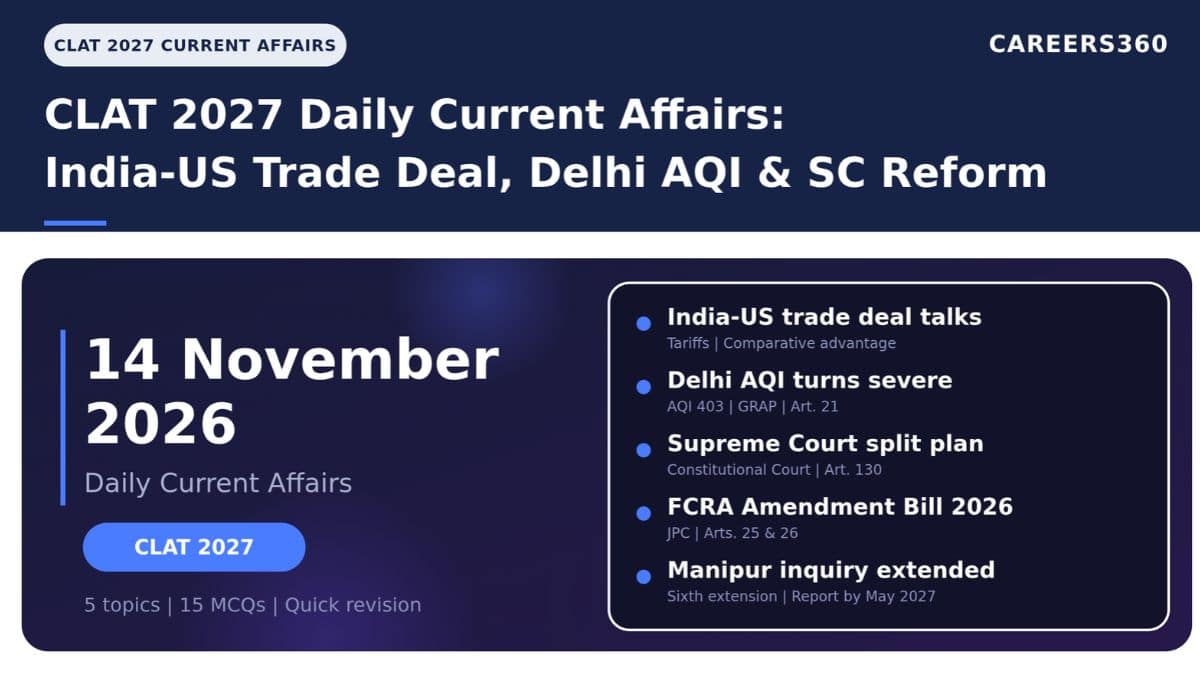
Today's CLAT 2027 current affairs cover five topics from international relations, economy, environment and law. These include India-US tariff talks, Delhi's air pollution, a proposal to restructure the Supreme Court, the FCRA Amendment Bill and the Manipur violence inquiry. Key facts, legal concepts and MCQs are included to help aspirants prepare for the Common Law Admission Test 2027.
In the news: A senior Commerce Ministry official said the US has assured India of a “comparative advantage” over competing countries under the proposed interim trade deal. Both sides aim to complete the agreement by the end of the financial year. India wants this advantage as agreed in the February 2026 joint statement between PM Modi and President Trump.
Since February, the US has imposed an additional 10% “forced labour” tariff on India and competitors such as Indonesia, Malaysia, Pakistan and Sri Lanka. It is also investigating excess capacity, which could lead to more tariffs. The deal allows either side to change its commitments if the other changes its tariffs.
Tariff: A tax on imported goods. It makes imports costlier and can protect local producers.
Comparative advantage: When a country can produce a good at a lower relative cost than another country.
Interim trade deal: A limited agreement made before a full trade agreement is finalised.
Rebalancing clause: Allows either side to change its commitments if the other changes its tariffs.
Union List: Foreign trade and commerce fall under the Union government's powers.
Q1. What is the main effect of a tariff on imported goods?
A. It reduces their price
B. It raises their price and can protect domestic producers
C. It stops all imports
D. It fixes exchange rates
Answer: B
Q2. Why would India seek a “comparative advantage” in a trade deal with the US?
A. To ensure Indian exporters are not placed at a disadvantage against competitors
B. To stop all trade with the US
C. To impose tariffs on Indian goods
D. To end trade negotiations
Answer: A
Q3. What is the purpose of a clause that allows either country to change its commitments if the other changes tariffs?
A. To make the agreement permanent and unchangeable
B. To keep the trade deal balanced if either side changes its terms
C. To remove all import duties
D. To make the deal apply to other countries
Answer: B
Attempt Free Official Practice Test & Solutions and Ace the CLAT Exam 2026
In the news: Delhi's average AQI reached 403 (severe) at 9 am on Friday, up from 373 the previous day. Vehicles contributed 20.2% of the pollution load, while stubble burning accounted for 9.2%, according to Ministry of Earth Sciences data.
Delhi Traffic Police plans stricter checks at city borders to stop vehicles that do not meet GRAP emission rules. Non-Delhi vehicles below BS-VI standards cannot enter under current restrictions. Police will also check Pollution Under Control certificates and enforce directions issued by the Supreme Court and National Green Tribunal.
AQI levels: 201-300 is poor, 301-400 very poor, 401-450 severe and 451-500 severe plus.
GRAP: Emergency measures that become stricter as air pollution increases.
Article 21: The right to life includes the right to breathe clean air.
Article 48A: Directs the State to protect and improve the environment.
Article 51A(g): Makes it a fundamental duty of citizens to protect the environment.
Polluter pays principle: Those responsible for pollution must bear the cost of controlling and repairing the damage.
Scholars’ Round Deadline: 14th Nov’26 | Earn upto 50% merit Scholarship + 10% for top performers | EFMD Accredited | AACSB (USA) & AMDISA Member | Highest CTC 28 LPA
BA LLB, BBA LLB, or BCom LLB and LLB | LLM 1 Year – 4 Specializations | Approved by BCI | Highest CTC 9 LPA
Q1. Which fundamental right has been interpreted to include the right to a pollution-free environment?
A. Article 19(1)(g)
B. Article 21
C. Article 25
D. Article 32
Answer: B
Q2. Why does GRAP introduce stricter measures as the AQI rises?
A. To match pollution-control steps with the severity of air pollution
B. To apply the same restrictions at every AQI level
C. To allow only the Centre to control pollution
D. Because pollution occurs only during winter
Answer: A
Q3. What does the “polluter pays” principle mean?
A. The public must pay for all pollution
B. Those causing pollution must bear the cost of the damage and its remedy
C. Only the government must pay pollution fines
D. Industries can pollute freely by paying a fixed fee
Answer: B
In the news: In an article in The Hindu, Pradeep S. Mehta proposed an 11-judge Constitutional Court and four or five regional Courts of Appeal. The Supreme Court had 92,318 pending cases at the end of 2025. Constitution Bench decisions have also fallen from an average of 134 a year in the early 1960s to fewer than 10 now.
The proposal refers to the 229th Law Commission Report (2009) and a 2023 Parliamentary Standing Committee recommendation. It argues that Article 130 may allow regional Benches without a constitutional amendment. However, critics warn that splitting the Court could weaken its authority as the country's final court. The author also calls for a system to filter cases.
Article 136: Allows the Supreme Court to grant special permission to appeal against decisions of courts and tribunals.
Article 130: The Supreme Court sits in Delhi or at another place decided by the Chief Justice with the President's approval.
Constitution Bench: A Bench of at least five judges that decides important questions of constitutional law under Article 145(3).
Pendency: The number of cases waiting to be heard or decided by a court.
Filter mechanism: A system to select which cases deserve to be heard by the Supreme Court.
Q1. Which Article allows the Supreme Court to grant special leave to appeal against a decision of a court or tribunal?
A. Article 131
B. Article 132
C. Article 136
D. Article 143
Answer: C
Q2. What is the minimum number of judges required for a Constitution Bench to decide a substantial question of constitutional law?
A. Two
B. Three
C. Five
D. Nine
Answer: C
Q3. What is the main concern about splitting the Supreme Court into regional courts?
A. It would end judicial review
B. It could weaken the authority of one final court of appeal
C. The Constitution completely bans regional Benches
D. It would end the right to appeal
Answer: B
Get the CLAT UG previous year question papers here
In the news: The Joint Parliamentary Committee (JPC) examining the FCRA Amendment Bill, 2026, met 25 organisations in one sitting. It aims to submit its report before the Parliament session, likely to begin on November 30. Opposition MPs have asked for wider consultations, saying the Bill could affect churches, schools, hospitals and welfare homes.
Christian groups say the Bill could affect charitable work and religious freedom. Several RSS-linked organisations support it and want stricter rules, including making FCRA violations a scheduled offence under the PMLA. The Bill was introduced in the Lok Sabha on March 25 and sent to the JPC on August 12.
FCRA: The Foreign Contribution (Regulation) Act controls how individuals and organisations receive foreign funds.
Joint Parliamentary Committee: A committee of MPs that examines a Bill, hears experts and stakeholders, and submits a report to Parliament.
Articles 25 and 26: Protect freedom of religion and the right of religious groups to manage their affairs and charitable institutions, subject to certain restrictions.
Scheduled offence under PMLA: An offence listed under the Prevention of Money Laundering Act. Its proceeds can form the basis of a money-laundering investigation.
Public consultation: Taking views from affected groups before making a law can help identify its possible impact.
Q1. What is the main role of a Joint Parliamentary Committee examining a Bill?
A. To pass the Bill into law
B. To examine the Bill and submit a report to Parliament
C. To cancel the Bill
D. To decide whether the Bill is constitutional
Answer: B
Q2. Which Articles protect religious freedom and the right of religious groups to manage their affairs?
A. Articles 14 and 15
B. Articles 25 and 26
C. Articles 29 and 30 only
D. Articles 32 and 226
Answer: B
Q3. What can happen when an offence is added to the list of scheduled offences under the PMLA?
A. It becomes a civil dispute
B. Its proceeds can be examined under money-laundering laws
C. It can no longer be prosecuted
D. It becomes a subject under the State List
Answer: B
In the news: The Union Home Ministry has given a sixth extension to the Commission of Inquiry into the 2023 Manipur violence. It must now submit its report by May 20, 2027. Set up on June 4, 2023, the commission is headed by former Supreme Court judge Balbir Singh Chauhan, who took over after former Gauhati High Court Chief Justice Ajai Lamba resigned in February.
More than 300 people have been killed and around 60,000 displaced since violence began on May 3, 2023. The commission has received around 11,000 affidavits. President's rule, imposed on February 13, 2025, ended after a new Chief Minister took oath on February 4 this year.
Commissions of Inquiry Act, 1952: Allows the government to set up a commission to investigate matters of public importance.
Non-binding findings: A commission submits findings and recommendations, but the government is not legally bound to accept them.
Article 356: Allows President's rule when a State government cannot function according to the Constitution.
Accountability: Public authorities must explain their actions and take responsibility for failures.
Affidavit: A written statement confirmed by oath or affirmation and used as evidence.
Q1. Under which law can the government set up a Commission of Inquiry?
A. Commissions of Inquiry Act, 1952
B. Indian Evidence Act, 1872
C. Right to Information Act, 2005
D. Protection of Human Rights Act, 1993
Answer: A
Q2. Are the findings of a Commission of Inquiry legally binding on the government?
A. Yes, in every case
B. No, the commission makes recommendations and the government decides what action to take
C. Yes, if the Supreme Court is informed
D. Only when the inquiry concerns a Union Territory
Answer: B
Q3. Which Article of the Constitution provides for President's rule in a State?
A. Article 352
B. Article 356
C. Article 360
D. Article 370
Answer: B
The key facts and figures from today's news are listed below for quick revision before the CLAT 2027.
India-US trade deal: US assures India of a comparative advantage; both sides aim to complete the interim deal by the end of the financial year.
US tariffs: Additional 10% forced labour tariff on India; excess capacity investigation is also underway.
Delhi pollution: AQI reached 403 (severe); vehicles contributed 20.2% and stubble burning 9.2% of the pollution load.
Supreme Court reform: Proposal for an 11-judge Constitutional Court and four or five regional Courts of Appeal.
FCRA Amendment Bill, 2026: JPC consulted 25 organisations; Parliament session likely to begin on November 30.
Manipur inquiry: Sixth extension granted; report due by May 20, 2027.
Merchandise exports: October exports reached a record $49.47 billion; trade deficit narrowed to $20.1 billion.
Islamic Research Foundation: UAPA ban on Zakir Naik's organisation extended for five years.

On Question asked by student community
Hello Miruthula,
For CLAT PG 2027, you need to focus on the core subjects of your LLB curriculum, particularly the following:
Constitutional Law
Jurisprudence
Administrative Law
Law of Contract
Law of Torts
Family Law
Criminal Law
Property Law
Company Law
Public International Law
Tax Law
Environmental Law
Labour and Industrial
Hello Student,
The full form of the CLAT exam is the Common Law Admission Test. You can check the link related to the CLAT exam
https://law.careers360.com/articles/what-is-clat-full-form-all-about-nlus-entrance-exam
Hello Student,
Here are the Careers360 CLAT 2027 Mock Test Resources for your exam preparation.
1. Online CLAT Mock Test
2. CLAT Mock Tests and Solutions
Hello student,
CLAT 2027 aspirants can access these monthly current affairs compilations for regular revision. Use these resources to stay updated with important events and topics for CLAT 2027.
|
Particular |
Download PDF |
|
CLAT Current Affairs- August Month (2026) |
|
|
CLAT Current Affairs- |
If you have only two months, use a highly structured plan: daily current affairs, English reading, legal reasoning practice, logical reasoning sets, basic quantitative practice and regular full-length mocks. Spend as much time analysing incorrect questions as taking the mock itself. Consistency during these two months can make a substantial

Ranked #18 amongst Institutions in India by NIRF | Get Upto 100% Scholarships | Spot Admissions via CUET
NAAC A++ Approved | Curriculum Aligned with BCI & UGC
Scholars’ Round Deadline: 14th Nov’26 | Earn upto 50% merit Scholarship + 10% for top performers | EFMD Accredited | AACSB (USA) & AMDISA Member | Highest CTC 28 LPA
BA LLB, BBA LLB, or BCom LLB and LLB | LLM 1 Year – 4 Specializations | Approved by BCI | Highest CTC 9 LPA
Grade 'A+' Accredited by NAAC | Ranked 33rd in India by NIRF
Moot Court | Mock trials | Legal Aid Clinic | Recruiting Partners: FICCI, TCS, Adani, Trilegal, and many others