Amity Law School, Noida
Experiential Learning through Legal Aid Camps, Lok Adalats, Court Visits, Community Lawyering and regular Moot Court sessions


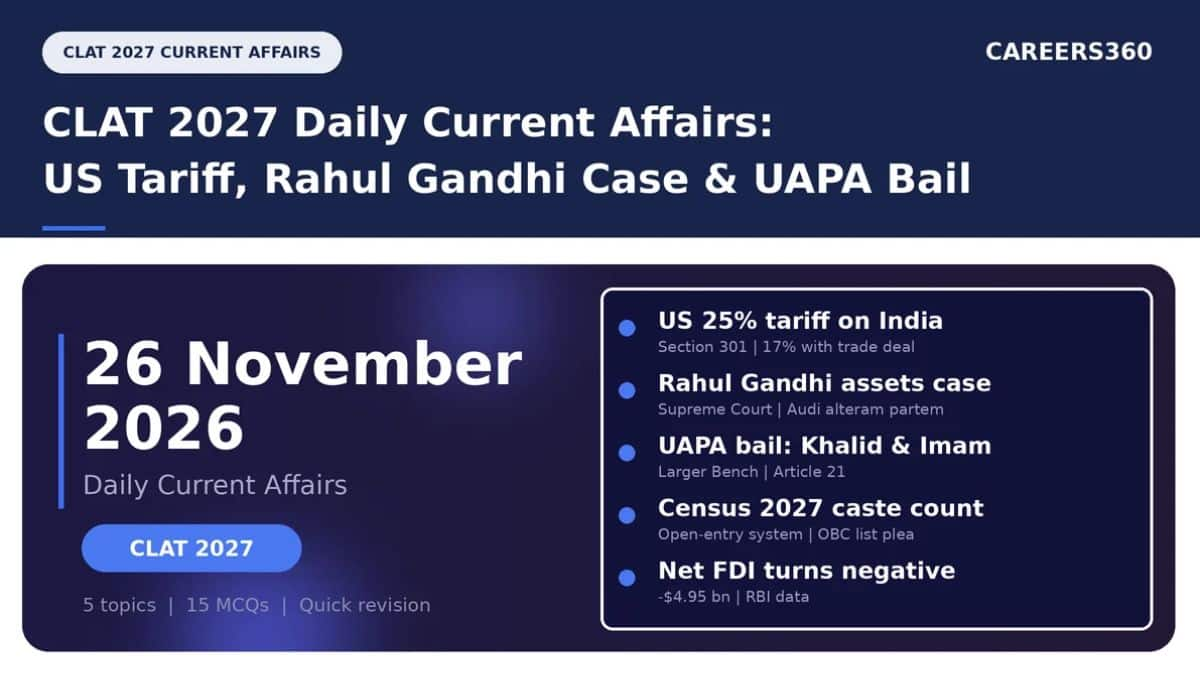
Today's CLAT 2027 current affairs cover five topics from international trade, the judiciary, national affairs and the economy. These include the 25% US tariff on India, Rahul Gandhi assets case, UAPA bail pleas, Census caste count and September net FDI. These developments are important for CLAT 2027 as they link current events with constitutional principles, court judgments and important laws. This article also covers key facts and MCQs from today’s news for practice.
In the news: The US has announced a 25% tariff on Indian goods, citing what it calls unfair trade practices that hurt American businesses. India's rate is the second highest among 14 economies, after Vietnam's 35%. It could fall to 17% if the two countries sign a reciprocal trade deal.
The US Trade Representative began two probes under Section 301 of the US Trade Act in March. One on forced labour led to a 10% tariff. The latest tariff follows a second probe into "structural excess capacity". India says it has engaged constructively and that the US Commerce Department found no structural excess capacity in any Indian sector. It wants an early trade deal.
For comparison, the EU, Japan, South Korea, Switzerland and Taiwan face 15% tariffs. Indonesia, Malaysia and Thailand face 18%, while China, Bangladesh, Cambodia and Singapore face up to 20%.
Tariff: A tax on imported goods. It makes foreign products costlier.
Section 301: A US trade law that allows action against trade practices the country considers unfair.
Reciprocal trade agreement: Two countries agree to reduce trade barriers for each other.
Excess capacity: When a country produces more goods than it can use or sell domestically.
Trade: Foreign trade falls under the Union List. The Centre and Parliament handle this subject.
Q1. What is a tariff?
A. A tax on imported goods
B. A subsidy on exports
C. A limit on foreign travel
D. A fee on domestic sales
Answer: A
Q2. What is the purpose of a reciprocal trade agreement?
A. To reduce trade barriers between two countries
B. To raise import duties
C. To stop all international trade
D. To avoid the WTO
Answer: A
Q3. What does the term "excess capacity" mean?
A. Producing more goods than the domestic market can absorb
B. Having no factories
C. Stopping exports
D. Banning imported goods
Answer: A
In the news: The Supreme Court set aside Allahabad High Court orders directing CBI and ED inquiries into a disproportionate assets complaint against Rahul Gandhi. The High Court's Lucknow Bench had passed the orders in May and July. A three-judge Bench led by CJI Surya Kant said Gandhi must be made a party before the matter is decided.
The case will return to the High Court for a fresh hearing before a new Bench, in open court. The CJI said the Supreme Court was examining only the basic requirements of a fair hearing, not the merits of the complaint.
Gandhi argued that the orders were passed without hearing him and called the proposed inquiry a "fishing" expedition. He also objected to in-chamber hearings and sealed-cover documents. The complainant argued that an accused has no automatic right to be heard before an FIR is registered. Justice Joymalya Bagchi noted that the new BNSS has expanded the scope of hearing the accused.
Audi alteram partem: Means "hear the other side". A person should get a chance to respond before an adverse decision.
Ex-parte order: An order passed without hearing one of the affected parties.
Impleadment: Adding a person as a party to a case.
Open court: Court hearings are generally open to the public, subject to legal exceptions.
Fishing inquiry: A probe without a specific basis, conducted in the hope of finding evidence.
Q1. What does audi alteram partem mean?
A. Hear the other side before deciding
B. The accused must remain silent
C. The judge decides without hearing anyone
D. Only the complainant gets a hearing
Answer: A
Q2. What is an order passed without hearing an affected party called?
A. Ex-parte
B. Obiter
C. Per incuriam
D. Suo motu
Answer: A
Q3. Why did the Supreme Court send the case back to the High Court?
A. For a fresh hearing in open court after making Gandhi a party
B. To decide the complaint itself
C. To close the inquiry
D. To transfer the case to the CBI
Answer: A
In the news: The Supreme Court issued notice on the bail pleas of Umar Khalid and Sharjeel Imam, accused in the larger conspiracy case linked to the 2020 Delhi riots. It refused interim relief for now. A larger three-judge Bench will examine whether long jail time and trial delays can justify bail despite the strict conditions under the UAPA. Delhi Police must respond by December 14.
The matter follows the Supreme Court's May 22 judgment in Tasleem Ahmed v. State (NCT of Delhi), which arose from differing views on UAPA bail rules. On January 5, the Court granted bail to five other accused but denied relief to Khalid and Imam, saying their alleged roles stood on a "qualitatively different footing". They have challenged the Delhi High Court's September 30 order. They argue that the trial has not begun and the case remains at the charge-framing stage.
UAPA, 1967: An anti-terror law with strict bail conditions. Under Section 43D(5), bail can be denied if the accusation appears prima facie true.
Article 21: Protects life and personal liberty. It also includes the right to a speedy trial.
K.A. Najeeb (2021): The Supreme Court held that long delays can justify bail even in UAPA cases.
Larger Bench: A Bench with more judges that can settle a legal question when different Benches have taken conflicting views.
Charge framing: The stage when a court formally sets out the charges against an accused. The trial follows.
Q1. Which fundamental right includes the right to a speedy trial?
A. Article 19(1)(a)
B. Article 21
C. Article 25
D. Article 32
Answer: B
Q2. Why may the Supreme Court refer a legal question to a larger Bench?
A. When different Benches have taken conflicting views
B. Whenever a case is old
C. Whenever the accused asks for it
D. Whenever the police request it
Answer: A
Q3. What will the larger Bench examine in the Umar Khalid and Sharjeel Imam case?
A. Whether long custody and trial delays can justify bail under the UAPA
B. Whether the UAPA should be repealed
C. Whether the Delhi riots took place
D. Whether Delhi Police should be dissolved
Answer: A
In the news: The 2027 Census will record caste through an open-entry system for people other than SCs and STs. Instead of choosing from a fixed list, respondents will state their caste, which the enumerator will record. Officials say a code directory and later checks will address spelling differences and sub-caste names. On October 28, the Supreme Court refused to hear a plea seeking a fixed OBC list, calling it a policy matter.
The 2011 Socio-Economic and Caste Census also used open entry and recorded about 46.7 lakh caste names, compared with 4,147 castes in 1931. Its caste tables were never released. Bihar, Karnataka and Telangana used fixed lists in their surveys and reported backward-class populations of 63%, about 70% and 56.33%, respectively. The Hindu explainer suggests recording the official category, such as the OBC list, alongside each caste name.
Census: A Union subject. The Centre is responsible for conducting the population count.
Open-entry question: Respondents name their caste instead of selecting it from a fixed list.
OBC sub-categorisation: Dividing OBCs into smaller groups to distribute reservation benefits. The Rohini Commission examined this issue.
State of Punjab v. Davinder Singh (2024): The Supreme Court allowed sub-classification within Scheduled Castes.
Creamy layer: The relatively better-off section of OBCs, which is excluded from OBC reservation benefits.
Q1. Who conducts the Census in India?
A. The Union government
B. State governments alone
C. The Election Commission
D. The Finance Commission
Answer: A
Q2. Which 2024 judgment allowed sub-classification within Scheduled Castes?
A. State of Punjab v. Davinder Singh
B. Indra Sawhney v. Union of India
C. Kesavananda Bharati v. State of Kerala
D. Maneka Gandhi v. Union of India
Answer: A
Q3. What is one challenge with an open-entry caste question?
A. The same caste may be recorded under different spellings or names
B. Respondents cannot answer it
C. It is legally prohibited
D. It records only SCs
Answer: A
5. Net FDI Turns Negative in September 2026
In the news: India's net foreign direct investment (FDI) fell to minus $4.95 billion in September 2026, its lowest level since at least March 2021, according to the RBI. Gross inflows dropped to $5.9 billion, down 46.6% from August and 17.6% from September last year. Outflows rose nearly 40% from August to $10.8 billion.
Foreign companies sent $6.4 billion in profits back to their home countries, up about 37% from a year earlier. Indian companies also increased overseas investments to $4.4 billion, a five-month high. Despite September's fall, net FDI for April to September was over 20% higher than in the same period last year. Manufacturing, communication and computer services received about two-thirds of gross inflows. Singapore and the US were the top sources.
FDI: Investment by a foreign company or investor in a business in another country, usually with a lasting interest or influence.
Portfolio investment: Investment in shares or other financial assets without seeking control over the business.
Net FDI: Gross FDI inflows minus outflows.
Repatriation of profits: When a foreign company sends its earnings back to its home country.
RBI data: The RBI publishes India's balance of payments and investment figures.
Q1. What is foreign direct investment (FDI)?
A. Investment in a business in another country with a lasting interest
B. A small purchase of shares for short-term gains
C. A loan from a domestic bank
D. A government grant
Answer: A
Q2. How is net FDI calculated?
A. Gross inflows minus outflows
B. Gross inflows plus outflows
C. Exports minus imports
D. Profits minus taxes
Answer: A
Q3. Why is portfolio investment generally considered less stable than FDI?
A. Investors can withdraw their money more easily
B. It is always larger than FDI
C. It is banned in India
D. It gives investors full control of a company
Answer: A
The key facts, figures and developments from today's news are listed below for a quick revision before the CLAT exam.
US tariff on India: 25% under Section 301. The rate could fall to 17% if both countries sign a trade deal.
Rahul Gandhi assets case: Supreme Court sets aside Allahabad High Court orders for CBI and ED inquiries. Fresh hearing ordered in open court.
UAPA bail pleas: Supreme Court issues notice on Umar Khalid and Sharjeel Imam's pleas. Larger Bench to examine bail and trial delay. Police reply due December 14.
Census 2027: Caste will be recorded through an open-entry system for people other than SCs and STs. Supreme Court declined an OBC drop-down list plea on October 28.
Net FDI: Falls to minus $4.95 billion in September 2026, the lowest since at least March 2021.
Class 6 languages: Supreme Court says students who took three languages need not switch back to two.
Great Nicobar project: Calcutta High Court defers hearing on forest rights to January 13, 2027.
Cabinet decision: Approves a Rs 11,000 crore scheme for construction equipment manufacturing.

On Question asked by student community
Hello student!
AIBE question papers in Kannada medium are not explicitly available. Meanwhile, you can check these resources for AIBE previous-year question papers and the AIBE 21 (2026) Set A and Set B papers for practice.
AIBE Previous-Year Question Papers:
https://law.careers360.com/articles/aibe-previous-year-question-papers
AIBE 21 Set B Question Paper 2026:
https://law.careers360.com/articles/aibe-21-set-b-question-paper-pdf-2026
AIBE
Hello Student,
You can check the relevant article below
https://law.careers360.com/download/ebooks/aibe-preparation-guide
Hope it helps!
Hello Student,
You can access the AIBE previous year question papers in Hindi by clicking on the relevant link given below.
https://law.careers360.com/hi/articles/aibe-previous-year-question-papers
Hey there,
No. If you are currently in the 5th semester of a 3-year LL.B., you generally cannot register for AIBE yet.
Under the current BCI rules, a 3-year LL.B. student must be in the final semester (6th semester) and have no backlogs from previous semesters to register for AIBE.
Hello Dear Student,
The All India Bar Examination (AIBE) covers 19 major legal subjects, carrying a high-weightage focus on Constitutional Law (8–12 questions) and Family Law including Hindu and Muslim law (6–8 questions)
You can check, find and access more information here:

Experiential Learning through Legal Aid Camps, Lok Adalats, Court Visits, Community Lawyering and regular Moot Court sessions
Ranked #18 amongst Institutions in India by NIRF | Get Upto 100% Scholarships | Spot Admissions via CUET
NAAC A++ Accredited | Avail up to 100% scholarship via MRNAT-Manav Rachna National Aptitude Test
NAAC A++ Approved | Curriculum Aligned with BCI & UGC
UG Scholar's Round Deadline: 1st Dec'26 | Earn upto 50% merit Scholarship + 10% for top performers | Highest CTC 18 LPA
Grade 'A+' Accredited by NAAC | Ranked 33rd in India by NIRF