School of Law, UPES, Dehradun
Ranked #18 amongst Institutions in India by NIRF | Get Upto 100% Scholarships | Spot Admissions via CUET


Today's CLAT 2027 current affairs cover five developments from Parliament, the judiciary and State politics. It covers the 132nd Amendment Bill, the Deepathoon contempt order, ex-CJI Gavai's letter, the Bengal Leader of Opposition ruling and Kolkata's ward delimitation row. The sections below also highlight the key legal points and include MCQs for CLAT exam practice.
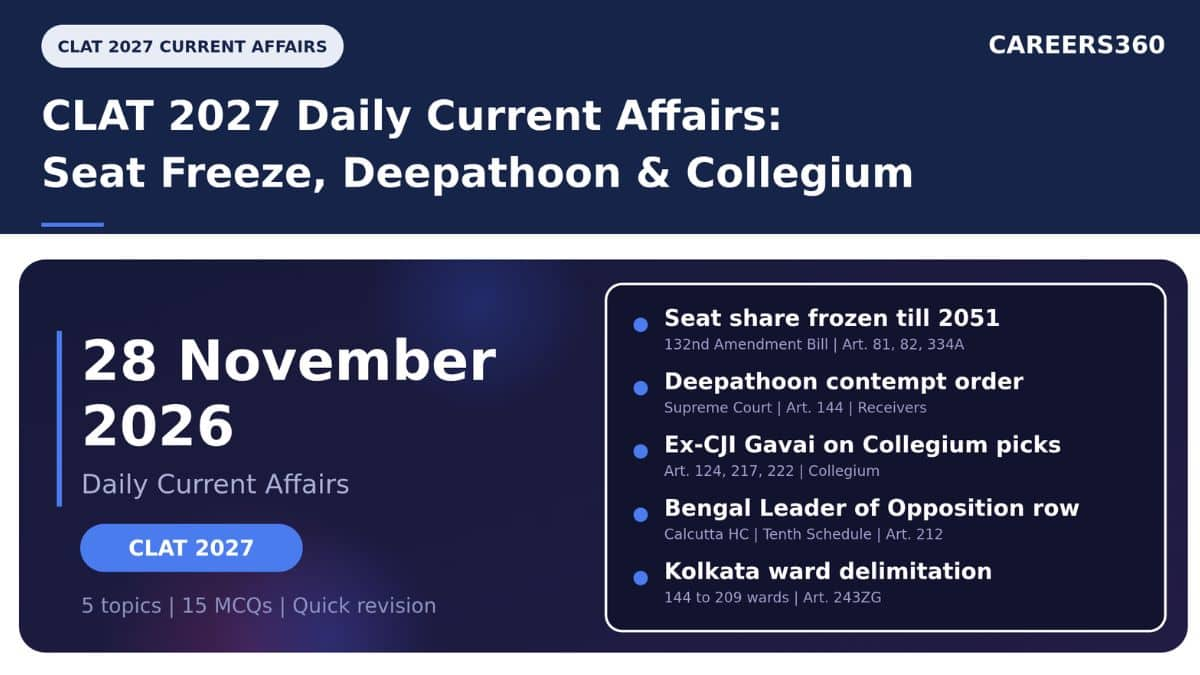
In the news: The Union Cabinet cleared the 132nd Constitution Amendment Bill. It extends the freeze on Lok Sabha seat shares among States until 2051 and removes the link to the 1971 Census. Lok Sabha and Assembly seats will rise by 50% in every State and Union Territory. The Lok Sabha's maximum strength will increase from 550 to 850.
The Bill amends Articles 81, 82 and 334A. Constituency boundaries within each State will be redrawn using the latest published Census. It replaces the 131st Amendment Bill, which failed in April. A separate Delimitation Bill will also be introduced during Parliament's special sitting from November 30 to December 3.
Article 81: Deals with the composition and maximum strength of the Lok Sabha.
Article 82: Provides for seat readjustment after each Census. The Bill extends the freeze until 2051.
Article 334A: Provides for women's reservation in the Lok Sabha and State Assemblies after delimitation.
Women's Reservation Act, 2023: The 106th Constitutional Amendment reserves one-third of seats for women.
Article 368: Lays down the procedure and special majority required to amend the Constitution.
Q1. Which Article deals with women's reservation in the Lok Sabha and State Assemblies after delimitation?
A. Article 330
B. Article 332
C. Article 334A
D. Article 338
Answer: C
Q2. What is the maximum Lok Sabha strength proposed under the 132nd Amendment Bill?
A. 530
B. 545
C. 550
D. 850
Answer: D
Q3. Which Article lays down the special majority required to amend the Constitution?
A. Article 356
B. Article 368
C. Article 370
D. Article 372
Answer: B
Get the AIBE previous year question papers here
In the news: The Supreme Court said Tamil Nadu's failure to follow its November 20 order was "wilful disobedience". It called it a "pre-meditated conspiracy" between the State and the temple trustees. A Bench of Justices Aravind Kumar and Vipul M. Pancholi suspended the Board of Trustees. Two former judges, S. Vaidyanathan and V. Parthiban, were named Receivers.
The Karthigai Deepam must be lit on the deepathoon on Saturday. Central forces will give security. The Chief Secretary must file a personal affidavit within 10 days. It must explain the "apparent disregard" of Article 144. The next hearing is on December 15. The Bench said no one, however high, can defy a Supreme Court order.
Contempt of court: Wilful disobedience of a court order. Articles 129 and 215 give the power to punish.
Article 144: All authorities must act in aid of the Supreme Court.
Receiver: A person the court appoints to take charge of property or management.
Article 142: The Supreme Court can pass any order needed for complete justice.
Rule of law: Court orders bind everyone, including the State.
Q1. Which Article requires all civil and judicial authorities to act in aid of the Supreme Court?
A. Article 141
B. Article 142
C. Article 143
D. Article 144
Answer: D
Q2. What is a Receiver?
A. A person appointed by the court to take charge of property or management
B. A witness in a criminal case
C. A junior judge
D. A government lawyer
Answer: A
Q3. Which Articles give the Supreme Court and High Courts the power to punish for contempt?
A. Articles 129 and 215
B. Articles 14 and 21
C. Articles 32 and 226
D. Articles 368 and 370
Answer: A
In the news: Former CJI B.R. Gavai wrote to President Droupadi Murmu. He alleges that recent judicial recommendations disregard "merit and inclusivity". He says candidates from one section of society are being favoured. He names SCs, STs, OBCs, minorities and women as left out. The letter is aimed at the Collegium headed by CJI Surya Kant.
Justice Gavai says the trend began "in the recent past", after his time on the Collegium. He cites the case of a High Court Chief Justice moved to a smaller court and later to a prominent one. He says the Supreme Court's profile has "barely moved" in 75 years. These are his allegations. The report does not carry a response from the Collegium.
Collegium: The CJI and senior Supreme Court judges. They recommend judges for appointment and transfer.
Article 124: Appointment of Supreme Court judges.
Article 217: Appointment of High Court judges.
Article 222: The President can transfer a High Court judge after consulting the CJI.
Three Judges Cases: Created the Collegium system.
Q1. Which Article provides for transfer of a judge from one High Court to another?
A. Article 221
B. Article 222
C. Article 223
D. Article 224
Answer: B
Q2. Who recommends names for judicial appointments under the Collegium system?
A. The CJI and senior judges of the Supreme Court
B. The Law Minister alone
C. The Election Commission
D. The Parliament
Answer: A
Q3. The Collegium system developed through which set of judgments?
A. The Three Judges Cases
B. The Fundamental Rights Cases
C. The Privy Purses Cases
D. The Banking Nationalisation Cases
Answer: A
Download the Free AIBE 22 Sample Paper with Answer Key and Ace the All India Bar Examination
In the news: The Calcutta High Court set aside the Speaker's June 3 decision naming Ritabrata Banerjee Leader of the Opposition. It also set aside Akhruzzaman's appointment as Chief Whip. Justice Krishna Rao said the decision was "not sustainable under law". The Speaker must decide afresh within 10 days. MLA Sobhandeb Chattopadhyay had challenged it.
The Trinamool won 80 of 294 seats. On May 9, party general secretary Abhishek Banerjee wrote nominating Chattopadhyay. A group of MLAs claimed their signatures were forged. Two MLAs were expelled, and the party split. 58 MLAs backed Banerjee. The Winter Session may begin on December 4.
Leader of Opposition: Usually the leader of the largest opposition party. The Speaker recognises the post.
Judicial review: Courts can check a Speaker's decisions for legality. Kihoto Hollohan (1992) is the key case.
Tenth Schedule: The anti-defection law. The Speaker decides disqualification.
Article 212: Courts cannot question proceedings inside the Legislature on grounds of procedural irregularity.
Speaker's role: Must act fairly and by law.
Q1. Which case held that the Speaker's anti-defection decisions are open to judicial review?
A. Kihoto Hollohan v. Zachillhu
B. Kesavananda Bharati v. State of Kerala
C. Minerva Mills v. Union of India
D. S.R. Bommai v. Union of India
Answer: A
Q2. Which schedule deals with the anti-defection law?
A. Seventh Schedule
B. Eighth Schedule
C. Ninth Schedule
D. Tenth Schedule
Answer: D
Q3. Who normally becomes the Leader of Opposition in an Assembly?
A. Leader of the largest opposition party
B. The most senior MLA
C. A Governor's nominee
D. The Speaker's choice, with no rules
Answer: A
5. Kolkata's Ward Delimitation Row Reaches Supreme Court
In the news: West Bengal passed the Kolkata Municipal Corporation (Amendment) Bill on August 12. It raises wards from 144 to 209. The last redrawing was in 1980. The Opposition alleges gerrymandering. Wards in one petition are uneven. 102 of 209 fall outside 10% of the 15,148 average voters. The board was dissolved on June 8, and an administrator runs the body.
On November 6, a Calcutta High Court Bench barred the State Election Commission from notifying polls on the new wards. The State went to the Supreme Court. On November 25, CJI Surya Kant said the Court was inclined to set aside the High Court order. The State says it may appoint coordinators if polls are delayed. The matter is still pending.
Gerrymandering: Drawing boundaries to favour one party.
Article 243ZA: The State Election Commission conducts municipal elections.
Article 243U: A municipality's term is five years. Elections must be held before it ends.
Article 243ZG: Courts cannot question laws on delimitation of municipal wards or seat allotment.
Equal voters: Constituencies should be of broadly equal size to keep each vote equal in value.
Q1. What is gerrymandering?
A. Drawing electoral boundaries to give one party an unfair advantage
B. Counting votes twice
C. Cancelling an election
D. Appointing election observers
Answer: A
Q2. Who conducts municipal elections in a State?
A. The Election Commission of India
B. The State Election Commission
C. The Governor
D. The State Finance Commission
Answer: B
Q3. What is the term of a municipality under Article 243U?
A. Three years
B. Four years
C. Five years
D. Six years
Answer: C
Key facts and developments from today's news for quick revision before the CLAT 2027 exam:
132nd Amendment Bill: Extends the freeze on State-wise Lok Sabha seat share until 2051. Seats to rise by 50%; maximum Lok Sabha strength increases from 550 to 850.
Special Parliament sitting: November 30 to December 3.
Deepathoon row: Supreme Court suspends temple trustees and appoints two Receivers. Lamp to be lit on Saturday.
Former CJI Gavai: Writes to the President alleging bias in Collegium appointments.
Bengal LoP: Calcutta High Court sets aside Ritabrata Banerjee's appointment. Speaker must decide again within 10 days.
Kolkata wards: Number of municipal wards rises from 144 to 209. Supreme Court says it is inclined to set aside the High Court order.
MCOCA case: Supreme Court grants bail to former AAP MLA Naresh Balyan.
Project 17A: Indian Navy receives the final stealth frigate.

On Question asked by student community
Hello student!
AIBE question papers in Kannada medium are not explicitly available. Meanwhile, you can check these resources for AIBE previous-year question papers and the AIBE 21 (2026) Set A and Set B papers for practice.
AIBE Previous-Year Question Papers:
https://law.careers360.com/articles/aibe-previous-year-question-papers
AIBE 21 Set B Question Paper 2026:
https://law.careers360.com/articles/aibe-21-set-b-question-paper-pdf-2026
AIBE
Hello Student,
You can check the relevant article below
https://law.careers360.com/download/ebooks/aibe-preparation-guide
Hope it helps!
Hello Student,
You can access the AIBE previous year question papers in Hindi by clicking on the relevant link given below.
https://law.careers360.com/hi/articles/aibe-previous-year-question-papers
Hey there,
No. If you are currently in the 5th semester of a 3-year LL.B., you generally cannot register for AIBE yet.
Under the current BCI rules, a 3-year LL.B. student must be in the final semester (6th semester) and have no backlogs from previous semesters to register for AIBE.
Hello Dear Student,
The All India Bar Examination (AIBE) covers 19 major legal subjects, carrying a high-weightage focus on Constitutional Law (8–12 questions) and Family Law including Hindu and Muslim law (6–8 questions)
You can check, find and access more information here:

Experiential Learning through Legal Aid Camps, Lok Adalats, Court Visits, Community Lawyering and regular Moot Court sessions
Ranked #18 amongst Institutions in India by NIRF | Get Upto 100% Scholarships | Spot Admissions via CUET
NAAC A++ Accredited | Avail up to 100% scholarship via MRNAT-Manav Rachna National Aptitude Test
NAAC A++ Approved | Curriculum Aligned with BCI & UGC
UG Scholar's Round Deadline: 1st Dec'26 | Earn upto 50% merit Scholarship + 10% for top performers | Highest CTC 18 LPA
Grade 'A+' Accredited by NAAC | Ranked 33rd in India by NIRF