School of Law, UPES, Dehradun
Ranked #18 amongst Institutions in India by NIRF | Get Upto 100% Scholarships | Spot Admissions via CUET


Tier 1 NLUs, NLSIU Bengaluru, NALSAR Hyderabad and GNLU Gandhinagar reserve 25% of seats for their state candidates. NLIU Bhopal, another top institution, reserves 50%. Maharashtra’s three NLUs (MNLU Mumbai, Nagpur, and Aurangabad) offer 374 state-quota seats combined. CNLU Patna lists 82 Bihar-category seats in each of its BA LLB and BBA LLB programmes. These domicile reservations can shift the CLAT cutoff ranks by hundreds or even thousands of places.
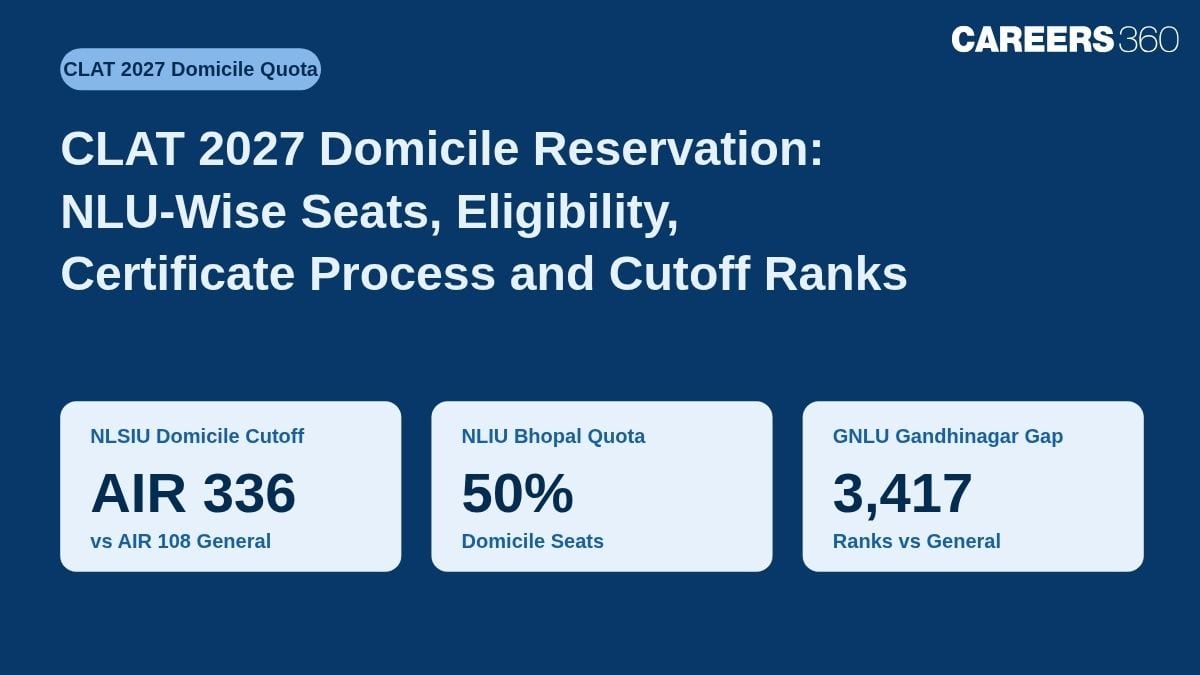
Last year, NLSIU saw a 228-rank gap between its all-India General closing rank (AIR 108) and the Karnataka domicile quota closing rank (AIR 336). The highest closing rank was recorded at IIULER Goa, where it reached AIR 72,430 in CLAT 2026, followed by NLU Tripura at AIR 22,355.
Domicile reservation, also called state quota, reserves a share of total seats in a university for students who belong to that state and meet the university’s eligibility criteria. NLUs are state universities established through Acts passed by state legislatures. Each university sets its own domicile conditions and reservation structure. NLU-wise domicile reservation works in two main ways:
Horizontal reservation: A fixed share of seats is reserved for state candidates across categories. For example, NLSIU, NALSAR, NLU Jodhpur, GNLU, etc reserve 25% each, while NLIU Bhopal and HNLU Raipur reserve 50%.
Ranked #18 amongst Institutions in India by NIRF | Get Upto 100% Scholarships | Spot Admissions via CUET
Scholars’ Round Deadline: 14th Nov’26 | Earn upto 50% merit Scholarship + 10% for top performers | EFMD Accredited | AACSB (USA) & AMDISA Member | Highest CTC 28 LPA
Vertical reservation: Seats are allocated under state-specific categories. Only that state’s SC, ST, OBC or EWS candidates can claim the seats. These NLUs include MNLU, CNLU, Uttar Pradesh’s RMNLU Lucknow and RPNLU Prayagraj, etc.
NLU | Domicile reservation | Domicile seats offered | Eligibility criteria |
25% horizontal (of 300) + 10 supernumerary seats | BA LLB: 85 of 310 (75 + 10) | 7 years of study in Karnataka; or child of Karnataka-linked defence, state government, All India Services or CAPF parents, with years outside matched to parental service outside | |
25% horizontal | BA LLB: 33 | Resident of Telangana for 4 of the last 7 years, and qualifying exam passed in Telangana | |
50% horizontal | BA LLB: 51; BSc LLB: 25-26 | Valid Madhya Pradesh domicile certificate | |
25% (BA LLB, of 120); 30% (BSc LLB, of 60) | BA LLB: 30 (General 19, SC 7, ST 2, OBC 2); BSc LLB: 18 (General 10, SC 5, ST 1, OBC 2) | 10 years of study in West Bengal, or parents are permanent residents of the state; SC/ST/OBC need a West Bengal certificate | |
25% horizontal (of 164 core seats) | BA LLB + BBA LLB: 41 of 196 (20.9%) | Valid Rajasthan domicile certificate | |
50% horizontal | BA LLB: 85 | Chhattisgarh domicile rules | |
25% horizontal | All LLB programmes: 40 | Valid Gujarat domicile; EWS excluded | |
25% horizontal | BA LLB: 15 | Domicile of Dadra & Nagar Haveli and Daman & Diu | |
Vertical, category-only | BA LLB: 89 (OBC 43, SC 34, ST 3, EWS 9) | Valid Uttar Pradesh certificate for the category | |
10% horizontal | BA LLB: 18 + 1 ancestral-resident seat | Punjab resident and applicable BC criteria; certificate or affidavit | |
Vertical, Bihar-only categories | BA LLB: 41; BBA LLB: 41; total 82 of 138 (per course: EWS 7, SC 11, ST 1, EBC 12, BC 8, Women of BC 2) | Bihar certificate for the category; outside candidates cannot claim; OBC applicants must declare BC or EBC | |
Vertical, state-linked | BA LLB: 37 (State Merit 5, SC 5, ST 1, SEBC 18, + 6 EWS and 2 transgender supernumerary) | Kerala reservation criteria; SEBC split among listed communities | |
25% horizontal + state SEBC | BA LLB: 37; BBA LLB: 17; total 54 | Class 12 from an Odisha institution with 60%+ marks, plus domicile certificate | |
50% horizontal | BA LLB: 66; BBA LLB: 33 | Jharkhand resident, qualifying exam passed in Jharkhand, or ward of an eligible state employee | |
Vertical + horizontal, state-linked | BA LLB: 44 (General 8, SC 9, ST 5, OBC/MOBC 16, + 6 EWS supernumerary) | Valid Assam residence or category status | |
50% state category reservation | BA LLB: 99 + 18 EWS | Andhra Pradesh reservation rules and local study requirements | |
Vertical, state-linked | BA LLB: 27; BCom LLB: 27; total 54 | Tamil Nadu quota criteria for the category, including GSSQ | |
Vertical, category-only | BA LLB: 73 | Maharashtra reservation rules for the category | |
Vertical, category-only | BA LLB: 86; BA LLB (Judiciary): 43; BBA LLB: 43; total 172 | Maharashtra reservation rules for the category | |
Vertical, category-only | BA LLB: 86; BBA LLB: 43; total 129 | Maharashtra rules; caste and validity certificates, non-creamy layer where applicable | |
25% horizontal + HP categories | BA LLB: 30 + SC 18, ST 10, EWS 12; BBA LLB: 15 + SC 9, ST 5, EWS 6 | Valid Himachal Pradesh bona fide certificate | |
50% horizontal + state EWS | BA LLB: 60 (General 30, SC 10, ST 12, OBC 8) + 6 EWS supernumerary | Valid Madhya Pradesh domicile certificate | |
Vertical, state-linked | BA LLB: 26 + 2 PwD | Haryana resident or domicile category requirements | |
30% horizontal (of 31 unreserved seats) + vertical SC/ST | BA LLB: 38 of 60 (General 9, SC 10, ST 19) | Valid Tripura domicile certificate; unfilled SC/ST seats convert between categories, then go to General | |
Vertical, state-linked | BA LLB: 36 | Valid Uttar Pradesh state category certificate | |
20% core + 10% EWS | BA LLB and BBA LLB; counts not specified | Goa student, for the local quota and fee waivers or scholarships | |
50% horizontal | 50% of total seats | Valid Meghalaya domicile certificate |
Tier 1 NLSIU requires seven years of schooling in Karnataka, offering 75 horizontal domicile seats and 10 additional Karnataka seats. NALSAR requires four of the last seven years of residence in Telangana, passing Class 12 from the state and offers 33 domicile seats in BA LLB.
In CLAT 2026, NLSIU’s 75 horizontal seats closed at AIR 336 and its 10 additional Karnataka seats at AIR 427, against AIR 108 for all-India General. NALSAR’s domicile cut-off was AIR 565, against AIR 168. NLU Jodhpur closed at AIR 600 against AIR 364, while WBNUJS Kolkata closed at AIR 746 against AIR 343.
NLIU Bhopal reserves 50% of seats horizontally and requires an MP domicile certificate. Its domicile cut-off was AIR 759, which is 300 ranks beyond its all-India General cut-off of AIR 459.
GNLU Gandhinagar, with a 25% horizontal quota, showed a much wider gap: AIR 3,815 against AIR 398, a difference of 3,417 ranks. Despite its one-fourth quota, the gap shows that a higher reservation share does not directly translate into a lower NLU cut-off. Eligible candidate numbers, NLU preferences and ranks also shape the outcome. GNLU excludes EWS candidates from its domicile quota.
Among Tier 2 NLUs, RGNUL Patiala closed at AIR 1,161 with a 10% horizontal quota, while NUALS Kochi closed at AIR 1,286 under Kerala’s state-linked category reservations.
Tier 3 universities cut-offs ranged from AIR 2,452 at DNLU Jabalpur and AIR 2,493 at DBRANLU Sonepat to AIR 3,519 at NLU Assam. NLU Tripura, which reserves 38 of 60 BA LLB seats for state candidates, closed at AIR 22,355. IIULER Goa closed at AIR 72,430.
The Consortium should set a common eligibility for domicile reservation, based on schooling or residence. There can be exceptions for cases such as a parent’s transferable government service. States can retain additional conditions, but clearer baseline rules are necessary to make eligibility easier to compare across NLUs.
NLUs should also guarantee a minimum share of seats for all-India merit instead of leaving the balance entirely to state reservation policies. Admission brochures should publish previous-year domicile closing ranks, category-wise seat counts and eligibility rules. States should review their quotas at fixed intervals.
The documents required for a domicile certificate vary by state. Applicants need to submit the following documents, depending on the state’s rules:
Proof of identity and age: Aadhaar card, voter's ID, passport, driving license, birth certificate or Class 10 marksheet.
Proof of address and residence: Recent electricity, water or telephone bills, ration card, property tax receipts, rent agreement or land records.
Proof of schooling: School marksheets or a study certificate confirming the required years of education in the state.
Parent’s documents: Parent’s domicile certificate and identity proof, particularly for minor applicants.
Service certificate: Employment records if eligibility depends on a parent’s government, defence or All India Services posting.
Photographs: Recent passport-size photographs.
Self-declaration or affidavit: A signed declaration confirming the accuracy of the information provided.
Candidates seeking domicile reservation in CLAT 2027 must apply for a domicile certificate through one of two methods. Through the state’s official portal (online method) or the local Tehsil, SDM or Revenue Department office (offline method). The process to apply through both is given below:
Online Application Process for a Domicile Certificate
The process to apply for a domicile certificate online through the state’s official e-District, Revenue Department, or ServicePlus portal is:
Visit the official state government portal the candidate is applying for, and register.
Log in and choose the domicile, residence or nativity certificate option.
Fill in the required personal and family details and upload the documents.
Pay the application fee and submit the form.
Save the acknowledgement number to check the status and download the certificate upon approval.
Note: Apply only through the official state government portal. Make sure to use only official government websites that end in .gov.in or .nic.in.
Candidates who prefer to apply in person can submit an application for a domicile certificate at the local revenue office. The general process is:
Visit the Tehsil, the office of the SDM/Taluka/District Collector (as applicable), to get the application form.
Fill out the form and attach self-attested copies of the documents.
Submit the application form and pay the fee.
Save the acknowledgement receipt for future reference.
Collect the domicile certificate once it has been approved.

On Question asked by student community
Hello Student,
Here are the Careers360 CLAT 2027 Mock Test Resources for your exam preparation.
1. Online CLAT Mock Test
2. CLAT Mock Tests and Solutions
Hello student,
CLAT 2027 aspirants can access these monthly current affairs compilations for regular revision. Use these resources to stay updated with important events and topics for CLAT 2027.
|
Particular |
Download PDF |
|
CLAT Current Affairs- August Month (2026) |
|
|
CLAT Current Affairs- |
If you have only two months, use a highly structured plan: daily current affairs, English reading, legal reasoning practice, logical reasoning sets, basic quantitative practice and regular full-length mocks. Spend as much time analysing incorrect questions as taking the mock itself. Consistency during these two months can make a substantial
You can download the CLAT previous years' question papers from here:
https://law.careers360.com/articles/clat-previous-year-question-papers
https://law.careers360.com/download/clat-sample-papers-previous-years
For CLAT 2027 UG, candidates need to have passed Class 12/equivalent with at least 45% marks, or 40% for SC/ST/PwD candidates.
In your situation, having an RT in an additional subject but subsequently passing the required qualification through an improvement examination does not automatically make you ineligible. However, the important

Ranked #18 amongst Institutions in India by NIRF | Get Upto 100% Scholarships | Spot Admissions via CUET
Scholars’ Round Deadline: 14th Nov’26 | Earn upto 50% merit Scholarship + 10% for top performers | EFMD Accredited | AACSB (USA) & AMDISA Member | Highest CTC 28 LPA
Moot Court | Mock trials | Legal Aid Clinic | Recruiting Partners: FICCI, TCS, Adani, Trilegal, and many others
NAAC A+ Accredited University
Law Admissions 2026 Open | Avail Merit-Based Scholarships
NAAC A++ Accredited | Ranked #11 by NIRF