School of Law, UPES, Dehradun
Ranked #18 amongst Institutions in India by NIRF | Get Upto 100% Scholarships | Spot Admissions via CUET


With around four months left for CLAT 2027 preparation, aspirants can still make some significant progress by following a focused CLAT 2027 study plan. Don't worry about the time left; try to focus on a regular CLAT preparation strategy: reading, test-taking, Test taking and revising.
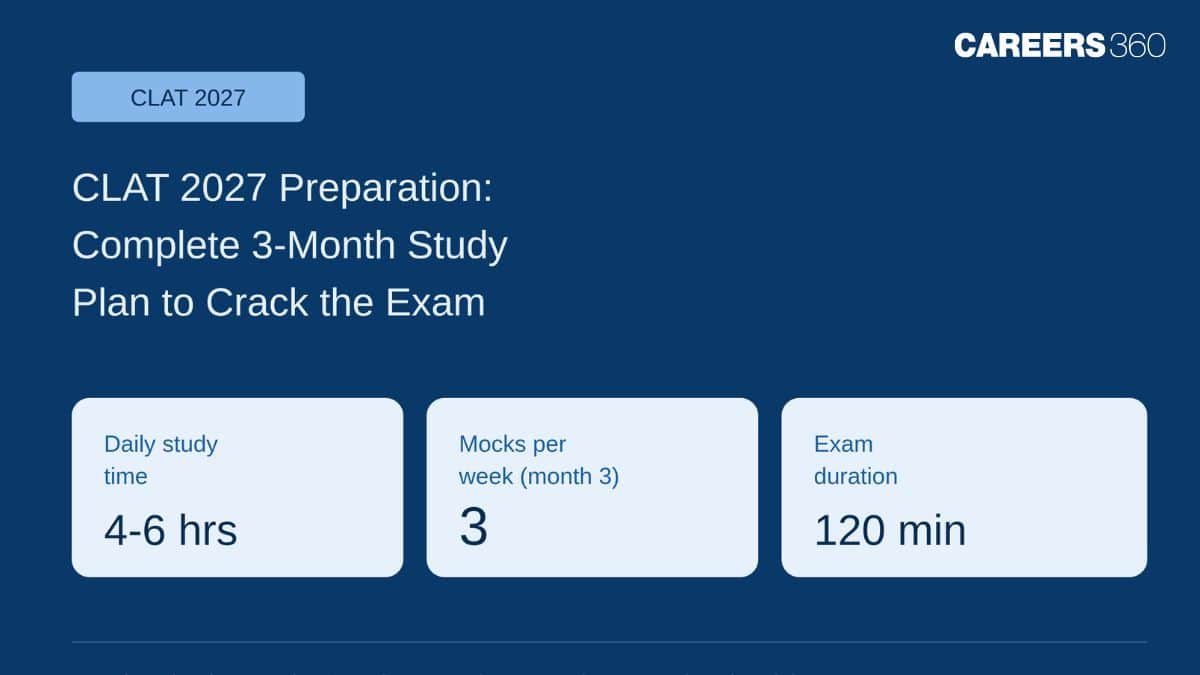
Mostly, CLAT 2027 is testing your comprehension, reasoning and application skills. Current Affairs, including the General Knowledge section, requires regular awareness of important national and international events with comprehension of their context and relevance. A good CLAT 2027 study plan of 3 months will help you improve in all 5 segments, get better speed and accuracy and also practice consistently with the help of CLAT 2027 mock tests.
3-month CLAT preparation strategy can definitely be helpful if you prepare consistently and follow the CLAT 2027 study plan. It does not matter whether you study for the entire day or not. The key issue is regularity and effectiveness in studying.
During the 3-month CLAT 2027 Preparation strategy, one must concentrate on:
Comprehending all five sections of CLAT
Developing the habit of reading regularly
Practising questions based on passages
Increasing one’s speed and efficiency
Attempting mock tests and analysing them
Revising Current Affairs regularly
CLAT preparation strategy must become increasingly exam-oriented with each passing month.
A well-focused 3-month CLAT 2027 preparation strategy can assist candidates to go through the CLAT syllabus, reinforce their understanding of the basic concepts, and practice mock tests. The trick lies in breaking down the period of four months into phases.
The first month must be devoted to understanding the CLAT syllabus and identifying areas that need improvement.
Start reading a newspaper regularly. Focus on CLAT 2027 current affairs: important national and international developments, legal news, government policies and major issues. Students can check which newspaper should you read for CLAT 2027? and learn how they can help improve their current affairs and reading skills.
Do not spend the entire day studying only one section. Try to practise different sections throughout the week.
Legal Reasoning: You must concentrate on comprehending the law being mentioned in the passage. It is not required to mug up a lot of provisions of the law.
English Language: Read comprehension and learn words from the context.
Logical Reasoning: Arguments, Assumptions, Conclusion, Inference, Strengthen and Weaken.
Current Affairs: Make notes and use a reliable monthly compilation.
Quantitative Techniques: Basic revision of percentages, ratios, averages, profit and loss and data interpretation.
Ranked #18 amongst Institutions in India by NIRF | Get Upto 100% Scholarships | Spot Admissions via CUET
Scholars’ Round Deadline: 14th Nov’26 | Earn upto 50% merit Scholarship + 10% for top performers | EFMD Accredited | AACSB (USA) & AMDISA Member | Highest CTC 28 LPA
During the second month itself, you would have mastered the basic question types.
Now increase practice based on passages and work towards increasing accuracy.
As you read an editorial or analytical piece, ask yourself these questions:
What is the main argument?
What evidence is there?
What conclusion is being made?
Is the author making any assumptions?
This habit can improve comprehension and reasoning for English, Logical Reasoning and Legal Reasoning.
Start attempting around two mock tests every week.
Do not check only your final score. After every mock, analyse:
Incorrect answers
Unattempted questions
Silly mistakes
Time spent on each section
Questions where you guessed unnecessarily
Topics where you repeatedly lose marks
Mock analysis is where much of the improvement happens.
The third month should focus on increasing speed without reducing accuracy.
Try to attempt around three full-length mocks every week.
Whenever possible, take mocks during the same time slot as the actual CLAT examination. This can help you become comfortable with maintaining concentration during those hours.
Practise CLAT previous year question papers passages from different areas, such as economics, science, the environment, philosophy, and international relations. Difficult topics can help you become comfortable with unfamiliar passages.
Continue revising Current Affairs every week. Do not leave months of Current Affairs revision for the end.
By this stage, you should also know the order in which you prefer attempting different sections.
Do not start a new book or entirely alter your study strategy at this stage.
Focus on:
Revision of Current Affairs
Do Legal Reasoning practice passages
Do English & Logical Reasoning practice passages
Revise Quantitative Techniques
Practice data interpretation
Give 2-3 mocks per week
Review your common mistakes
During this time, mock scores may fluctuate. Do not fret about individual scores; instead, analyse your overall performance across a few mocks.
During the final week, reduce unnecessary pressure. Revise your notes, sleep properly and avoid experimenting with new study material.
Also check: 500+ Must-Know English Vocabulary Words for CLAT 2027
The CLAT 2027 preparation becomes simpler if you follow an appropriate CLAT preparation strategy for each section individually. As each of the five sections is different from the other, it cannot be studied in the same manner. Some sections require reading, and some require practice and revision.
Read regularly and solve reading comprehension passages. Pay attention to the key idea, arguments, tone, and conclusion in the passage.
Develop vocabulary by reading instead of memorising word lists.
Understand the basic principle of the passage and apply it to the given situation.
Practise passage-based Legal Reasoning regularly instead of spending too much time memorising laws. Students can check the CLAT 2027 time management strategies and learn how to effectively manage the 120-minute exam duration, improve speed and accuracy, and maximise their attempts.
Practise critical reasoning questions on assumptions, conclusions, arguments, inferences and strengthen-weaken concepts.
Give extra attention to questions you repeatedly get wrong.
Read important news regularly and prepare short revision notes.
Frequently revise your monthly Current Affairs section. Always try to get a grasp on the background and importance of the event rather than collecting unnecessary information.
Frequently revise mathematics and practise your data interpretation set.
Try to increase your calculation speed, but don't reduce your accuracy just for the sake of increasing your speed.
Also check: Biggest Myths About CLAT 2027 You Should Stop Believing
Mistakes may be committed by candidates while preparing for the CLAT 2027 exam, and being aware of them in advance can be of great help in making full use of your preparation time. Given below are the Common Mistakes to Avoid In CLAT 2027 Preparation.
Using several books for preparing one subject will make your preparation a mess. Use limited and reliable resources.
Do not leave Current Affairs for the final few weeks. Study and revise it throughout your preparation.
Attempting more mocks will not automatically improve your score. Understand why you made each mistake and try not to repeat it.
Revision helps you retain Current Affairs, mathematics concepts and important strategies. Keep some time every week for revision.
Every student's preparation level is different. Focus on improving your own accuracy, speed and mock performance.
Studying consistently for a few focused hours is more useful than studying for very long hours only once or twice a week.
Also check: Can You Crack CLAT 2027 Without Coaching?: Complete Self-Study Guide
A dedicated CLAT 2027 study plan of about 4-6 hours per day can prove to be very effective for most students, based on their school or college timings.
A basic daily routine can include:
30-45 minutes: Newspaper and Current affairs
45-60 minutes: English Language
60 minutes: Legal Reasoning
45 minutes: Logical Reasoning
30-45 minutes: Quantitative Techniques
60 minutes: Sectional tests/ revision or mock analysis
You can tweak the timetable based on your weak and strong areas
Four months of focused CLAT 2027 preparation can make a major difference if you remain regular with reading, practice, revision and mock tests.
Do not expect your mock score to improve after every test. Some mocks will go well,l and others may show new weaknesses. Use those mistakes to understand what needs improvement. Instead of thinking about how little time is left, make the best use of the time you have.
Also check: CLAT 2027 Guessing Strategy: When to Attempt and When to Skip

On Question asked by student community
Hello Student,
Here are the Careers360 CLAT 2027 Mock Test Resources for your exam preparation.
1. Online CLAT Mock Test
2. CLAT Mock Tests and Solutions
Hello student,
CLAT 2027 aspirants can access these monthly current affairs compilations for regular revision. Use these resources to stay updated with important events and topics for CLAT 2027.
|
Particular |
Download PDF |
|
CLAT Current Affairs- August Month (2026) |
|
|
CLAT Current Affairs- |
If you have only two months, use a highly structured plan: daily current affairs, English reading, legal reasoning practice, logical reasoning sets, basic quantitative practice and regular full-length mocks. Spend as much time analysing incorrect questions as taking the mock itself. Consistency during these two months can make a substantial
You can download the CLAT previous years' question papers from here:
https://law.careers360.com/articles/clat-previous-year-question-papers
https://law.careers360.com/download/clat-sample-papers-previous-years
For CLAT 2027 UG, candidates need to have passed Class 12/equivalent with at least 45% marks, or 40% for SC/ST/PwD candidates.
In your situation, having an RT in an additional subject but subsequently passing the required qualification through an improvement examination does not automatically make you ineligible. However, the important

Ranked #18 amongst Institutions in India by NIRF | Get Upto 100% Scholarships | Spot Admissions via CUET
Scholars’ Round Deadline: 14th Nov’26 | Earn upto 50% merit Scholarship + 10% for top performers | EFMD Accredited | AACSB (USA) & AMDISA Member | Highest CTC 28 LPA
Law Admissions 2026 Open | Avail Merit-Based Scholarships
NAAC A++ Accredited | Ranked #11 by NIRF
Law Admissions Open 2026 | #2nd in India by The World University Rankings for Innovation | 200+ Collaborations | 700+ Industry Recruiters
Law Application Open 2027 | International Students from 30 countries | Merit-Based Scholarship worth Rs. 50 Crores | 100,000+ Alumni Globally.