TopRankers Judiciary Exam Prep
Register for Judiciary Exam Preparation from TopRankers.


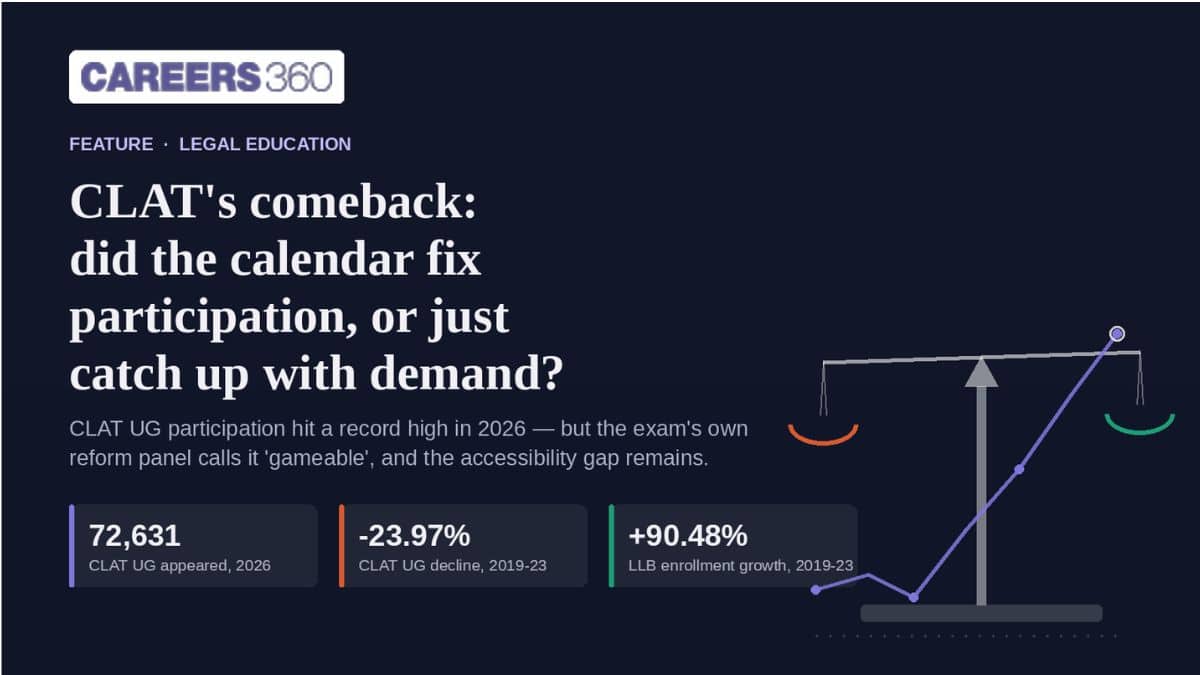
The AISHE 2023 and CLAT data reveal a striking paradox in India’s legal education system. Between 2019 and 2023, when 5-year LLB enrollments increased by 90.48%, from 131,452 to 250,388, student participation in CLAT UG fell by 23.97%, from 56,247 to 42,766. The national-level law entrance exam was shrinking when the demand for legal education was growing across the country.
Then, in 2024, the Consortium of National Law Universities (NLUs) shifted the exam calendar from May to December of the preceding year while also reducing the total number of questions from 150 to 120. New NLUs such as NLU Meghalaya, GNLU Silvassa, NLU Tripura and IIULER Goa also became part of the CLAT consortium. Later, non-NLUs such as Delhi University and IIM Rohtak widened the exam’s reach.
These changes reversed the declining trend in CLAT, with UG participation increasing every year, and reaching a record high of 72,631 in 2026. But this recovery itself raised a question – did the calendar shift fix the participation problem, or was CLAT simply trying to catch up with the same demand that AISHE has been recording?
Register for Judiciary Exam Preparation from TopRankers.
Year | Total CLAT Registration | Total CLAT Appeared | CLAT UG Appeared | CLAT PG Appeared | 5-yr LLB Enrollment (AISHE) |
|---|---|---|---|---|---|
2019 | 69,587 | 62,834 | 56,247 | 6,587 | 131,452 |
2020 (COVID) | 75,183 | 59,331 | 53,226 | 6,105 | 164,918 |
2021 (COVID) | 70,277 | 62,106 | 53,532 | 8,574 | 197,330 |
2022* | 60,895 | 56,472 | N/A | N/A | 236,413 |
2023 | 54,163 | 51,469 | 42,766 | 8,703 | 250,388 |
2024 | 67,590 | 65,185 | 53,180 | 12,005 | –** |
2025 | 78,914 | 75,361 | 60,544 | 14,817 | –** |
2026 | 92,344 | 88,657 | 72,631 | 16,026 | –** |
*Separate data not disclosed by the consortium for 2022
**AISHE has not published enrollment data beyond 2023
AISHE has not published its report beyond 2023. The available data shows LLB enrollments rose every year. It remains to be seen whether this growth in CLAT matches LLB enrollment trends from 2024 to 2026.
Increased acceptance of CLAT and growth don’t necessarily mean equitable and fair participation. Even with record numbers and reforms, is CLAT actually an exam for all, or an elite exam for English medium and better-resourced students? The CLAT’s own reform committee calls it a ‘gameable’ exam.
A major drawback in CLAT’s current framework is its limited accessibility. Language becomes a major barrier. A 2025 report by Careers360 shows that CBSE students who study in English are six to ten times more likely to clear CLAT than students from regional school boards.
The CLAT 2026 reform committee’s own report provided a separate note on accessibility. It stated that barriers posed by reliance on dense English-language passages, expectations of high reading and response speed, and absence of vernacular options create ‘structural disadvantages’ for a large section of students.
The committee recommended making information about legal education and admissions processes accessible to all, from first-generation, non-elite, and non-metropolitan backgrounds. It also recommended centrally produced online materials, informational videos with translations in regional languages, and school-level engagement to make CLAT more equitable and scalable.
The role of private coaching institutes is another major barrier. The CLAT committee notes that coaching has made the examination highly “gameable”, and access becomes skewed in favour of privileged candidates who can afford coaching.
Unlike CLAT, other major national-level examinations such as NEET and JEE are held in regional languages. The BCI’s advocate qualifying exam, All India Bar Examination (AIBE), is also held in regional languages. The question of conducting the CLAT in regional languages is currently sub judice and is being read with a broad context – the medium of imparting legal education in NLUs.
CLAT may have solved one part of the problem by moving the exam to December, but the accessibility question remains unanswered.

On Question asked by student community
Hello student,
CLAT 2027 aspirants can access these monthly current affairs compilations for regular revision. Use these resources to stay updated with important events and topics for CLAT 2027.
|
Particular |
Download PDF |
|
CLAT Current Affairs- August Month (2026) |
|
|
CLAT Current Affairs- |
If you have only two months, use a highly structured plan: daily current affairs, English reading, legal reasoning practice, logical reasoning sets, basic quantitative practice and regular full-length mocks. Spend as much time analysing incorrect questions as taking the mock itself. Consistency during these two months can make a substantial
You can download the CLAT previous years' question papers from here:
https://law.careers360.com/articles/clat-previous-year-question-papers
https://law.careers360.com/download/clat-sample-papers-previous-years
For CLAT 2027 UG, candidates need to have passed Class 12/equivalent with at least 45% marks, or 40% for SC/ST/PwD candidates.
In your situation, having an RT in an additional subject but subsequently passing the required qualification through an improvement examination does not automatically make you ineligible. However, the important
Here's the link to download the CLAT mock test:

Ranked 1 st among Top Law Schools of super Excellence in India - GHRDC | NAAC A+ Accredited | #36 by NIRF
NAAC A++ Accredited | Ranked #11 by NIRF
Bar Council of India (BCI) approved | Accredited by LAWASIA | Ranked 13th , among the Best Law Colleges (Private) in India by IIRF
Free Ebook - CLAT 2025 English Language questions with detailed solutions
Stay updated with current affairs & check your preparation with the CLAT General Knowledge Mock Tests Ebook
Law Admissions 2026 Open | Avail Merit-Based Scholarships