School of Law, UPES, Dehradun
Ranked #18 amongst Institutions in India by NIRF | Get Upto 100% Scholarships | Spot Admissions via CUET


Court cases could appear very complex at first glance because of the use of the language of law, long arguments, and facts. But a CLAT 2027 aspirant does not have to study the case as a prospective lawyer preparing to analyse it. The first task will be to understand the facts of the case, the issue in the case, and the judgment by the court and How to study case laws for CLAT.
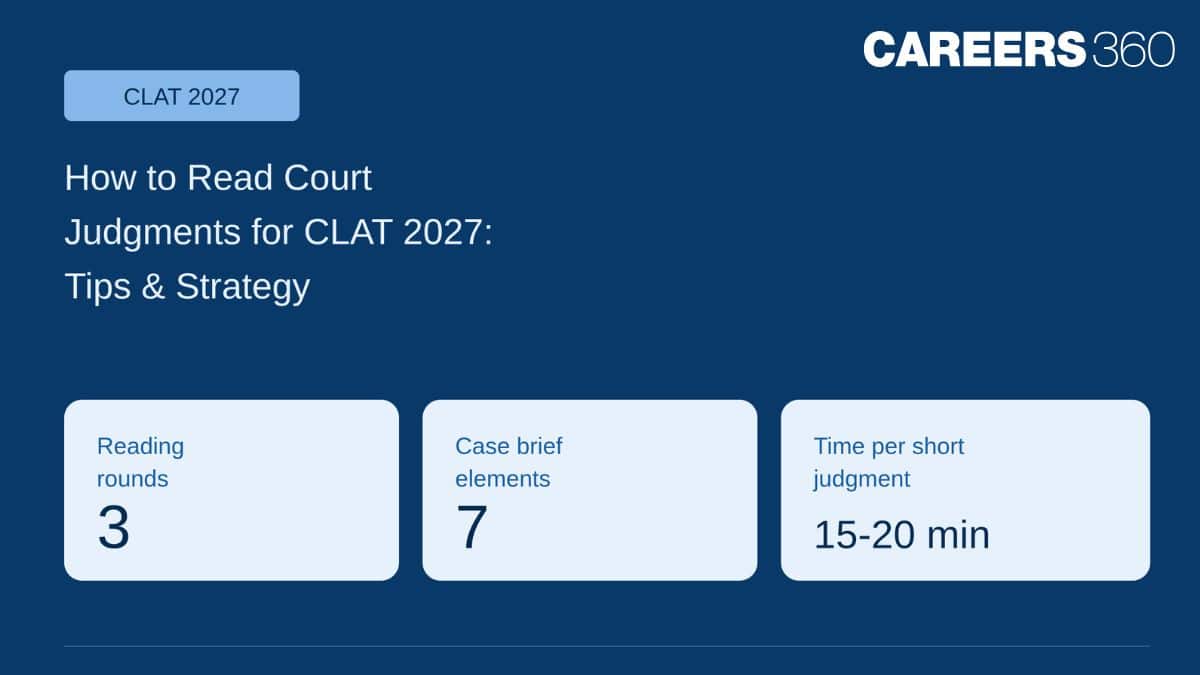
Reading court cases is an ability that could assist aspirants in preparing for CLAT 2027 legal reasoning, reading comprehension, and laws.
The reading of judgements helps because the CLAT 2027: last 5 years question paper trends test the student's abilities to:
Understand principles of law.
Find facts of importance.
Recognise arguments and logic in a judgment.
Apply a principle to a situation.
Understand the result of a case.
Analyse long pieces of text fast.
Students need to study the reasoning in the judgment for the CLAT exam, rather than remembering the whole judgment.
While a judgment may comprise multiple pages, one needs only to consider the significant parts of the judgment for CLAT 2027.
First of all, you need to understand what has transpired.
Consider:
Who are the parties?
What took place between them?
Why did the conflict arise?
What is the significant background of the case?
Ranked #18 amongst Institutions in India by NIRF | Get Upto 100% Scholarships | Spot Admissions via CUET
Scholars’ Round Deadline: 14th Nov’26 | Earn upto 50% merit Scholarship + 10% for top performers | EFMD Accredited | AACSB (USA) & AMDISA Member | Highest CTC 28 LPA
Try to summarise the facts in 2-3 sentences
The legal issue is the primary point of concern for the court to decide.
For instance:
Did a certain right get violated?
Was a certain act done lawfully?
Can a certain remedy be claimed?
This will help you understand the other points easily.
CLAT 2027 Judgment may provide details about the arguments of the parties. You should not try to remember every argument made. Just note:
Arguments of the petitioner/appellant.
Arguments of the respondent.
Legal provisions used.
This is perhaps the most crucial part for CLAT 2027 legal reasoning preparation.
Look out for:
How did the court understand the statute?
Which principle(s) was/were applied by the court?
Why did the court accept/reject an argument?
Facts and their connection with law.
Reasoning might help you understand why the court decided this way.
Thoroughly analyse the result of the case. Answer the following questions:
What is the decision of the court?
The petition or appeal is either allowed or dismissed.
What is the relief ordered?
What are the directions given?
Going through the decision in court for CLAT 2027 should not be a process of remembering everything written. Rather, one should read it in three easy steps so that he or she can comprehend the facts, the legal problem, and then the decision.
Firstly, figure out what really happened in the case. Find out the events, parties, and the reason behind the litigation of the case.
Then, determine the legal issue involved in the case. Observe the law or the provision of constitutional law or the principle of law involved in the decision. It must be highlighted here that Round 2 will be very important in CLAT 2027, as questions can be based on the application of the principle to a different case.
Lastly, analyse the reasoning and conclusion provided by the court. Inquire about the following – what is the decision made by the court? Why did the court arrive at such a decision? What principle can be deduced from the judgment? Once done, try to summarise the judgment in 3-4 lines.
By following these three rounds, one would be able to simplify lengthy judgments and make the necessary notes in preparation for CLAT 2027. Aspirants can also practice a set of 50+ legal reasoning passages for CLAT 2027 practice.
Rather than noting down pages of text from the judgment, prepare Court Judgments for CLAT 2027 a brief note of the case following this structure:
Name of the case
Facts: What happened?
Issue: What legal issue was there in the case?
Arguments: What was argued by both sides?
Decision: What decision did the court arrive at?
Reasoning: On what grounds did the court decide on this particular decision?
Important principle: What important principle was recognised in the case?
It will be very helpful to revise CLAT 2027 with this format.
Ratio decidendi refers to the legal principle or rule that forms the basis of the court's decision. In simpler terms, it tells the legal principle that became crucial for the determination of the case.
Try to understand the following things while reading the case:
What was the legal principle determined by the court?
How was the principle related to the facts?
Why was it necessary for the decision?
Do not consider all observations made by the judges as the ratio decidendi.
One of the major mistakes committed by the students while preparing for CLAT is memorising the complete judgment.
Remember only the following things instead:
Name of the Case
Facts of the Case
Legal Question in Issue
Important Legal Principle Determined in the Case
Decision of the Case
Why is the Case Important?
Judgments are known to use words that you don’t know. You should not get stuck on every new word.
You can follow this method:
Read the entire sentence.
Grasp the meaning through the context.
Highlight the new word.
Find out its meaning later.
Note down new words in your legal vocabulary notes.
There is no set duration for each judgment. While a smaller one will take 15-20 minutes, a larger constitutional judgment will surely take more time. While preparing for CLAT 2027, it’s the quality, not quantity, of the judgments that should matter. It’s better to:
Read fewer but important judgments.
Make short notes.
Revisit them often.
Solve questions related to them
Try out these useful tips for CLAT 2027 preparation:
First, read the heading and case title.
Note the parties involved in the dispute.
Get hold of the issue at stake.
Underline key legal principles.
Avoid the unnecessary procedural aspects in your first reading.
Divide large paragraphs into several smaller ones.
Make a one-sentence summary after each major point.
Pay attention to reasoning, not to cram the words used.
Revise your case notes before attempting CLAT mock tests.
Also check: CLAT 2027 Guessing Strategy: When to Attempt and When to Skip
When reading cases for CLAT 2027, remember not to:
Go through all the judgments from start to finish without any particular purpose.
Remember the words of the judgment exactly.
Pay no attention to the reasoning process and only pay attention to the verdict.
Give unnecessary time to insignificant facts.
Be discouraged by the legal jargon.
Make very long notes.
Read the judgments, ignoring their legal context.
Also check: Last Year CLAT Question Paper
The most crucial advantage of reading court judgments is that one can understand the process of legal reasoning.
Court judgments enable one to know how the courts:
Determine the legal problem.
Interpret the legal rule.
Consider different points of view.
Apply the principle to the facts.
Conclude after giving reasons.
These can help in answering CLAT 2027 legal reasoning questions, which give a principle or passage and then ask the student to apply it to a particular case.
Also check: CLAT Sample Question Paper
It need not necessarily be tough for CLAT 2027 aspirants to read court judgments. Rather than memorising lengthy court judgments, students must try to concentrate on facts, legal issues, arguments raised by the court, reasoning of the court, and its decision, along with the important principle of law.
Students can prepare small case briefs, revise important principles and apply them to new problems.
Also check: CLAT Model Paper

On Question asked by student community
Hello Student,
Here are the Careers360 CLAT 2027 Mock Test Resources for your exam preparation.
1. Online CLAT Mock Test
2. CLAT Mock Tests and Solutions
Hello student,
CLAT 2027 aspirants can access these monthly current affairs compilations for regular revision. Use these resources to stay updated with important events and topics for CLAT 2027.
|
Particular |
Download PDF |
|
CLAT Current Affairs- August Month (2026) |
|
|
CLAT Current Affairs- |
If you have only two months, use a highly structured plan: daily current affairs, English reading, legal reasoning practice, logical reasoning sets, basic quantitative practice and regular full-length mocks. Spend as much time analysing incorrect questions as taking the mock itself. Consistency during these two months can make a substantial
You can download the CLAT previous years' question papers from here:
https://law.careers360.com/articles/clat-previous-year-question-papers
https://law.careers360.com/download/clat-sample-papers-previous-years
For CLAT 2027 UG, candidates need to have passed Class 12/equivalent with at least 45% marks, or 40% for SC/ST/PwD candidates.
In your situation, having an RT in an additional subject but subsequently passing the required qualification through an improvement examination does not automatically make you ineligible. However, the important

Ranked #18 amongst Institutions in India by NIRF | Get Upto 100% Scholarships | Spot Admissions via CUET
Scholars’ Round Deadline: 14th Nov’26 | Earn upto 50% merit Scholarship + 10% for top performers | EFMD Accredited | AACSB (USA) & AMDISA Member | Highest CTC 28 LPA
Moot Court | Mock trials | Legal Aid Clinic | Recruiting Partners: FICCI, TCS, Adani, Trilegal, and many others
NAAC A+ Accredited University
Law Admissions 2026 Open | Avail Merit-Based Scholarships
NAAC A++ Accredited | Ranked #11 by NIRF