KCC ITM | Law Admissions 2026
Law Admissions 2026 Open | Avail Merit-Based Scholarships


It is natural for one to feel disappointed at not being able to get into the college or rank one had hoped to get into after taking the CLAT exam. This raises the doubt in many people’s minds: whether to attend the college assigned to them or to do a CLAT drop year and attempt CLAT 2027 once again.
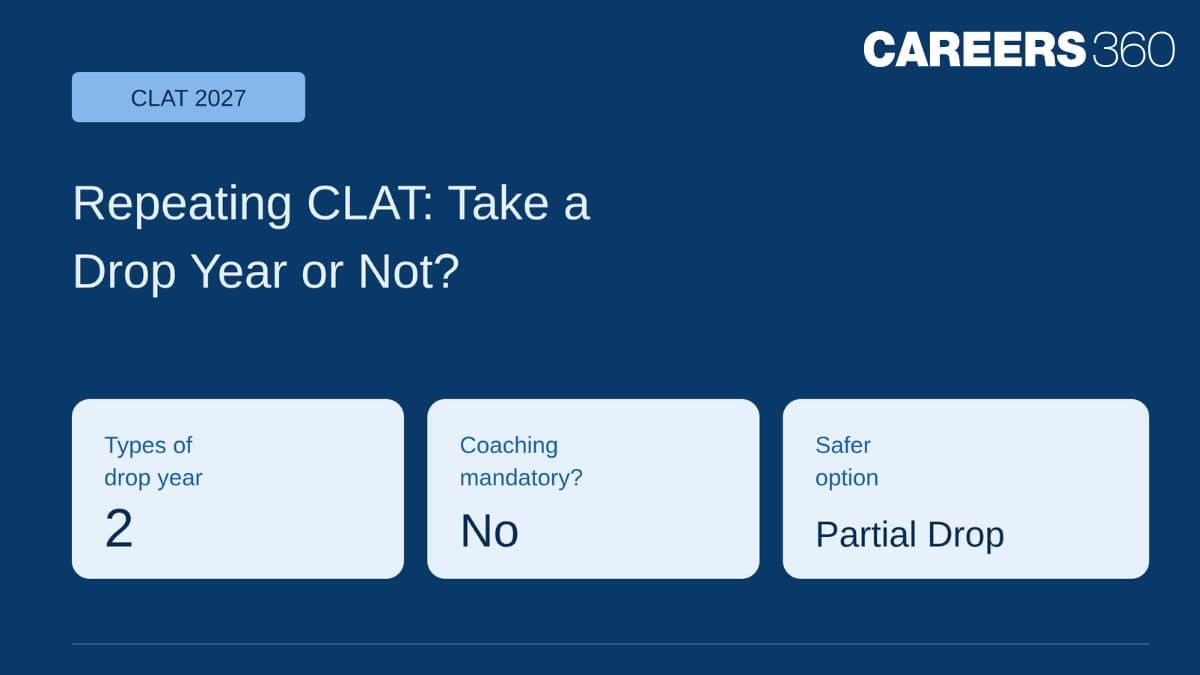
This depends entirely on each individual’s circumstances. It would be advisable for someone to take a CLAT drop year if he knows exactly where he went wrong in his previous attempt and what he needs to do differently.
Before taking a CLAT drop year, students should look at their previous performance, current college options, target rank and ability to prepare consistently for another attempt.
Taking a CLAT drop year may be worth it if you have a realistic reason to believe that your performance can improve.
Start by analysing your previous attempt. Ask yourself:
Did I start CLAT 2027 preparation too late?
Had I done enough mock test preparation?
Was I reading too slowly?
Was time management a problem for me in any way?
In which section was my performance the worst and hence the overall score low?
Were there marks lost due to unnecessary guesswork in the paper?
Was the preparation of current affairs topics inadequate?
Was there pressure from the examination that adversely affected my performance?
If the reasons behind your poor performance in the exam were inadequate practice, CLAT 2027 time management or poor preparation in certain sections, then taking up the exam again will give you the chance to rectify those mistakes.
But taking a CLAT drop year just because you are not happy with your rank is certainly not the right approach.
CLAT drop year could be a good idea for those individuals who feel that their past performance does not do justice to their true abilities.
Such students may not have prepared adequately due to lack of time. Having additional time to prepare will help them improve their speed, accuracy, CLAT 2027 current affairs knowledge and section-wise strategies.
Those who have scored/ ranked close to their desired institution through the past CLAT 2027 test might consider giving it another shot. But then it depends on how much improvement they can realistically hope for. Before taking a CLAT drop year, compare the gap between your current performance and your target.
Knowing exactly where you went wrong can be a major advantage. For example, if you know that your main problem was poor time management, low CLAT mock test practice or weak Current Affairs preparation, you can focus directly on improving those areas instead of starting everything from the beginning.
The decision to opt for a CLAT drop year should not be based on emotions following poor outcomes.
Especially if you have already received an acceptance into a good law college, you should not give that up easily. Compare your current option with the possible benefit of getting a better college next year.
You should also reconsider a full drop if:
You are not sure whether you actually want to pursue law.
You do not have a proper preparation plan.
You are taking a drop only because of pressure from others.
You are not ready to prepare consistently for another year.
A second attempt does not automatically guarantee a better rank.
Opting for the drop year for CLAT 2027 would also offer the candidates an additional chance of preparing themselves well and secure a better rank. But it will mean that one year of further CLAT preparation for the examination needs to be done, without any assurance of getting into the NLU of their choice in the next attempt.
Taking a CLAT drop year can have some clear advantages.
A dropper usually does not have to manage CLAT 2027 along with 12th board exams. This gives more time for reading, mock tests, revision and Current Affairs.
Repeaters already know what the actual CLAT 2027 environment feels like. They have felt the stress of solving questions within a certain timeframe, and they can apply this to their preparation once again.
When you take a drop, you get some extra time to work on areas that were weak for you before instead of covering all areas at the same time.
There are also some disadvantages when it comes to taking a CLAT drop year for the CLAT 2027 exam
There is no surety that your rank would improve just because you have prepared for one more year.
A full CLAT drop year also means joining college one academic year later. Some students may also feel additional pressure because they have invested an extra year in preparation.
This is why the decision should be based on your situation rather than fear of missing out on a better NLU.
Students who want to repeat CLAT 2027 generally consider either a full CLAT drop year or a partial drop.
The student does not take a full CLAT drop year at the college and instead focuses mainly on preparing for CLAT 2027.
A full CLAT drop year offers better preparation time but comes with increased risks since there is no college fallback option.
A partial drop allows the student to enrol in college and prepare again for CLAT, while continuing with his/her academic courses.
A partial drop is comparatively safer because the student continues college, but balancing both college studies and CLAT 2027 preparation can be difficult.
Register for Judiciary Exam Preparation from TopRankers.
The better option depends on your current college, target rank and how much improvement you need.
A CLAT repeater should not simply study for longer hours. The main focus should be on correcting the mistakes from the CLAT repeat year.
Revisit your CLAT preparation and find out how many marks you lost in the process. The problem may have been related to:
Reading speed
Comprehension
Accuracy
Time management
Wrong question selection
Excessive guessing
Weak Current Affairs preparation
Lack of mock-test practice
Once you know the problem, you can prepare more effectively.
Mock tests are extremely useful, but simply attempting them is not enough. After every mock, check:
Incorrect answers
Unattempted questions
Accuracy in each section
Time taken in each section
Questions where you guessed unnecessarily
Mistakes that are being repeated
Also look at your performance across several CLAT previous year question papers rather than judging yourself from one test.
Reading regularly helps to increase speed and also improve comprehension. Newspapers, editorials and analytical articles can be useful for building reading habits.
Current Affairs should also be prepared consistently instead of leaving everything for the final few months.
Coaching is not compulsory for CLAT repeaters. Candidates who know about the examination and are able to follow a proper CLAT 2027 schedule and regularly do mock tests can prepare for the examination through self-study.
However, coaching may help students who need CLAT 2027 structured classes, regular doubt-solving, guidance or external discipline. The decision should depend on what was missing from your previous CLAT preparation.
Before making your decision, think about:
Why was my performance low in my previous attempt?
Is there any chance to improve my weak spots?
How much do I lag behind my targeted rank?
Which colleges can I get into currently?
Am I prepared to forego all these chances?
Am I able to keep myself focused for one more year?
Should I take only a partial drop instead?
What precisely will I modify in my preparation?
If you cannot answer these questions clearly, taking a full drop may not be the best decision.
If you are aware of where you went wrong, taking a drop for CLAT 2027 can be a good decision with a practical plan of improvement. It should not be taken only because you are disappointed with your previous result. Consider your current college options, target NLUs, previous performance and chances of improvement before making the decision. Whether you choose a full drop, partial drop or continue with your current college, the decision should be practical.
If you decide to attempt CLAT again, the goal should not be to repeat the same preparation for another year. The goal should be to prepare in a smarter and more focused way.

On Question asked by student community
Hello student,
CLAT 2027 aspirants can access these monthly current affairs compilations for regular revision. Use these resources to stay updated with important events and topics for CLAT 2027.
|
Particular |
Download PDF |
|
CLAT Current Affairs- August Month (2026) |
|
|
CLAT Current Affairs- |
If you have only two months, use a highly structured plan: daily current affairs, English reading, legal reasoning practice, logical reasoning sets, basic quantitative practice and regular full-length mocks. Spend as much time analysing incorrect questions as taking the mock itself. Consistency during these two months can make a substantial
You can download the CLAT previous years' question papers from here:
https://law.careers360.com/articles/clat-previous-year-question-papers
https://law.careers360.com/download/clat-sample-papers-previous-years
For CLAT 2027 UG, candidates need to have passed Class 12/equivalent with at least 45% marks, or 40% for SC/ST/PwD candidates.
In your situation, having an RT in an additional subject but subsequently passing the required qualification through an improvement examination does not automatically make you ineligible. However, the important
Here's the link to download the CLAT mock test:

Ranked 1 st among Top Law Schools of super Excellence in India - GHRDC | NAAC A+ Accredited | #36 by NIRF
Last Date to Apply: 17th August | QS I-Gauge Diamond Rated | NAAC A+ Accredited | 621 Recruitment Partners | INR 40 LPA Highest CTC | 4482 Job offers
NAAC A++ Accredited | Ranked #11 by NIRF
Bar Council of India (BCI) approved | Accredited by LAWASIA | Ranked 13th , among the Best Law Colleges (Private) in India by IIRF
60+ Years of Education Legacy | UGC & AICTE Approved | Prestigious Scholarship Worth 6 Crores
Free Ebook - CLAT 2025 English Language questions with detailed solutions