ICFAI University Sikkim Law Admissions 2026
Approved by BCI


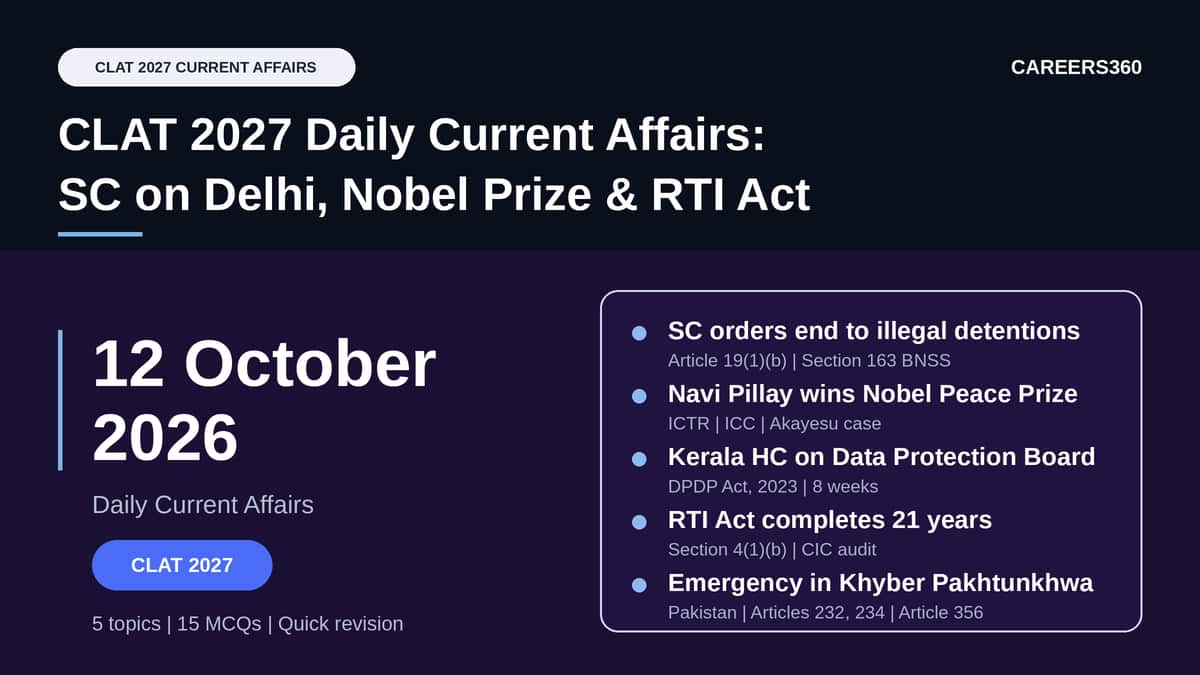
Today's current affairs cover five topics from polity, law and international affairs: the Supreme Court on detentions and protest rights in Delhi, the 2026 Nobel Peace Prize, the Kerala High Court on the Data Protection Board, 21 years of the RTI Act, and Pakistan's emergency in Khyber Pakhtunkhwa. The topics cover important legal and policy developments that candidates can come across in the CLAT 2027 exam. Each topic is followed by key points and practice questions to help with quick revision.
This Story also Contains
In the news: Thousands of young people were detained in Delhi on Saturday while trying to protest against Chief Election Commissioner Gyanesh Kumar. On Sunday, the Supreme Court held a special hearing. It told the Centre and Delhi Police to stop illegal detentions and let people move freely, with the Metro, trains and the Internet working normally. This was "subject to law and public order", meaning the police can still keep reasonable control.
The Court also asked police to review road barricades and lift Section 163 orders near courts so that people can reach lawyers. It said people cannot be detained without legal grounds outside the four-km restricted zone around Jantar Mantar. It also issued notice on a contempt plea against the Home Secretary, the Delhi Police Commissioner and the DMRC chairperson. The plea says they broke the Court's October 9 order, which had said Metro services cannot be fully shut.
Article 19(1)(b): Right of citizens to assemble peacefully and without arms.
Article 19(3): Allows the State to impose reasonable restrictions on this right in the interest of public order and the sovereignty and integrity of India.
Section 163, BNSS: Allows prohibitory orders in urgent cases of nuisance or danger. It replaced Section 144 CrPC.
Himat Lal K. Shah v. Commissioner of Police (1972): A Constitution Bench held that the right to assemble can be limited only by reasonable restrictions. The State cannot take it away.
Anita Thakur v. State of J&K (2016): Peaceful protest is a fundamental right.
Mazdoor Kisan Shakti Sangathan v. Union of India (2018): The Court asked authorities to frame guidelines for regulated protests at Jantar Mantar.
Article 22: Protects a person who is arrested or detained. They must be told the grounds and produced before a magistrate within 24 hours.
Contempt of court: Wilful disobedience of a court order. It is punishable under the Contempt of Courts Act, 1971.
Q1. Which provision replaced Section 144 CrPC?
A. Section 144 BNS
B. Section 163 BNSS
C. Section 189 BNSS
D. Section 129 BNSS
Answer: B
Q2. Which Article guarantees the right to assemble peacefully?
A. 19(1)(a)
B. 19(1)(b)
C. 19(1)(c)
D. 21
Answer: B
Q3. Which 2016 case declared peaceful protest a fundamental right?
A. Himat Lal Shah
B. Anita Thakur
C. Ramlila Maidan
D. Kesavananda Bharati
Answer: B
In the news: The Nobel Committee in Norway has given the 2026 Peace Prize to Navi Pillay, a judge and human rights lawyer from South Africa. She worked as a judge at the International Criminal Tribunal for Rwanda (ICTR) and the International Criminal Court (ICC). She also led a UN inquiry into the Occupied Palestinian Territory.
Pillay was born in Durban in 1941 to a family of Indian Tamil origin. She grew up under apartheid and, as a lawyer, defended anti-apartheid activists, including Nelson Mandela. In the 1998 Akayesu case, she was on the bench that ruled that rape and sexual violence can be acts of genocide.
Nobel Peace Prize: Awarded in Oslo by the Norwegian Nobel Committee. The other Nobel prizes are awarded in Sweden.
ICTR: A temporary UN tribunal set up in 1994 to try those responsible for the Rwandan genocide. It sat in Arusha, Tanzania.
ICC: A permanent court at The Hague that tries genocide, war crimes, crimes against humanity and aggression. It is set up under the Rome Statute (1998).
India and the ICC: India is not a party to the Rome Statute.
Akayesu (1998): The first conviction for genocide by an international court. It treated sexual violence as a means of genocide.
ICJ vs ICC: The ICJ settles disputes between States. The ICC tries individuals.
Genocide Convention (1948): Defines genocide as acts committed with intent to destroy a national, ethnic, racial or religious group.
Past winners in the news: Maria Corina Machado won in 2025.
Q1. Who won the 2026 Nobel Peace Prize?
A. Maria Corina Machado
B. Navi Pillay
C. Karim Khan
D. Malala Yousafzai
Answer: B
Q2. Which 1998 judgment recognised rape as an act of genocide?
A. Tadic
B. Akayesu
C. Lubanga
D. Milosevic
Answer: B
Q3. Which court tries individuals for genocide and war crimes on a permanent basis?
A. ICJ
B. ICC
C. ICTR
D. PCA
Answer: B
In the news: A law to protect our personal data was passed in 2023. It created a Data Protection Board to handle complaints, but the Board has not yet started working. The Kerala High Court has now told the Centre to make it functional within eight weeks.
The case was a PIL about how airports collect and store passengers' personal data. Earlier, the Court said that Digi Yatra, the app used for faster airport entry, cannot force travellers to give Aadhaar. A driving licence is also accepted as ID. The Court hopes Voter ID will be accepted too.
DPDP Act, 2023: India's law on processing of digital personal data. Its Rules were notified in 2025.
Data Principal: The person whose data is collected.
Data Fiduciary: The entity that decides why and how the data is processed, such as a bank or an app.
Data Protection Board of India: The body that hears complaints and can impose penalties under the Act.
K.S. Puttaswamy v. Union of India (2017): A nine-judge Bench held privacy to be a fundamental right under Article 21.
Consent: The Act is built on free, specific and informed consent, which can be withdrawn.
Digi Yatra: A facial-recognition-based system for paperless airport entry, run by the Digi Yatra Foundation.
PIL: A petition filed in the public interest, which can be heard under Articles 32 and 226.
Q1. Within how many weeks must the Board be made functional?
A. Four
B. Six
C. Eight
D. Twelve
Answer: C
Q2. Under the DPDP Act, who decides the purpose and means of processing data?
A. Data Principal
B. Data Fiduciary
C. Data Processor
D. Data Auditor
Answer: B
Q3. Which case recognised privacy as a fundamental right?
A. Maneka Gandhi
B. K.S. Puttaswamy
C. A.K. Gopalan
D. Kharak Singh
Answer: B
In the news: The Right to Information (RTI) Act, which lets citizens ask government offices for information, turned 21 on October 12. The law also says offices should publish basic information on their own, so people need not file RTI requests. This is called suo motu disclosure.
A new analysis shows offices are not doing this well. The Central Information Commission (CIC) says only 1,446 of 2,303 public authorities (62.7%) submitted audit reports on their transparency. More than half of those scored Grade C or below. The Hindu checked 94 department websites and found only 33 had the latest audit report.
RTI Act, 2005: Came into force on October 12, 2005.
Section 4(1)(b): Lists 16 types of information that public authorities must publish themselves.
Section 6: Any citizen can request information from a public authority.
Section 7: Information must normally be given within 30 days. For life or liberty matters, it is 48 hours.
Section 8: Lists exemptions, such as threats to national security and sovereignty.
Section 19: Provides for first appeal and second appeal to the Information Commission.
CIC: The apex appellate body at the Centre. States have State Information Commissions.
Constitutional basis: The Supreme Court has linked the right to information to Article 19(1)(a), freedom of speech and expression.
DPDP Act link: The 2023 Act amended Section 8(1)(j) of the RTI Act on personal information.
Q1. How many types of information does Section 4(1)(b) list?
A. 10
B. 12
C. 16
D. 20
Answer: C
Q2. Which body issues guidelines on additional proactive disclosure?
A. NITI Aayog
B. DoPT
C. Law Commission
D. CAG
Answer: B
Q3. Within how many days must a normal RTI request be answered?
A. 15
B. 30
C. 45
D. 60
Answer: B
In the news: Pakistan's President Asif Ali Zardari has declared an emergency in the province of Khyber Pakhtunkhwa. This was done on the advice of the federal cabinet. The reasons given were rising terrorist attacks and a breakdown of constitutional machinery in the province.
The elected provincial government, led by the party of jailed former PM Imran Khan, has been removed. The Chief Minister, ministers and advisers must leave office at once. The step came while Chief Minister Sohail Afridi was leading a protest march demanding Khan's release and medical treatment.
Articles 232 and 234 (Pakistan): Allow an emergency in a province for internal disturbance or failure of constitutional machinery.
Effect: The federal government takes over key executive and legislative powers of the province.
Indian parallel: Article 356 allows President's Rule when a State government cannot function according to the Constitution.
S.R. Bommai v. Union of India (1994): Use of Article 356 is open to judicial review. A State government's majority must be tested on the floor of the House.
Article 355: Duty of the Union to protect States against external aggression and internal disturbance.
Duration of President's Rule: Parliament must approve it within two months. It can last up to three years with periodic approvals.
Governor's report: In India, President's Rule is usually imposed on the Governor's report.
Head of State in Pakistan: The President is the formal head of state. The Prime Minister heads the government.
Q1. Which Pakistani province is under emergency?
A. Sindh
B. Balochistan
C. Khyber Pakhtunkhwa
D. Punjab
Answer: C
Q2. Which Indian provision is closest to this proclamation?
A. Article 352
B. Article 356
C. Article 360
D. Article 370
Answer: B
Q3. Which case made President's Rule judicially reviewable?
A. Kesavananda Bharati
B. S.R. Bommai
C. Minerva Mills
D. Rameshwar Prasad
Answer: B
These key facts will help aspirants revise today’s current affairs quickly for CLAT 2027:
SC on Delhi: No detentions except by law outside the 4-km prohibitory zone. Article 19(1)(b) applies, along with Section 163 BNSS. Contempt notice issued to the Home Secretary, the Police Commissioner and the DMRC chairperson.
Nobel Peace Prize 2026: Navi Pillay, ICTR and ICC judge, part of the bench in the Akayesu ruling.
Kerala HC: Data Protection Board to be functional in 8 weeks under the DPDP Act, 2023.
RTI: 21 years. Section 4(1)(b) covers 16 categories. 1,446 of 2,303 public authorities filed audit reports.
Pakistan: Emergency in Khyber Pakhtunkhwa under Articles 232(1) and 234(1).
Also in the news: The Brazil run-off is on October 25, and Mizoram will count refugees on a separate list in the Census 2027.

On Question asked by student community
Hello Student,
Here are the Careers360 CLAT 2027 Mock Test Resources for your exam preparation.
1. Online CLAT Mock Test
2. CLAT Mock Tests and Solutions
Hello student,
CLAT 2027 aspirants can access these monthly current affairs compilations for regular revision. Use these resources to stay updated with important events and topics for CLAT 2027.
|
Particular |
Download PDF |
|
CLAT Current Affairs- August Month (2026) |
|
|
CLAT Current Affairs- |
If you have only two months, use a highly structured plan: daily current affairs, English reading, legal reasoning practice, logical reasoning sets, basic quantitative practice and regular full-length mocks. Spend as much time analysing incorrect questions as taking the mock itself. Consistency during these two months can make a substantial
You can download the CLAT previous years' question papers from here:
https://law.careers360.com/articles/clat-previous-year-question-papers
https://law.careers360.com/download/clat-sample-papers-previous-years
For CLAT 2027 UG, candidates need to have passed Class 12/equivalent with at least 45% marks, or 40% for SC/ST/PwD candidates.
In your situation, having an RT in an additional subject but subsequently passing the required qualification through an improvement examination does not automatically make you ineligible. However, the important

Ranked #18 amongst Institutions in India by NIRF | Get Upto 100% Scholarships | Spot Admissions via CUET
Ranked 1 st among Top Law Schools of super Excellence in India - GHRDC | NAAC A+ Accredited | #36 by NIRF
NAAC A++ Accredited | Ranked #11 by NIRF
Bar Council of India (BCI) approved | Accredited by LAWASIA | Ranked 13th , among the Best Law Colleges (Private) in India by IIRF
Free Ebook - CLAT 2025 English Language questions with detailed solutions
Stay updated with current affairs & check your preparation with the CLAT General Knowledge Mock Tests Ebook