School of Law, UPES, Dehradun
Ranked #18 amongst Institutions in India by NIRF | Get Upto 100% Scholarships | Spot Admissions via CUET


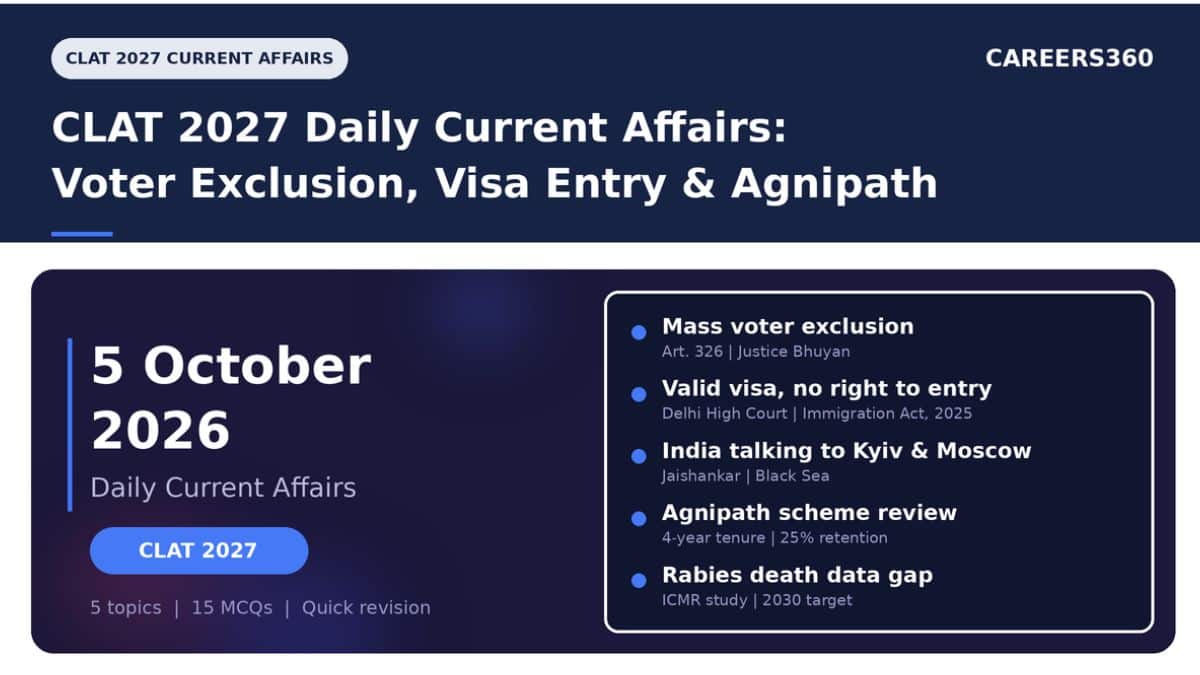
Today's CLAT 2027 current affairs cover Justice Ujjal Bhuyan's remarks on mass exclusion of voters, the Delhi High Court ruling that a valid visa does not guarantee entry into India. It also includes External Affairs Minister S. Jaishankar's comments on India's role in the Russia-Ukraine conflict, the Services' review of the Agnipath scheme, and the gap in India's rabies death data. These topics are useful for candidates preparing for the CLAT 2027 exam. Quick revision facts and MCQs are included for exam preparation.
In the news: Supreme Court judge Justice Ujjal Bhuyan said on October 4 that any process which disenfranchises millions of people is "intrinsically arbitrary." He was speaking at NALSAR University of Law, Hyderabad. He said such a process makes people second-class citizens and goes against universal adult suffrage and the right to equality. These were his views at a lecture, not a court judgment.
He said the right to be a voter is not just a statutory right. It is a constitutional right that falls within the Basic Structure. He also said that, except for a dead voter, a name cannot be removed from the electoral roll without notice and a hearing.
The remarks come during the Election Commission's special intensive revision (SIR) of electoral rolls. Around 13.3 crore names have been deleted so far, according to the report. Justice Bhuyan also recalled that under the Government of India Act, 1935, only about 14% of the population could vote.
What CLAT 2027 aspirants should know
Article 326: Lok Sabha and State Assembly elections are based on adult suffrage. Citizens aged 18 and above can vote, unless disqualified by law.
Article 14: Guarantees equality before law and allows arbitrary State action to be challenged.
Basic Structure doctrine: Parliament cannot alter the Constitution’s core features.
Section 21, Representation of the People Act, 1950: Deals with preparing and revising electoral rolls.
Universal adult franchise: Every adult citizen has one vote of equal value, regardless of wealth, religion, sex or education.
Ranked #18 amongst Institutions in India by NIRF | Get Upto 100% Scholarships | Spot Admissions via CUET
Scholars’ Round Deadline: 14th Nov’26 | Earn upto 50% merit Scholarship + 10% for top performers | EFMD Accredited | AACSB (USA) & AMDISA Member | Highest CTC 28 LPA
Q1. Which Article provides for elections based on adult suffrage?
A. Article 324
B. Article 325
C. Article 326
D. Article 329
Answer: C
Q2. According to Justice Bhuyan, except for a dead voter, what is required before deleting a name from the electoral roll?
A. A police report
B. Notice and hearing
C. A court order
D. Approval of Parliament
Answer: B
Q3. Under which law was only about 14% of the population allowed to vote before Independence, as mentioned by the judge?
A. Government of India Act, 1919
B. Indian Councils Act, 1909
C. Government of India Act, 1935
D. Indian Independence Act, 1947
Answer: C
In the news: The Delhi High Court has held that a foreign national with a valid visa has no inherent or legally enforceable right to enter India. Justice Amit Mahajan dismissed the petition on September 30.
The petitioner, a Turkmenistan citizen, was stopped at Delhi airport on March 25 despite a valid business visa. She was sent back the same day. Her husband, who travelled with her on the same flight and held the same type of visa, was allowed in. She argued that she was denied entry without reasons and that this was discriminatory under Articles 14 and 21.
The Centre said it had received "adverse inputs" about her and that the decision was taken in the interest of national security and public order. The court examined material in a sealed cover. It said that getting a visa and being allowed to enter are two different things. It also said her husband and she were not similarly situated, so there was no violation of Article 14.
What CLAT 2027 aspirants should know
Immigration and Foreigners Act, 2025: Now governs entry of foreigners. A foreigner must have a valid passport or travel document and a valid visa. Entry can still be refused on grounds such as national security.
Hans Muller of Nurenburg v. Superintendent, Presidency Jail (1955): The Supreme Court held that the Central government has wide powers over foreigners, including the power to expel them.
Louis De Raedt v. Union of India (1991): A foreigner's fundamental rights are limited to Article 21. The right to reside and settle in India under Article 19(1)(e) belongs only to citizens.
Article 226: Power of High Courts to issue writs. A writ needs a legally enforceable right.
Sealed cover: Sensitive material is given to the court in a closed envelope and not shared with the other side.
Q1. According to the Delhi High Court, what does a valid visa give a foreigner?
A. An absolute right to enter India
B. No inherent or legally enforceable right to enter India
C. A right to settle in India
D. A right to work in India
Answer: B
Q2. In which case did the Supreme Court say fundamental rights of foreigners are limited to Article 21?
A. Hans Muller of Nurenburg v. Superintendent, Presidency Jail
B. Louis De Raedt v. Union of India
C. Maneka Gandhi v. Union of India
D. Bijoe Emmanuel v. State of Kerala
Answer: B
Q3. Which law now governs the legal framework on foreigners in India?
A. Foreigners Act, 1946
B. Passport Act, 1967
C. Immigration and Foreigners Act, 2025
D. Citizenship Act, 1955
Answer: C
In the news: External Affairs Minister S. Jaishankar said on October 4 that India is going "beyond advocacy" on the Russia-Ukraine conflict. He was speaking at the Munich Leaders Meeting in Delhi. It is the first time he has shared details of India's talks with both sides.
He said India is in conversation with both Russia and Ukraine. The talks cover Black Sea shipping safety, grain exports, energy exports and non-attack possibilities. A day earlier, Ukraine's Foreign Minister Andrii Sybiha said India had the "broadest" proposal among four countries offering to help end the conflict.
Mr. Jaishankar also defended India's ties with Russia, saying it stood by India in difficult times, including during the 1971 war. Russia supplies over 50% of India's oil imports. The remarks suggest India will not cut these purchases, even if the U.S. imposes sanctions under a new law enacted on September 18.
What CLAT 2027 aspirants should know
Strategic autonomy: India's policy of making its own foreign policy choices without joining any bloc.
Black Sea: A sea route important for grain and energy shipments from Russia and Ukraine.
Bilateral vs multilateral diplomacy: A bilateral talk is between two countries. Multilateral engagement happens in forums such as the UN General Assembly.
Sanctions: Economic penalties imposed by one country on another, or on those who trade with it.
Q1. Which sea's shipping safety was mentioned among the issues India is discussing with Russia and Ukraine?
A. Red Sea
B. Black Sea
C. Baltic Sea
D. South China Sea
Answer: B
Q2. Roughly what share of India's oil imports comes from Russia, as per the report?
A. Less than 10%
B. About 25%
C. Over 50%
D. 100%
Answer: C
Q3. Where did Jaishankar make these remarks?
A. Munich Leaders Meeting in Delhi
B. UN Security Council in New York
C. G20 Summit in Florida
D. Quad Summit in Tokyo
Answer: A
In the news: The Army, Navy and Air Force have sent recommendations to the Department of Military Affairs (DMA) on improving the Agnipath scheme. The first batch of Agniveers, who enrolled in 2023, will complete their four-year tenure later this year. A report with the suggestions has been sent to the competent authority.
Under the current policy, up to 25% of each batch can be retained in the regular cadre. The rest leave after four years. The review comes as the forces try to balance a younger force with the need for experience and continuity.
What CLAT 2027 aspirants should know
Agnipath scheme: Introduced in June 2022. Young men and women aged 17.5 to 21 are recruited as Agniveers for four years, including six months of training.
Seva Nidhi: A tax-free package for those who exit. It is built from monthly contributions by the Agniveer, matched by the government.
No pension or gratuity: Agniveers who leave after four years do not get these benefits.
Department of Military Affairs (DMA): The department in the Ministry of Defence headed by the Chief of Defence Staff.
Q1. What is the tenure of an Agniveer?
A. Two years
B. Four years
C. Seven years
D. Ten years
Answer: B
Q2. What share of each batch can be retained in the regular cadre?
A. Up to 10%
B. Up to 25%
C. Up to 50%
D. Up to 75%
Answer: B
Q3. In which year was the Agnipath scheme introduced?
A. 2020
B. 2021
C. 2022
D. 2023
Answer: C
In the news: A study by the ICMR-National Institute of Epidemiology, published in The Lancet Infectious Diseases, estimates that 5,726 people die of rabies in India every year. This is a modelled estimate based on a survey of 337,808 people in 78,807 households across 60 districts in 15 States. It suggests India has about 9.1 million animal bites every year, including about 5.6 million dog bites.
Government systems show far lower numbers. The Health Ministry's IDSP-IHIP surveillance system recorded 54 rabies deaths in 2024. The Registrar-General's medical certification system (MCCD) recorded 271 in 2023. Neither gives a complete national count. The MCCD covers only about 22% of registered deaths. A senior Health Ministry official said the figures are produced by different methods and should not be treated as equal.
India aims to eliminate dog-mediated human rabies by 2030. The World Health Organization (WHO) estimates that India accounts for about 35% of rabies deaths worldwide.
What CLAT 2027 aspirants should know
IDSP-IHIP: Integrated Disease Surveillance Programme and Integrated Health Information Platform. It tracks disease outbreaks.
MCCD: Medical Certification of Cause of Death, run under the Registrar-General of India.
Modelled estimate: A figure calculated from survey data and statistical models, not a direct count of recorded deaths.
Rabies: A viral disease spread mainly through animal bites. It is almost always fatal once symptoms appear.
Q1. By which year does India aim to eliminate dog-mediated human rabies?
A. 2027
B. 2030
C. 2035
D. 2047
Answer: B
Q2. What is the ICMR-NIE study's estimate of yearly rabies deaths in India?
A. 54
B. 271
C. 5,726
D. 59,000
Answer: C
Q3. Roughly what share of global rabies deaths does the WHO attribute to India?
A. 10%
B. 20%
C. 35%
D. 60%
Answer: C
Candidates can revise these key facts for quick CLAT 2027 current affairs revision:
Article 326: Adult suffrage for Lok Sabha and Assembly elections
Justice Bhuyan: No deletion of a voter's name without notice and hearing, except a dead voter
Immigration and Foreigners Act, 2025: Valid visa does not guarantee entry
Hans Muller (1955) and Louis De Raedt (1991): Wide State power over foreigners; limited rights for non-citizens
India-Russia-Ukraine: Talks on Black Sea shipping, grain and energy exports
Agnipath: Four-year tenure; up to 25% retained; Seva Nidhi package
Rabies: ICMR study estimates 5,726 deaths a year; official systems record far fewer
Elimination target: Dog-mediated human rabies by 2030
Date | Current affairs |
October 02-04, 2026 | |
October 01, 2026 | |
September 30, 2026 | |
September 29, 2026 | |
September 28, 2026 |

On Question asked by student community
Hello Student,
Here are the Careers360 CLAT 2027 Mock Test Resources for your exam preparation.
1. Online CLAT Mock Test
2. CLAT Mock Tests and Solutions
Hello student,
CLAT 2027 aspirants can access these monthly current affairs compilations for regular revision. Use these resources to stay updated with important events and topics for CLAT 2027.
|
Particular |
Download PDF |
|
CLAT Current Affairs- August Month (2026) |
|
|
CLAT Current Affairs- |
If you have only two months, use a highly structured plan: daily current affairs, English reading, legal reasoning practice, logical reasoning sets, basic quantitative practice and regular full-length mocks. Spend as much time analysing incorrect questions as taking the mock itself. Consistency during these two months can make a substantial
You can download the CLAT previous years' question papers from here:
https://law.careers360.com/articles/clat-previous-year-question-papers
https://law.careers360.com/download/clat-sample-papers-previous-years
For CLAT 2027 UG, candidates need to have passed Class 12/equivalent with at least 45% marks, or 40% for SC/ST/PwD candidates.
In your situation, having an RT in an additional subject but subsequently passing the required qualification through an improvement examination does not automatically make you ineligible. However, the important

Ranked #18 amongst Institutions in India by NIRF | Get Upto 100% Scholarships | Spot Admissions via CUET
Scholars’ Round Deadline: 14th Nov’26 | Earn upto 50% merit Scholarship + 10% for top performers | EFMD Accredited | AACSB (USA) & AMDISA Member | Highest CTC 28 LPA
Moot Court | Mock trials | Legal Aid Clinic | Recruiting Partners: FICCI, TCS, Adani, Trilegal, and many others
NAAC A+ Accredited University
BA LLB, BBA LLB, or BCom LLB and LLB | LLM 1 Year – 4 Specializations | Approved by BCI | Highest CTC 9 LPA
Grade 'A+' Accredited by NAAC | Ranked 33rd in India by NIRF