Amity Law School, Noida
Experiential Learning through Legal Aid Camps, Lok Adalats, Court Visits, Community Lawyering and regular Moot Court sessions


With just around 30 days left for CLAT 2027 , you may still have current affairs notes to revise, unfinished topics, and a mock test to attempt. Deciding what you should do first can be confusing, especially when the mock test scores are not improving as expected. A practical CLAT 2027 30-day plan can help you organize the remaining work and give enough time to the areas where you are losing marks
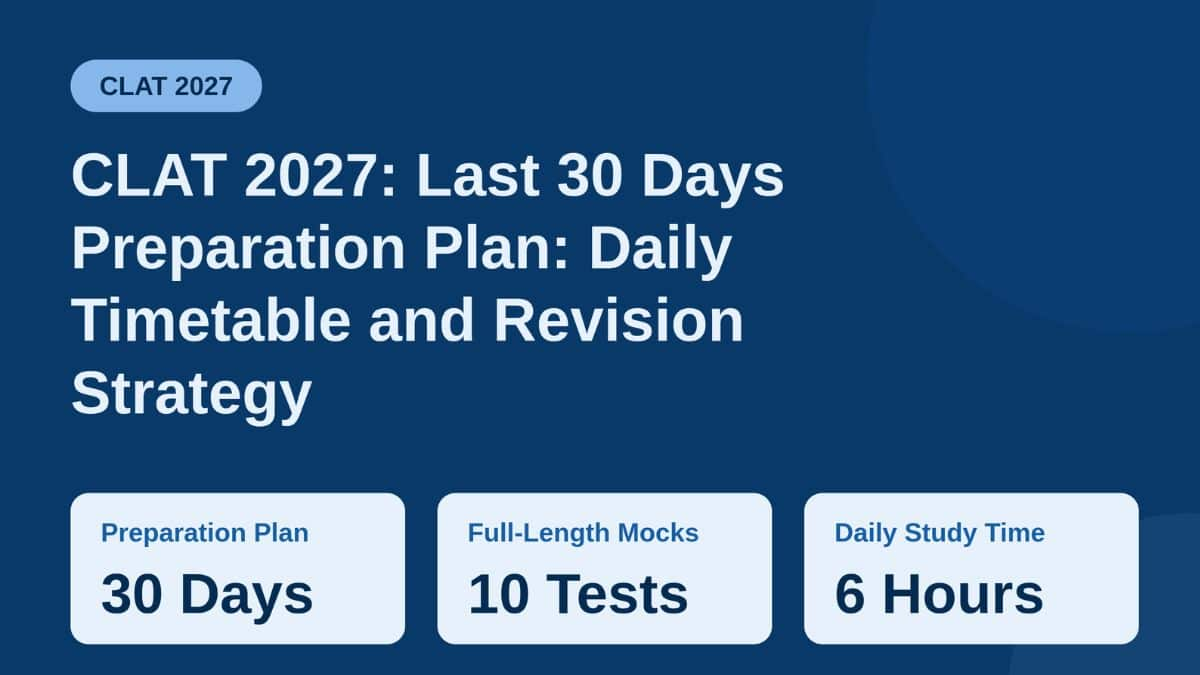
The final month is also a chance to check the questions you got wrong and check whether you can solve them correctly under the time limit. While some candidates need more revision, other may need to work on reading speed or completing the exam. This article provides a week-wise study plan, daily timetable, section-wise preparation tips and a mock test schedule that you can adjust to your preparation level.
Before making a CLAT timetable , check where you stand. Attempt a CLAT 2027 mock tests or a previous-year paper that you have not solved before. Review more than your total score. Did you leave questions because you ran out of time? Were you confused between two options? Did you forget facts you had already revised? Your answers will help you decide what needs attention first.
Choose two or three weak areas to work on during the first week. For example, if you struggle with inference questions or make calculation errors, include short practice sessions for these alongside your regular revision. Keep a notebook of recurring mistakes and revisit those questions after a few days to check whether you have improved.
Use the books, notes and practice material you already have. If most of your syllabus is complete, spend more time on revision and timed practice. If you still have gaps in basic concepts, make time to understand them before attempting more questions. Leave room in your timetable to review answers, too—otherwise, you may keep repeating the same mistakes
Break the remaining month into smaller goals so you know what to focus on each week. Identify weak areas and then progress to timed practice and revision The schedule below has ten full-length tests but you can reduce this number if you need extra time to analyze answers and clear doubts.
Days | Main Focus | What to do |
Days 1–7 | Find gaps in your preparation | Attempt two full-length tests, including your initial mock. Review mistakes, revise the concepts you struggled with and divide your current affairs notes into daily portions. |
Days 8–14 | Work on accuracy | Attempt three mocks on separate days. Between tests, practise question types you frequently get wrong. Continue current affairs revision and revisit facts you could not recall. |
Days15–21 | Improve time management | Attempt three mocks and track the time spent on each section. Check whether difficult passages are preventing you from reaching easier questions. Practise a section order that works for you. |
Days22–26 | Bring your revision together | Attempt two full-length tests and review them carefully. Revisit your error notebook, revise important concepts, and complete any pending mock analysis. |
Days27–28 | Clear remaining doubts | Practise short sets from topics where mistakes continue. Review current affairs notes and familiar formulas without overloading your day. |
Days29–30 | Keep revision light | Go through brief notes and recurring mistakes. Read your admit card instructions, organise the required documents, and get adequate rest. |
Keep the days between mocks for correcting mistakes. If the same problem appears in several tests, spend time working through it before attempting another full paper.
Once your weekly targets are clear, divide your study time between revision, practice, and reviewing answers. Avoid filling the entire day with tests—you also need time to understand why an answer was wrong and how to approach a similar question next time.
The following timetable allows around six hours of study on days when you are not taking a full-length mock. Adjust the duration around school or other commitments, and take breaks between sessions.
Study Activity | Suggested Time |
Revise current affairs and test your recall | 75 minutes |
Solve Legal Reasoning passages and review answers | 75 minutes |
Practise English reading comprehension | 45 minutes |
Solve Logical Reasoning questions | 60 minutes |
Practise Quantitative Techniques sets | 45 minutes |
Revisit mistakes and clear pending doubts | 60 minutes |
Total | 6 hours |
On mock days, replace some of these practice sessions with the test and its analysis instead of adding them to an already full schedule. Keep a short current affairs revision session, but adjust the rest of the day according to the mistakes that need attention.
Your mock results can help you decide how much time each section needs. Give extra attention to areas where you repeatedly lose marks, but continue practising your stronger sections so that you stay comfortable with them.
Practise two reading comprehension passages on non-mock days and review the answers carefully. If you choose the wrong option, return to the passage and find the information you missed. Pay attention to the author’s main argument, tone and implied meaning. For vocabulary questions, read the surrounding sentences before deciding what a word means.
Divide your current affairs notes into small daily portions. After revising a topic, close your notes and check how much you can recall. Revisit forgotten details the next day. Don’t just learn isolated facts. Learn major events and the background information to them, including the organizations, countries or agreements involved.
Read the rule given in the passage very carefully before applying it to the situation in question. Search for conditions and exceptions that might alter the answer. When two options seem equally convincing, compare them to the exact rule. In review, see if you followed the passage or let your personal understanding of what is fair influence your choice.
Focus on identifying the argument, the supporting evidence and the conclusion. Assumptions, Inferences, and Strengthen or Weaken Argument practice questions. If you read your answer choice and it doesn't sound right, you should say why it doesn't work. This helps you recognize trends, such as picking out a statement that sounds reasonable, but is not supported by the passage.
Go over familiar topics such as percentages, ratios, averages, simple algebra and mensuration. Solve one or two sets of numerical regularly and write the steps of calculation clearly. If you get a wrong answer, check to see if you misread the data, used the wrong formula, or made an arithmetic error. Work on the specific step that you had problems with before moving to another set.
The suggested plan includes ten full length test. However completing that number should not take priority over reviewing mistakes.
After each mock, record section-wise attempts, correct answers and time spent. Review uncertain answers even when they happened to be correct. Reattempt skipped questions without the timer to identify whether the difficulty came from the question itself or time pressure.
Finally, write one specific correction for the next paper . For example, “check exceptions before selecting a legal answer” gives a clearer practice target than “improve Legal Reasoning.”
The more you cram into your timetable with limited time left, the harder revision becomes to deal with. Watch out for these common errors:
Switching between study materials: You may find much of the same content in a new book or compilation. Use the resources you already have and fill in the gaps only when you know what needs to be added.
Not reviewing mocks after taking them If you have any doubts that you haven’t been able to answer from the previous test, go through them before taking another paper.
Ignoring a weak part altogether: Limit it to short practice sessions. Find the kinds of questions you can solve and build from there.
Leave OMR practice until exam day Practise marking answers during timed tests so it becomes part of your routine.
A bad grade and you change your strategy: Before rearranging your sections or your time allocation, review what went wrong.
More study, less sleep: Make the last days bearable. Don’t leave large chunks of revision to the night before the exam.
Scholars’ Round Deadline: 14th Nov’26 | Earn upto 50% merit Scholarship + 10% for top performers | EFMD Accredited | AACSB (USA) & AMDISA Member | Highest CTC 28 LPA
BA LLB, BBA LLB, or BCom LLB and LLB | LLM 1 Year – 4 Specializations | Approved by BCI | Highest CTC 9 LPA

On Question asked by student community
Hello Student,
The full form of the CLAT exam is the Common Law Admission Test. You can check the link related to the CLAT exam
https://law.careers360.com/articles/what-is-clat-full-form-all-about-nlus-entrance-exam
Hello Student,
Here are the Careers360 CLAT 2027 Mock Test Resources for your exam preparation.
1. Online CLAT Mock Test
2. CLAT Mock Tests and Solutions
Hello student,
CLAT 2027 aspirants can access these monthly current affairs compilations for regular revision. Use these resources to stay updated with important events and topics for CLAT 2027.
|
Particular |
Download PDF |
|
CLAT Current Affairs- August Month (2026) |
|
|
CLAT Current Affairs- |
If you have only two months, use a highly structured plan: daily current affairs, English reading, legal reasoning practice, logical reasoning sets, basic quantitative practice and regular full-length mocks. Spend as much time analysing incorrect questions as taking the mock itself. Consistency during these two months can make a substantial
You can download the CLAT previous years' question papers from here:
https://law.careers360.com/articles/clat-previous-year-question-papers
https://law.careers360.com/download/clat-sample-papers-previous-years

Experiential Learning through Legal Aid Camps, Lok Adalats, Court Visits, Community Lawyering and regular Moot Court sessions
Ranked #18 amongst Institutions in India by NIRF | Get Upto 100% Scholarships | Spot Admissions via CUET
Scholars’ Round Deadline: 14th Nov’26 | Earn upto 50% merit Scholarship + 10% for top performers | EFMD Accredited | AACSB (USA) & AMDISA Member | Highest CTC 28 LPA
BA LLB, BBA LLB, or BCom LLB and LLB | LLM 1 Year – 4 Specializations | Approved by BCI | Highest CTC 9 LPA
Grade 'A+' Accredited by NAAC | Ranked 33rd in India by NIRF
Moot Court | Mock trials | Legal Aid Clinic | Recruiting Partners: FICCI, TCS, Adani, Trilegal, and many others