School of Law, UPES, Dehradun
Ranked #18 amongst Institutions in India by NIRF | Get Upto 100% Scholarships | Spot Admissions via CUET


The CLAT 2027 Official Mock Test 1 was released on 10 November, and if you have just attempted it, you are probably wondering which legal topics to revise next. You’re in the right place. The CLAT 2027 Legal Reasoning section had 30 questions across 6 passages, and each CLAT 2027 passage tested a different area of law: Writ of Mandamus, Negligence, Offer and Acceptance, Defamation, Consumer Protection, and private defence.
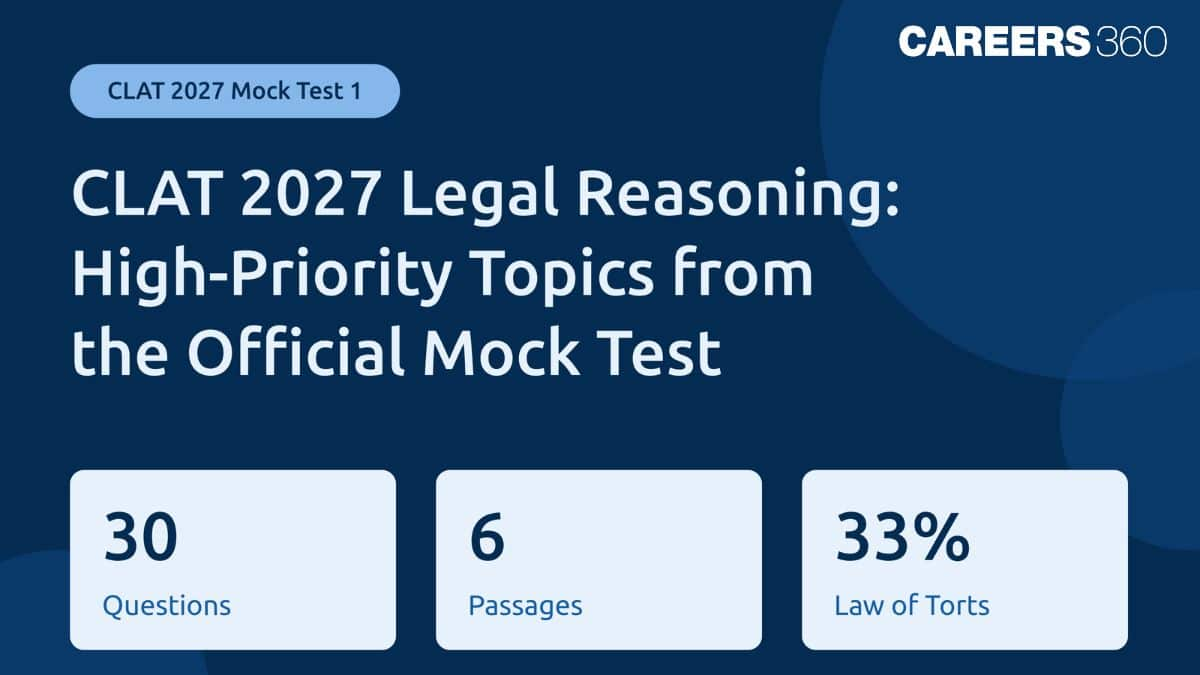
The big takeaway is that the Law of Torts alone made up about 33% of the CLAT 2027 legal reasoning. That means Negligence and Defamation deserve extra time in your revision plan. In this article, we break down the key concepts from each passage, the rules you must know, and quick exam tips to help you apply them confidently in your CLAT 2027 legal reasoning preparation.
The CLAT 2027 Legal Reasoning section of Mock Test 1 consists of 30 questions. These questions are divided into six passages, with five questions based on each passage. Here is the detailed analysis of each passage.
Passage | Topic | Subject Area | No. of Questions |
I | Writ of Mandamus | Constitutional Law/ Administrative Law | 5 |
II | Negligence | Law of Torts | 5 |
III | Offer, Acceptance and Revocation | 5 | |
IV | Defamation | Law of Torts | 5 |
V | Unfair Trade Practices / Consumer Remedies | Consumer Protection Law | 5 |
VI | Private Defence | Criminal Law (IPC/BNS) | 5 |
Total | 6 Passages | 6 Legal Topics | 30 |
Attempt Free Official Practice Test & Solutions and Ace the CLAT Exam 2026
Based on Mock Test 1 and the usual CLAT 2027 pattern, these are the areas that deserve most of your revision time.
Torts gave 10 of 30 questions (about 33%) in Mock Test 1.
Negligence: duty of care, breach, damage, reasonable man test, res ipsa loquitur, contributory negligence
Defamation: libel vs slander, publication, defences (truth, fair comment, privilege)
Also revise: strict and absolute liability (Rylands v. Fletcher, M.C. Mehta), vicarious liability, nuisance, trespass, volenti non fit injuria
Offer, acceptance and revocation
Invitation to treat vs offer
Consideration and privity of contract
Free consent: coercion, undue influence, fraud, misrepresentation, mistake
Void, voidable and illegal agreements
Breach of contract and damages
Private defence (limits and proportionality)
General exceptions: mistake, accident, insanity, necessity, consent
Mens rea and actus rea
Offences against the body: culpable homicide vs murder, hurt vs grievous hurt
Theft, extortion, robbery, dacoity, cheating, criminal breach of trust
Abetment, conspiracy and attempt
Scholars’ Round Deadline: 14th Nov’26 | Earn upto 50% merit Scholarship + 10% for top performers | EFMD Accredited | AACSB (USA) & AMDISA Member | Highest CTC 28 LPA
BA LLB, BBA LLB, or BCom LLB and LLB | LLM 1 Year – 4 Specializations | Approved by BCI | Highest CTC 9 LPA
Fundamental Rights (Articles 14, 19, 21) and the meaning of “State”
Writs (Mandamus, Habeas Corpus, Certiorari, Prohibition, Quo Warranto) and Articles 32 and 226
Directive Principles and Fundamental Duties
Separation of powers, judicial review and the basic structure doctrine
Preventive detention and arrest safeguards
Who is a “consumer”
Unfair trade practices and misleading advertisements
Three-tier forums and pecuniary jurisdiction
Remedies, product liability and the role of the CCPA
Learn each topic as a checklist of essentials, not as long notes.
Pay extra attention to exceptions and defences, because wrong options often hide there.
Practise passage-based questions and read the principle in the passage, even when it differs from the actual law.
Keep a short list of landmark cases, but spend more time on applying principles than on memorising names.
Get the CLAT UG previous year question papers here

On Question asked by student community
Hello Miruthula,
For CLAT PG 2027, you need to focus on the core subjects of your LLB curriculum, particularly the following:
Constitutional Law
Jurisprudence
Administrative Law
Law of Contract
Law of Torts
Family Law
Criminal Law
Property Law
Company Law
Public International Law
Tax Law
Environmental Law
Labour and Industrial
Hello Student,
The full form of the CLAT exam is the Common Law Admission Test. You can check the link related to the CLAT exam
https://law.careers360.com/articles/what-is-clat-full-form-all-about-nlus-entrance-exam
Hello Student,
Here are the Careers360 CLAT 2027 Mock Test Resources for your exam preparation.
1. Online CLAT Mock Test
2. CLAT Mock Tests and Solutions
Hello student,
CLAT 2027 aspirants can access these monthly current affairs compilations for regular revision. Use these resources to stay updated with important events and topics for CLAT 2027.
|
Particular |
Download PDF |
|
CLAT Current Affairs- August Month (2026) |
|
|
CLAT Current Affairs- |
If you have only two months, use a highly structured plan: daily current affairs, English reading, legal reasoning practice, logical reasoning sets, basic quantitative practice and regular full-length mocks. Spend as much time analysing incorrect questions as taking the mock itself. Consistency during these two months can make a substantial

Ranked #18 amongst Institutions in India by NIRF | Get Upto 100% Scholarships | Spot Admissions via CUET
NAAC A++ Approved | Curriculum Aligned with BCI & UGC
Scholars’ Round Deadline: 14th Nov’26 | Earn upto 50% merit Scholarship + 10% for top performers | EFMD Accredited | AACSB (USA) & AMDISA Member | Highest CTC 28 LPA
BA LLB, BBA LLB, or BCom LLB and LLB | LLM 1 Year – 4 Specializations | Approved by BCI | Highest CTC 9 LPA
Grade 'A+' Accredited by NAAC | Ranked 33rd in India by NIRF
Moot Court | Mock trials | Legal Aid Clinic | Recruiting Partners: FICCI, TCS, Adani, Trilegal, and many others