School of Law, UPES, Dehradun
Ranked #18 amongst Institutions in India by NIRF | Get Upto 100% Scholarships | Spot Admissions via CUET


Reasoning and Analytical Ability is one of the vital segments in CLAT 2027 and can fetch good marks provided the test taker has the proper method of approaching the questions. Most of the CLAT 2027 candidates score low marks not because they cannot comprehend the passage but due to carelessness while reading the questions and assuming without understanding.
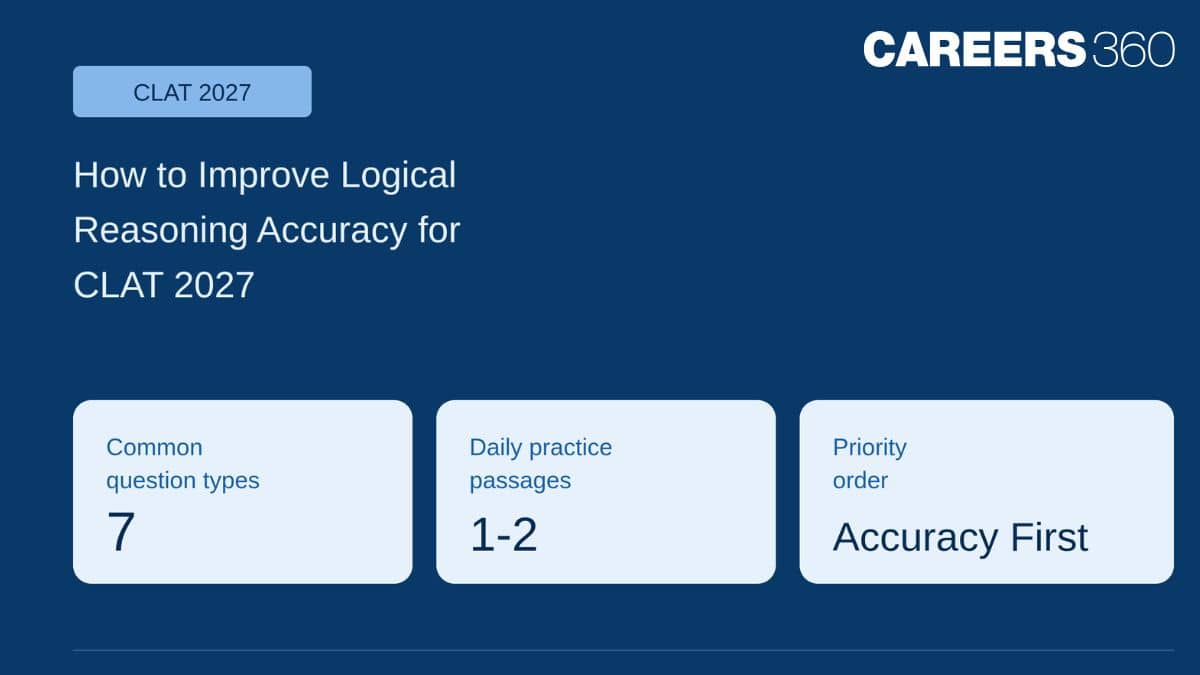
Accuracy in CLAT 2027 logical reasoning preparation does not depend on how fast you solve the questions. What is more important is to comprehend the context and choose the option that suits the passage most.
Practice and proper methodology will help you to enhance your CLAT 2027 Logical Reasoning accuracy.
In the CLAT 2027 exam pattern, wrong responses attract negative marks. Hence, being accurate is as important as being fast.
Responding to more CLAT logical reasoning questions without worrying about whether they are correct can end up lowering your score. Instead of that, you should work on accuracy first and then move on to improving speed.
Points to consider include:
Understanding the passage
Getting to the crux of the argument
Not making assumptions
Discarding the wrong choices
Effective management of time
The most frequent mistake made while answering these questions is the haste with which one goes through the passage. A CLAT Logical Reasoning passage may have several arguments, examples, and views in it.
Prior to considering the answer options, first try to grasp the structure of the passage.
Think of the following questions:
What is the primary theme of the passage?
What is the primary argument made by the author?
What evidence is provided by the author?
Is the author in favour of or against something?
What is the conclusion that can be drawn from the passage?
Ranked #18 amongst Institutions in India by NIRF | Get Upto 100% Scholarships | Spot Admissions via CUET
Scholars’ Round Deadline: 14th Nov’26 | Earn upto 50% merit Scholarship + 10% for top performers | EFMD Accredited | AACSB (USA) & AMDISA Member | Highest CTC 28 LPA
A CLAT 2027 Logical Reasoning question might require you to do various forms of reasoning. Understanding what is expected in CLAT 2027 preparation will help prevent any unnecessary confusion.
Popular question types are as follows:
Main conclusion
Strengthen the argument
Weaken the argument
Assumption
Inference
Principle-based questions
Argument application
For instance, in a strengthen question, you have to locate the evidence supporting the argument, whereas in a weaken question, you have to locate the information opposing the argument.
Identifying the question type before looking at the options can save you precious time.
The type of Logical Reasoning asked in the CLAT syllabus is usually based on passages. The answer has to be supported by the data present in the passage.
There might be occasions when students would pick an option that may seem factually correct in reality. This, however, doesn’t mean that the option is right.
Always think of the following question:
"Am I able to back up this option with the passage?"
If the answer is no, be careful about choosing it.
Also check: How to Read Court Judgments for CLAT 2027
It is not necessary for you to always find the right choice straight away. Sometimes, eliminating the wrong answers might be an easier process.
First, rule out answers which:
Contradict the passage
Have nothing to do with the passage
Make an unwarranted assumption
Go to an extreme
Change the argument's meaning
Answer a different question from the one asked
If there are only two remaining after elimination, scrutinise them with the passage.
This technique can especially help you when you cannot distinguish between two choices.
Watch out for phrases that include "always," "never," "completely," "only," "all," and "none."
When a choice includes a very absolute statement, and there is not enough information provided in the passage to support such an absolute claim, it can possibly be an incorrect choice.
But don't immediately rule out an answer choice because it has a very strong statement. Look at whether the passage backs up that statement.
Accuracy comes through practice. Rather than answering hundreds of questions randomly, practice passages and analyse your results.
A good practice pattern would be:
Solve one or two passages per day.
Allocate yourself a realistic time frame.
List the mistakes that you have made.
Find out the reason behind each mistake.
Practice difficult questions after some days.
Eventually, you will start identifying certain patterns in the questions.
Also check: 5 Common Excuses CLAT Aspirants Make (And How to Stop)
It will be very helpful for CLAT preparation to maintain a mistake notebook.
While solving any question, if you get a wrong answer, note down:
Type of question
Your answer
Right answer
Why did your answer go wrong?
What hint have you missed?
Reason behind the right answer
You should not just write the right answers. It is better to know the reason of your wrong answer.
If you make mistakes again and again in the same question types, practice those question types.
Both speed and accuracy should be considered simultaneously, but accuracy should be a priority.
In the beginning phase of preparation, pay attention to answering the questions correctly rather than concerning yourself with the time limit. Only after you achieve consistency in your accuracy, impose time constraints.
A basic approach could be:
Understanding → Practice → Analysis of errors → Accuracy → Speed
Don’t hurry with reading a passage just to meet the target time requirement.
Mock tests are crucial in determining how well you performed in the real test environment.
After each CLAT 2027 mock tests, do more than just check your score.
Review:
Incorrectly attempted questions
Questions on which you took guesses
Questions that consumed a lot of your time
Question types that had low accuracy levels
Passages you found hard to comprehend
You should also establish the reason why you made those mistakes; whether they were as a result of poor comprehension, misreading, confusion of options or carelessness.
Also check: 10 Current Affairs and GK Topics You Must Read for CLAT 2027
Some of the errors could affect the accuracy a lot.
Do not:
Rush through passages
Check options without comprehending the argument
Make a choice based on personal preferences
Use external knowledge when it is not required
Miss key words in the questions
Spend too much time on one question
Change the answer without any reason
Overlook mock test error analysis
CLAT 2027 Logical Reasoning does not like guessing!
Enhancing the efficiency of Logical Reasoning in preparation for CLAT 2027 depends on practice, reading carefully, and analysing errors made. Your progress should not only be based on the number of questions you attempt but also on how well you understand the arguments, classify the question type, eliminate wrong options and analyse errors.
Through regular practice of passages and analysis of mock tests, your accuracy will increase, and you will become quicker.
Also check: CLAT 2027 Study Plan with Class 12 Board

On Question asked by student community
Hello Student,
Here are the Careers360 CLAT 2027 Mock Test Resources for your exam preparation.
1. Online CLAT Mock Test
2. CLAT Mock Tests and Solutions
Hello student,
CLAT 2027 aspirants can access these monthly current affairs compilations for regular revision. Use these resources to stay updated with important events and topics for CLAT 2027.
|
Particular |
Download PDF |
|
CLAT Current Affairs- August Month (2026) |
|
|
CLAT Current Affairs- |
If you have only two months, use a highly structured plan: daily current affairs, English reading, legal reasoning practice, logical reasoning sets, basic quantitative practice and regular full-length mocks. Spend as much time analysing incorrect questions as taking the mock itself. Consistency during these two months can make a substantial
You can download the CLAT previous years' question papers from here:
https://law.careers360.com/articles/clat-previous-year-question-papers
https://law.careers360.com/download/clat-sample-papers-previous-years
For CLAT 2027 UG, candidates need to have passed Class 12/equivalent with at least 45% marks, or 40% for SC/ST/PwD candidates.
In your situation, having an RT in an additional subject but subsequently passing the required qualification through an improvement examination does not automatically make you ineligible. However, the important

Ranked #18 amongst Institutions in India by NIRF | Get Upto 100% Scholarships | Spot Admissions via CUET
Scholars’ Round Deadline: 14th Nov’26 | Earn upto 50% merit Scholarship + 10% for top performers | EFMD Accredited | AACSB (USA) & AMDISA Member | Highest CTC 28 LPA
Moot Court | Mock trials | Legal Aid Clinic | Recruiting Partners: FICCI, TCS, Adani, Trilegal, and many others
NAAC A+ Accredited University
BA LLB, BBA LLB, or BCom LLB and LLB | LLM 1 Year – 4 Specializations | Approved by BCI | Highest CTC 9 LPA
Grade 'A+' Accredited by NAAC | Ranked 33rd in India by NIRF