School of Law, UPES, Dehradun
Ranked #18 amongst Institutions in India by NIRF | Get Upto 100% Scholarships | Spot Admissions via CUET


Critical Reasoning and Analytical Reasoning are two topics that CLAT 2027 aspirants encounter while preparing for the CLAT 2027 exam. Since both require reading and comprehending information followed by answering a question related to the passage, aspirants tend to confuse them, thinking that they are more or less the same topics. But in reality, there exists a significant distinction between Critical Reasoning and Analytical Reasoning in the CLAT 2027 logical reasoning section.
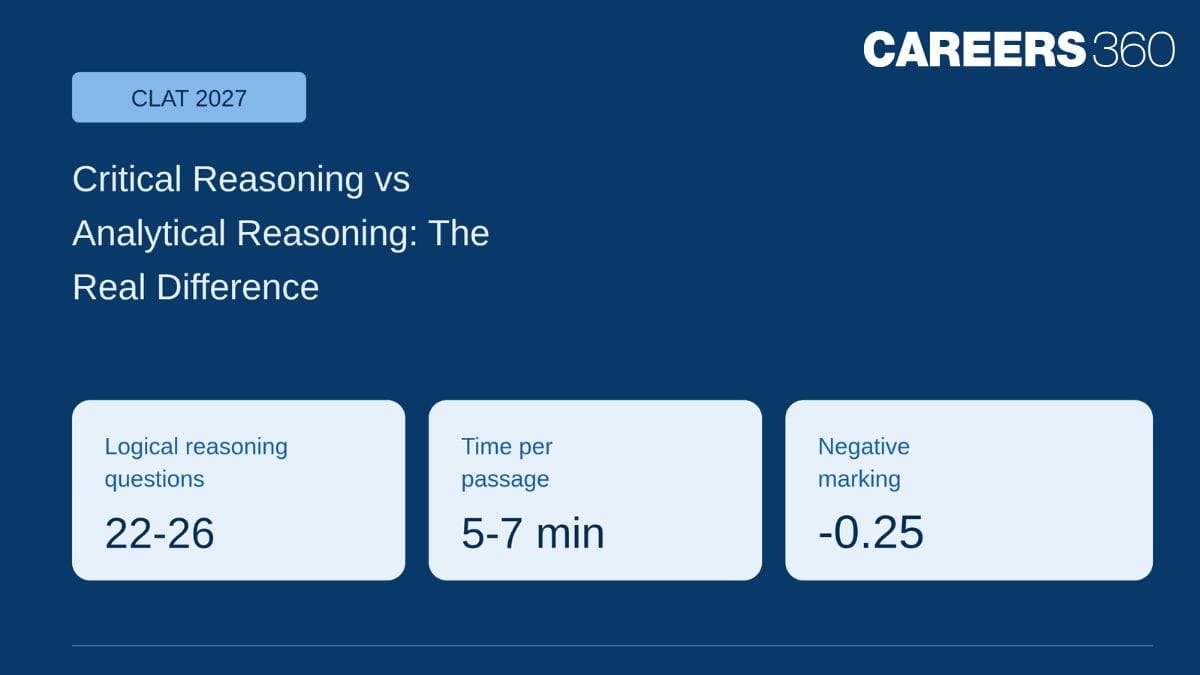
While Critical Reasoning in CLAT 2027 focuses on testing a candidate’s ability to analyse an argument, detect its assumptions and conclusions, and check if any statement supports or undermines the argument, Analytical Reasoning is a broad concept, encompassing comprehension of written information, interpretation of relations between different ideas, and CLAT logical reasoning through words.
The distinction between Critical Reasoning vs Analytical Reasoning in CLAT 2027 will help candidates select a proper CLAT 2027 preparation method and not follow the same technique in solving every reasoning problem. In this article, we will discuss their differences, question types, required skills, and methods of CLAT reasoning preparation.
Ranked #18 amongst Institutions in India by NIRF | Get Upto 100% Scholarships | Spot Admissions via CUET
Scholars’ Round Deadline: 14th Nov’26 | Earn upto 50% merit Scholarship + 10% for top performers | EFMD Accredited | AACSB (USA) & AMDISA Member | Highest CTC 28 LPA
The CLAT Logical Reasoning paper is based on the ability to think analytically, which is something that is required of law students studying in law schools. Law students must be able to understand an argument, comprehend the premise and conclusion of the argument, find flaws in the reasoning process and come up with a logical opinion.
CLAT 2027 Logical Reasoning covers most of these aspects through passage-type questions in the CLAT 2027 syllabus. Instead of rote learning, it requires the candidate to read and reason about a situation logically within the CLAT 2027 time management.
Given below is the detailed overview of the CLAT 2027 Logical Reasoning Section:
Peremeters | Details |
Total Questions | 22 - 26 |
Question Format | Short Passages about 450 words followed by one or more questions. |
Sections Distribution |
|
Critical Reasoning | Understanding and evaluating arguments, identifying assumptions and inferences, analysing cause-and-effect relationships, strengthening or weakening arguments, and resolving logical contradictions. |
Analytical Reasoning | Questions based on blood relations, directions, syllogisms, coding-decoding, seating arrangements, calendars and clocks. |
Marks |
|
Recommended Time | 5-7 mins for each passage question |
Difficulty | Differs from passage to passage based on the difficulty level of the reasoning required |
Critical Reasoning is the skill of analysing an argument using logical skills instead of just comprehending the meaning of the author's writing. In Critical Reasoning questions, the candidate is usually provided with a passage that contains some facts, opinions, arguments, or conclusions.
Now the candidate is expected to analyse how the argument has been presented and attempt an answer to the questions that follow based on it.
Some of the skills tested through CLAT Critical Reasoning questions could be:
Identification of the main argument
Determining the conclusion of the argument
Identifying assumptions
Strengthening an argument
Weakening an argument
Drawing inferences
Identifying errors in reasoning
Understanding causal relationship
Evaluation of the arguments
For example, if the passage presents an argument that the introduction of some policy will solve traffic problems in a city. Instead of merely asking about the contents of the passage, the Critical Reasoning question would ask about what further information could be added to strengthen or weaken the argument.
Hence, the candidate needs to analyse the argument presented by the author of the passage.
Practice is the key to improving critical reasoning skills rather than mere cramming. Students must know how to dissect each argument. Here are the key preparation tips and know how to score 25+ in CLAT 2027 Logical Reasoning.
When going through an argument, students must know how to determine the following:
What is the author trying to establish?
What has been given as evidence?
What assumption is linking the evidence and the conclusion?
What might be an alternative to the given explanation?
What additional facts would make the argument stronger/ weaker?
Students can improve their understanding of the above concepts by practising CLAT previous year question papers and logical reasoning based on passages.
Incorrect responses should also be analysed by the candidates. It is always more useful than just marking the right response.
Passages consist of several entities (persons, objects, or positions) and several constraints on their organisation or characteristics. In questions, you are required to decide which arrangements are possible or inevitable. This involves a methodical approach to solving constraints using matrices or grids.
In the CLAT 2027 logical reasoning questions, Analytical Reasoning Questions are based on blood relations, directions, syllogisms, coding-decoding, seating arrangements, calendars and clocks.
Types of Questions Asked in CLAT 2027 Analytical Reasoning:
Linear Seating Arrangement
Circular Arrangement
Blood Relations
Scheduling/Ordering
Grid Puzzles
Direction/Distance
CLAT exam Analytical Reasoning proficiency can only be attained through practice. Students need to learn to understand the data given and apply the right logic, rather than shortcut tricks.
While answering a problem, students should ask themselves:
What is the information given in the problem?
What conditions/rules should be followed?
What is the connection between people, things or statements?
Can the given information be organised in the form of a table, order or figure?
What can be eliminated from the given options?
Does the final answer satisfy all the conditions in the problem?
These skills can be developed by practising previous year CLAT question papers, sample questions and logical reasoning exercises regularly. Simple questions. Complex questions.
Also check: Last Year CLAT Question Paper
The main difference between Critical Reasoning and Analytical Reasoning is that in Critical Reasoning you are asked to analyse an argument carefully and determine whether the argument is well-reasoned and logical. But in CLAT 2027 Analytical Reasoning, you have to solve a logic problem by applying given facts and conditions.
Critical Reasoning | Analytical Reasoning |
|
|
Also check: CLAT Sample Question Paper
One of the essential aspects of CLAT Logical Reasoning test preparation is the understanding of the various kinds of Critical Reasoning questions.
Questions Strengthening the Argument: Here, candidates are expected to choose the option that strengthens the author's argument or conclusion.
Questions Weakening the Argument: The candidates have to find something that weakens the argument, lowers its credibility or gives an alternative explanation.
Questions Based on Assumption: An assumption is an unstated belief that is necessary for the argument to hold. Here, candidates are expected to identify the unspoken link between the premises and the conclusion.
Questions of Inference: Questions based on inference require the candidates to infer what could logically be drawn out of the premises presented in the passage.
Questions about Conclusion: Candidates might be required to identify the conclusion that logically flows from the argument or the argument itself.
Such questions make Critical Reasoning a highly analytical exercise compared to mere reading of the passage.
Also check: How To Solve CLAT 2027 Legal Reasoning Passages Faster
A frequent mistake made by CLAT 2027 aspirants is opting for an answer because it seems to make logical sense in real-life situations. Usually, questions related to CLAT reasoning should be solved using the facts and logic that are present in the passage itself. CLAT 2027 aspirants should analyse the CLAT: last 5 years question paper trends to know the question type.
Another mistake is the confusion between assumption and inference. An assumption is what the argument is based on but is not explicitly stated, while an inference can be made logically based on the facts present.
The students should be cautious about the selection of answers that are extremely high or low, especially those that contain words like “always”, “never” or “completely”.
Lastly, reading the passage in haste will lead to missing out on words like “not”, “except”, “most likely” or “least likely”.
Also check: CLAT 2027 Model Paper
The significance of Critical Reasoning and Analytical Reasoning in cultivating logical reasoning is very significant, yet there are differences between them that must be understood by the test-takers. The former relates to comprehending and analysing the argumentation, while the latter pertains to employing facts, premises and relationships for solving a problem.
For CLAT 2027 aspirants, practice is very important, along with an attempt to understand the logic behind each question type. Solving past year questions, practising CLAT mock tests and learning from one’s mistakes are some ways of improving oneself.

On Question asked by student community
Hello Student,
Here are the Careers360 CLAT 2027 Mock Test Resources for your exam preparation.
1. Online CLAT Mock Test
2. CLAT Mock Tests and Solutions
Hello student,
CLAT 2027 aspirants can access these monthly current affairs compilations for regular revision. Use these resources to stay updated with important events and topics for CLAT 2027.
|
Particular |
Download PDF |
|
CLAT Current Affairs- August Month (2026) |
|
|
CLAT Current Affairs- |
If you have only two months, use a highly structured plan: daily current affairs, English reading, legal reasoning practice, logical reasoning sets, basic quantitative practice and regular full-length mocks. Spend as much time analysing incorrect questions as taking the mock itself. Consistency during these two months can make a substantial
You can download the CLAT previous years' question papers from here:
https://law.careers360.com/articles/clat-previous-year-question-papers
https://law.careers360.com/download/clat-sample-papers-previous-years
For CLAT 2027 UG, candidates need to have passed Class 12/equivalent with at least 45% marks, or 40% for SC/ST/PwD candidates.
In your situation, having an RT in an additional subject but subsequently passing the required qualification through an improvement examination does not automatically make you ineligible. However, the important

Ranked #18 amongst Institutions in India by NIRF | Get Upto 100% Scholarships | Spot Admissions via CUET
Scholars’ Round Deadline: 14th Nov’26 | Earn upto 50% merit Scholarship + 10% for top performers | EFMD Accredited | AACSB (USA) & AMDISA Member | Highest CTC 28 LPA
Moot Court | Mock trials | Legal Aid Clinic | Recruiting Partners: FICCI, TCS, Adani, Trilegal, and many others
NAAC A+ Accredited University
Law Admissions 2026 Open | Avail Merit-Based Scholarships
NAAC A++ Accredited | Ranked #11 by NIRF