School of Law, UPES, Dehradun
Ranked #18 amongst Institutions in India by NIRF | Get Upto 100% Scholarships | Spot Admissions via CUET


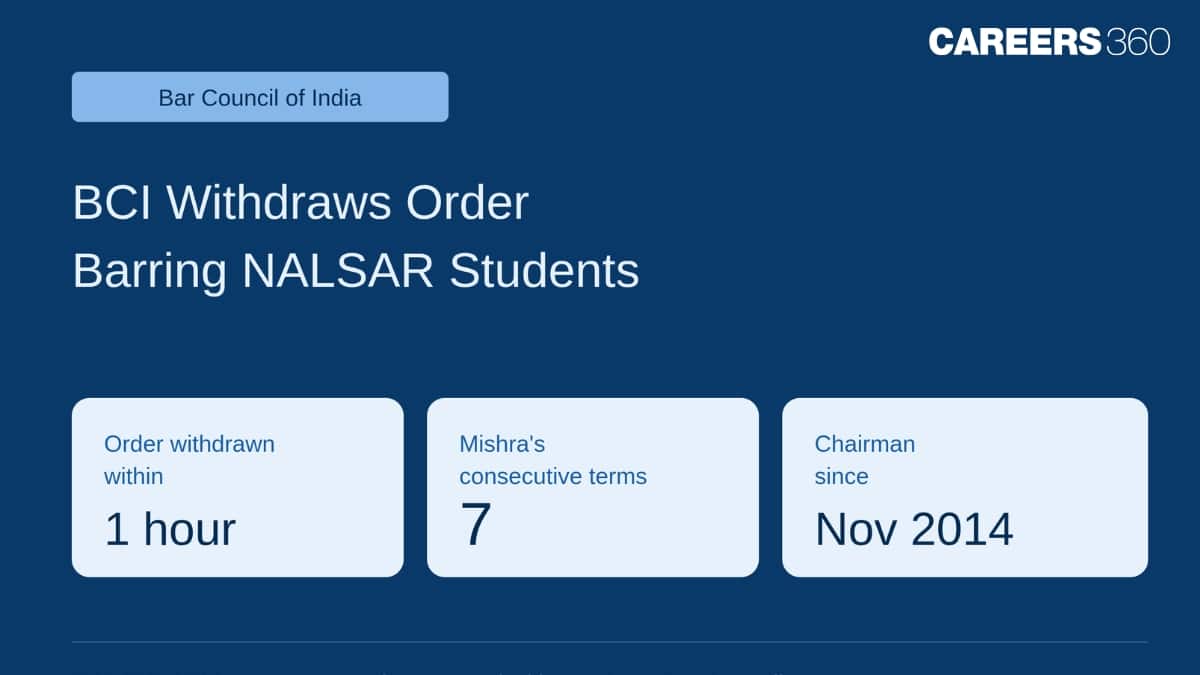
Manan Kumar Mishra, the Bar Council of India’s Chairman for the last seven consecutive terms, has been in the headlines amid the NALSAR University’s convocation ceremony. Mishra passed an order barring NALSAR students from BCI enrollment and immediately withdrew it within an hour as the legal community and activists erupted in opposition. While the BCI’s own constitution says the chairman's term lasts for two years, Mishra has held the post since November 2014 through consecutive re-elections. Previously, he also headed the BCI from April 2012 to April 2014. In 2025, Mishra was elected unopposed and will hold office till 2027. Along with this, Mishra is also a Member of Parliament in the Rajya Sabha from Bihar. He was nominated to the Rajya Sabha by the Bharatiya Janata Party in August 2012.
The Bar Council of India is a statutory body established under the Advocates Act, 1961. The BCI is the apex regulator of legal education and profession in the country. It approves law colleges and universities imparting legal education and lays down standards of education. The BCI also conducts the All India Bar Examination (AIBE), a mandatory qualifying exam for every LLB graduate to become an advocate.
Composition:
BCI comprises members elected from each State Bar Council, the Attorney General of India, and the Solicitor General of India, who is an ex-officio member.
Members of the State Bar Councils are elected for a term of five years. The Council elects its own Chairman and Vice-Chairman for a period of two years from among its members. The BCI Chairman is elected at a meeting of the Council. If the Vice-Chairman is not a candidate, he presides over the Chairman election meeting. In case of the absence of the VC, the members elect one of themselves to preside over the meeting. Below is the step-by-step process of how a BCI Chairman is elected.
Nomination of Candidates: To be a Chairman candidate, the name should be proposed by one bar member and seconded by another member at the same meeting. No member can propose or second more than one candidate.
Uncontested Elections: In case only one member is duly nominated, and there is no other proposed candidate, he/she is directly declared elected by the presiding officer.
Contested Elections: In case there is more than one nomination, the chairman election is held through a secret ballot. The Secretary of BCI prepares the voting papers, listing out all the nominated candidates. Each voting paper must have the signature of the secretary to be deemed authentic and valid. Voting members must mark ‘X’ against the name of their chosen candidate.
Counting of Votes: The Secretary counts the votes immediately after the voting process concludes. The results are declared immediately after counting is finished. In case two or more candidates secure the same number of votes, the presiding Chairman of the meeting decides the result by drawing lots.
Ranked #18 amongst Institutions in India by NIRF | Get Upto 100% Scholarships | Spot Admissions via CUET
Scholars’ Round Deadline: 14th Nov’26 | Earn upto 50% merit Scholarship + 10% for top performers | EFMD Accredited | AACSB (USA) & AMDISA Member | Highest CTC 28 LPA
A BCI chairman can be removed from the post through a “No Confidence” motion. The no-confidence motion is subject to strict conditions. To remove a chairman through a no-confidence motion, it must be passed by not less than 3/4th of the members present and voting, and that majority must also constitute more than 2/3rd of the total membership of the Council. Such a meeting can only be convened after a prior one month’s notice. The chairman of BCI still holds the right to vote, speak and take part in the meeting. The chairman ceases to hold office forthwith if the motion is passed with the given conditions.
Manan Kumar Mishra became the BCI chairman for his first term on April 17, 2012. His first tenure lasted for two years till April 16, 2014. He was succeeded by Biri Singh Sinsanwar, who took office on April 17, 2014. However, within less than seven months, Sinsanwar voluntarily resigned from his post on November 9, 2014. He was immediately re-elected unopposed on the same day as the BCI chairman for the second time. Manan Kumar Mishra has held the post to date as there is no limit on the maximum number of terms.
Following the objection of some students against CJI Surya Kant being invited as the chief guest at the NALSAR Hyderabad 2026 convocation, Mishra wrote a letter barring all NALSAR 2026 passouts from being enrolled at any of the state bar councils in India. He further ordered an inquiry into students involved in mobilising resentment against the CJI being invited as the chief guest at the convocation. The letter drew massive resentment and backlash on social media and was withdrawn one hour later.
The BCI published an official circular regarding the withdrawal, and Mishra posted on X that after detailed deliberation, the BCI has modified its earlier directions. All 2026 passed-out students of NALSAR will now be entitled to seek enrolment with the State Bar Council of their choice. The factual inquiry will continue, and further action will follow based on the report. No student shall be made to suffer without any fault on his or her part. Later, after further uproar, Mishra also clarified that no enquiry will be initiated against the students of NALSAR Hyderabad.

On Question asked by student community
Hello Student,
You can access the AIBE previous year question papers in Hindi by clicking on the relevant link given below.
https://law.careers360.com/hi/articles/aibe-previous-year-question-papers
Hey there,
No. If you are currently in the 5th semester of a 3-year LL.B., you generally cannot register for AIBE yet.
Under the current BCI rules, a 3-year LL.B. student must be in the final semester (6th semester) and have no backlogs from previous semesters to register for AIBE.
Hello Dear Student,
The All India Bar Examination (AIBE) covers 19 major legal subjects, carrying a high-weightage focus on Constitutional Law (8–12 questions) and Family Law including Hindu and Muslim law (6–8 questions)
You can check, find and access more information here:
Hello Dear Student,
Could you provide more information so that i could help you further!
Hello Venkataharanadh
Please check the link given below for the answer key:
https://law.careers360.com/articles/aibe-answer-key
Hope it helps.

Ranked #18 amongst Institutions in India by NIRF | Get Upto 100% Scholarships | Spot Admissions via CUET
Scholars’ Round Deadline: 14th Nov’26 | Earn upto 50% merit Scholarship + 10% for top performers | EFMD Accredited | AACSB (USA) & AMDISA Member | Highest CTC 28 LPA
Moot Court | Mock trials | Legal Aid Clinic | Recruiting Partners: FICCI, TCS, Adani, Trilegal, and many others
Law Admissions 2026 Open | Avail Merit-Based Scholarships
NAAC A++ Accredited | Ranked #11 by NIRF
Law Admissions Open 2026 | #2nd in India by The World University Rankings for Innovation | 200+ Collaborations | 700+ Industry Recruiters