
Search Colleges, Exams, Schools & more


Login
Why Do Nearly Half of LLB Graduates Fail AIBE?

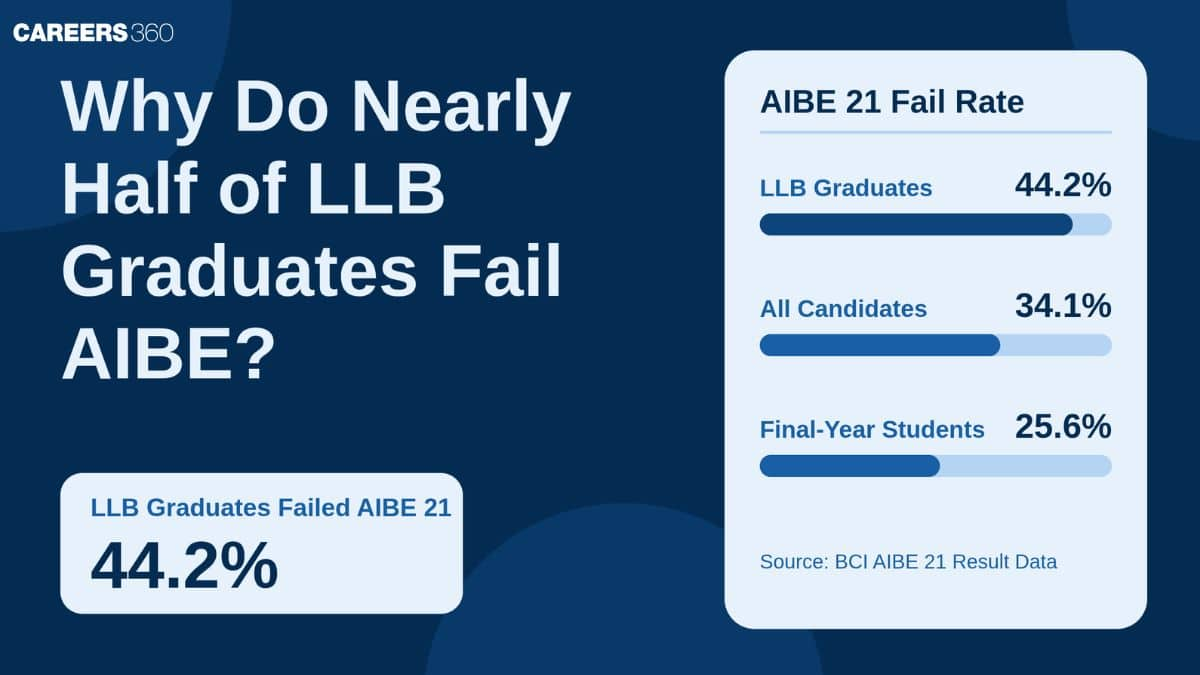
The All India Bar Examination (AIBE) is a qualifying exam, yet 34% of all candidates and 44.2% of LLB graduates failed the 21st AIBE conducted by the Bar Council of India (BCI). 33.1% of all enrolled LLB graduates failed the AIBE 20. Overall, nearly 30-34% of candidates, including both LLB graduates and final-year students, failed in recent AIBE exams. The high failure rate in AIBE is particularly concerning, because it is designed to test basic legal proficiency and suitability for practising law in Indian courts. In a broader context, such failure rate puts a question mark on the quality of law graduates.
AIBE 22 is on November 29. Over a lakh students will appear in the exam; many of them will be repeat takers who failed in the previous exams.
Why Do Nearly Half of LLB Graduates Fail AIBE?
Ankita Yadav, who completed her LLB from CSJMU University, Kanpur and appeared in AIBE in 2025, says the widespread perception of AIBE is that it is an easy exam, and law graduates don't even prepare for it.
Yadav explains that many LLB graduates fail to keep up with landmark judgments or developments in law. Although they study law during LLB as a mandatory part of the curriculum, they lose touch after graduation.
AIBE - Previous Year Question Papers
Get the AIBE previous year question papers here
- Free PDF
- Detailed Solutions
- Instant Access
Is AIBE really difficult to clear?
The BCI says the exam is conducted to assess basic-level knowledge and lay down a minimum benchmark for entering into the practice of law, in addition to assessing candidates' analytical skills.
On the question of difficulty level, Akhiya Tiwari, who cleared AIBE 21, says her question paper was moderately difficult. But since it is a qualifying exam, there are enough easy questions for you to answer to clear the exam.
Akhiya is a recent LLB graduate. She went through bare acts, read important case laws, and prepared for only a week. Still, she scored 76 out of 100. She had the advantage of being a fresh graduate.
Many LLB graduates appear in AIBE several years after completing their LLB and have lost touch with the subjects by then. Moreover, everyone says that the paper is easy; they don't prepare for it, Akhiya adds.
Many LLB graduates take AIBE only when they need to obtain a Certificate of Practice (CoP) from the BCI, and often they have to prepare from scratch. To some extent, this explains why LLB graduates have a higher failure rate than those taking the AIBE during their final year. In contrast to LLB graduates’ high failure rates ranging from 33% to 44%, final-year LLB candidates have around a 25% failure rate.
AIBE 20 Results: Final-Year vs. Graduates
Group | Appeared | Not qualified | Fail rate | Pass rate |
Final-year (undertaking) | 79,039 | 20,377 | 25.8% | 74.2% |
LLB graduates (enrolled) | 172,929 | 57,202 | 33.1% | 66.9% |
Total | 251,968 | 77,579 | 30.8% | 69.2% |
AIBE 21 Results: Final Year vs Graduates
Group | Appeared | Qualified | Not qualified | Pass rate | Fail rate |
Final-year (undertaking) | 95,962 | 71,353 | 24,605 | 74.4% | 25.6% |
LLB graduates (enrolled) | 79,739 | 44,452 | 35,271 | 55.7% | 44.2% |
Total | 175,701 | 115,805. | 59,876 | 65.9% | 34.1% |
AIBE 22 Preparation
AIBE 22 Sample Paper
Download the Free AIBE 22 Sample Paper with Answer Key and Ace the All India Bar Examination
What is Minimum Passing Score in AIBE?
AIBE is a qualifying exam. There is no competition among candidates. The BCI has set a minimum benchmark for all. General and OBC category candidates are required to secure at least 45% marks. SC and ST category candidates are required to secure at least 40% marks.
The paper pattern and topic-wise weightage are stable, and the question paper revolves around 19 topics suggested by the BCI. Many questions, facts, case laws and judgments repeat year after year, often framed with different contexts and wordings. A significant portion of the question paper falls in identifiable lines and can be prepared from previous year papers.
A Careers360 analysis of the last four years' AIBE question papers shows that direct fact and concept-based questions dominate; on average, they accounted for 44% of the questions. Case scenarios and questions based on articles and sections are another dominant section, making up around 26.8% of the question paper. A strong grasp of these three sections can help the candidates clear the AIBE exam.
Question type | AIBE 18 | AIBE 19 | AIBE 20 | AIBE 21 | Total | % of all |
Direct fact / concept | 48 | 30 | 51 | 47 | 176 | 44.0% |
Scenario / applied problem | 7 | 27 | 6 | 19 | 59 | 14.8% |
Section / Article number | 11 | 26 | 7 | 4 | 48 | 12.0% |
Negative (NOT / incorrect) | 20 | 4 | 2 | 9 | 35 | 8.8% |
Case law | 11 | 4 | 6 | 7 | 28 | 7.0% |
Multi-statement (I-IV) | 3 | 5 | 7 | 3 | 18 | 4.5% |
Assertion–Reason | 0 | 1 | 7 | 5 | 13 | 3.3% |
Two statements (true/false) | 0 | 2 | 7 | 3 | 12 | 3.0% |
Statement–Conclusions | 0 | 0 | 5 | 3 | 8 | 2.0% |
Match the following | 0 | 1 | 2 | 0 | 3 | 0.8% |
TOTAL | 100 | 100 | 100 | 100 | 400 | 100.0% |
For candidates appearing in AIBE 22, the message from those who cleared the exam is clear: the exam is easy to clear, but it punishes complacency. During the last few days, focused preparation can make a difference. Analysing previous-year question papers and spotting the most repeated questions and high-weightage topics, such as constitutional law, family law, and new criminal laws, can help clear the exam. It is also important to compare the old criminal laws with BNS, BNSS and BSA. While bare Acts are allowed in the exam hall, not understanding them can lead to poor time management. AIBE rewards honest preparation, and those who assume the exam is easy are the ones most likely to be back for the next edition.
Articles
Related Stories
|
Upcoming Law Exams

Certifications By Top Providers
Explore Top Universities Across Globe
Popular Courses and Specializations
Questions related to AIBE
On Question asked by student community
Have a question related to AIBE ?
Hello student!
AIBE question papers in Kannada medium are not explicitly available. Meanwhile, you can check these resources for AIBE previous-year question papers and the AIBE 21 (2026) Set A and Set B papers for practice.
AIBE Previous-Year Question Papers:
https://law.careers360.com/articles/aibe-previous-year-question-papers
AIBE 21 Set B Question Paper 2026:
https://law.careers360.com/articles/aibe-21-set-b-question-paper-pdf-2026
AIBE
Hello Student,
You can check the relevant article below
https://law.careers360.com/download/ebooks/aibe-preparation-guide
Hope it helps!
Hello Student,
You can access the AIBE previous year question papers in Hindi by clicking on the relevant link given below.
https://law.careers360.com/hi/articles/aibe-previous-year-question-papers
Hey there,
No. If you are currently in the 5th semester of a 3-year LL.B., you generally cannot register for AIBE yet.
Under the current BCI rules, a 3-year LL.B. student must be in the final semester (6th semester) and have no backlogs from previous semesters to register for AIBE.
Hello Dear Student,
The All India Bar Examination (AIBE) covers 19 major legal subjects, carrying a high-weightage focus on Constitutional Law (8–12 questions) and Family Law including Hindu and Muslim law (6–8 questions)
You can check, find and access more information here:
-
https://law.careers360.com/articles/aibe-important-topics
Hope it helps!

Applications for Admissions are open.
Experiential Learning through Legal Aid Camps, Lok Adalats, Court Visits, Community Lawyering and regular Moot Court sessions
School of Law, UPES, Dehradun
ApplyRanked #18 amongst Institutions in India by NIRF | Get Upto 100% Scholarships | Spot Admissions via CUET
Manav Rachna University, Faridabad
ApplyNAAC A++ Accredited | Avail up to 100% scholarship via MRNAT-Manav Rachna National Aptitude Test
School of Law, Jain University, Bangalore
ApplyNAAC A++ Approved | Curriculum Aligned with BCI & UGC
Woxsen University, Hyderabad
ApplyUG Scholar's Round Deadline: 1st Dec'26 | Earn upto 50% merit Scholarship + 10% for top performers | Highest CTC 18 LPA
Institute of Law, Nirma University, Ahmedabad
ApplyGrade 'A+' Accredited by NAAC | Ranked 33rd in India by NIRF
AIBE Notifications
Never miss AIBE update
Get timely AIBE updates directly to your inbox. Stay informed!