
Search Colleges, Exams, Schools & more


Login
Will Gyanesh Kumar Resign? What the Law Says About CEC Removal | CLAT 2027 Current Affairs
Opposition parties and student groups are demanding Chief Election Commissioner Gyanesh Kumar’s resignation over the Election Commission of India’s (ECI) special intensive revision of electoral rolls. However, there is no announcement, as of October 12, of Kumar’s intention to resign. His removal is governed by Article 324(5) of the Constitution, which sets out specific grounds and a parliamentary procedure. For CLAT 2027 aspirants, the issue is important for constitutional law and legal current affairs.
Why are protests demanding Gyanesh Kumar's resignation?
The protests are linked to the ECI's special intensive revision (SIR) of electoral rolls, with opposition parties raising concerns over the deletion of eligible voters' names.
On October 6, INDIA bloc MPs marched towards the ECI office. Congress leader Rahul Gandhi said the protests would continue until the CEC resigned.
On October 10, Cockroach Janta Party (CJP) founder Abhijeet Dipke and members Saurav Das and Ashutosh Ranka were detained ahead of a planned march to Jantar Mantar. Police had denied permission for the protest. The three were released on October 11 after furnishing a Rs 50,000 surety bond.
The Supreme Court held a special hearing on October 11 and directed authorities to prevent unlawful detentions and ensure free movement, subject to law and public order. Meanwhile, the BJP and its allies criticised the protests, while the opposition continued to demand the CEC's resignation.
Can the Chief Election Commissioner be removed?
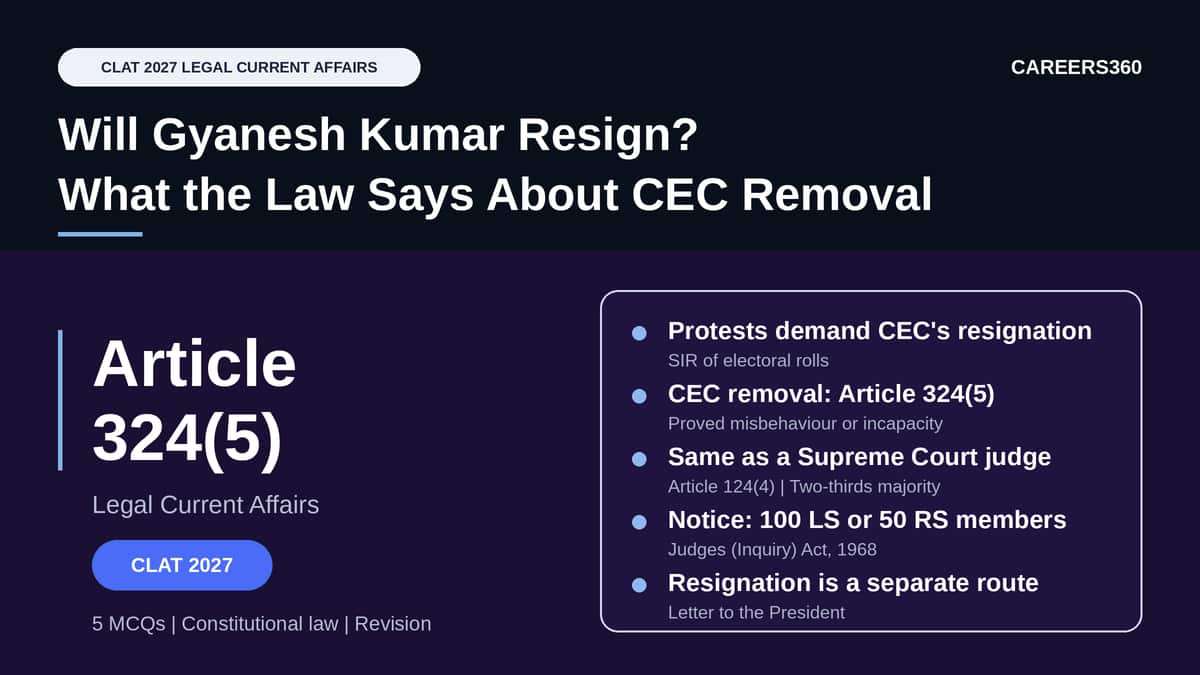
Yes. The Constitution gives the CEC protection against removal through an ordinary executive decision. Under Article 324(5), the CEC can be removed only in the same manner and on the same grounds as a Supreme Court judge: proved misbehaviour or incapacity. Public protests or disagreement with the CEC's decisions are not, by themselves, grounds for removal.
The Constitution also protects the CEC's service conditions from being changed to his disadvantage after appointment. Other Election Commissioners and Regional Commissioners cannot be removed except on the CEC's recommendation.
What is the procedure for CEC removal?
Under the Judges (Inquiry) Act, 1968, a removal motion must be signed by at least 100 Lok Sabha members or 50 Rajya Sabha members. The Speaker or Chairman can admit or reject it. If admitted, a three-member committee investigates the charges.
For removal, each House (the Lok Sabha and the Rajya Sabha) must then pass the removal address by a majority of its total membership and a two-thirds majority of members present and voting, in the same session.
This makes removal a demanding constitutional process. Even if a motion is initiated, it cannot result in removal without the required inquiry and parliamentary majorities.
Can Gyanesh Kumar resign voluntarily?
Yes. Resignation and removal are two different processes. The CEC can resign by writing to the President. A resignation does not require Parliament to pass a removal motion or establish misbehaviour or incapacity.
The Constitution does not require the CEC to resign because of public protests or political demands. Whether Kumar chooses to step down is a separate question from whether Parliament can remove him under Article 324(5).
CLAT 2027 Legal Current Affairs: MCQs
Q1. Under which constitutional provision can the Chief Election Commissioner be removed only in the same manner and on the same grounds as a Supreme Court judge?
A. Article 124(4)
B. Article 324(5)
C. Article 326
D. Article 329
Answer: B. Article 324(5)
Q2. What majority is required in each House of Parliament for the removal of a Supreme Court judge?
A. A simple majority of members present and voting
B. A majority of total membership and a two-thirds majority of members present and voting
C. A three-fourths majority of total membership
D. A two-thirds majority of total membership only
Answer: B. A majority of total membership and a two-thirds majority of members present and voting
Q3. Under the Judges (Inquiry) Act, 1968, how many Lok Sabha members must sign a notice for a removal motion?
A. 50
B. 75
C. 100
D. 150
Answer: C. 100
Q4. Which of the following is a constitutional ground for removing the CEC?
A. Public criticism
B. Loss of political support
C. Proved misbehaviour or incapacity
D. A demand by opposition parties
Answer: C. Proved misbehaviour or incapacity
Q5. Which provision protects the CEC and other Election Commissioners in relation to acts done in the discharge of official duties under the 2023 Act?
A. Section 6
B. Section 11
C. Section 16
D. Section 21
Answer: C. Section 16
Articles
Related Stories
|
Certifications By Top Providers
Explore Top Universities Across Globe
Popular Courses and Specializations
Popular Degrees
List of colleges accepting CLAT

Browse Law Colleges by State
Questions related to CLAT
On Question asked by student community
Have a question related to CLAT ?
Hello Student,
Here are the Careers360 CLAT 2027 Mock Test Resources for your exam preparation.
1. Online CLAT Mock Test
2. CLAT Mock Tests and Solutions
Hello student,
CLAT 2027 aspirants can access these monthly current affairs compilations for regular revision. Use these resources to stay updated with important events and topics for CLAT 2027.
CLAT 2027 Current Affairs - Monthly Compilations
|
Particular |
Download PDF |
|
CLAT Current Affairs- August Month (2026) |
|
|
CLAT Current Affairs- |
If you have only two months, use a highly structured plan: daily current affairs, English reading, legal reasoning practice, logical reasoning sets, basic quantitative practice and regular full-length mocks. Spend as much time analysing incorrect questions as taking the mock itself. Consistency during these two months can make a substantial
You can download the CLAT previous years' question papers from here:
https://law.careers360.com/articles/clat-previous-year-question-papers
https://law.careers360.com/download/clat-sample-papers-previous-years
For CLAT 2027 UG, candidates need to have passed Class 12/equivalent with at least 45% marks, or 40% for SC/ST/PwD candidates.
In your situation, having an RT in an additional subject but subsequently passing the required qualification through an improvement examination does not automatically make you ineligible. However, the important

Start a career in Law. Admissions Open for LLB courses for
Ranked #18 amongst Institutions in India by NIRF | Get Upto 100% Scholarships | Spot Admissions via CUET
ICFAI-LAW School BA-LLB / BBA-LLB Admissions 2026
ApplyRanked 1 st among Top Law Schools of super Excellence in India - GHRDC | NAAC A+ Accredited | #36 by NIRF
SRM University, Chennai Law UG 2026
ApplyNAAC A++ Accredited | Ranked #11 by NIRF
ICFAI University,Dehradun-Law Admissions 2026
ApplyBar Council of India (BCI) approved | Accredited by LAWASIA | Ranked 13th , among the Best Law Colleges (Private) in India by IIRF
CLAT English Language Mock Tests
ApplyFree Ebook - CLAT 2025 English Language questions with detailed solutions
CLAT Current Affairs with GK Mock Tests
ApplyStay updated with current affairs & check your preparation with the CLAT General Knowledge Mock Tests Ebook
CLAT Notifications
Never miss CLAT update
Get timely CLAT updates directly to your inbox. Stay informed!