
Search Colleges, Exams, Schools & more


Login
AIBE 21 Question Paper PDF: All 17 Questions Asked in Constitutional Law With Answers

Constitutional Law makes up roughly 10% of the AIBE question paper, making it the highest-weightage topic. AIBE 22 is on November 29. It will again feature many questions on Constitutional Law. Many topics in AIBE repeat year after year, often with slight changes in the way they are framed. Therefore, candidates preparing for AIBE 22 must study Constitutional Law from previous years. AIBE 21 question paper has around 17 questions directly or indirectly linked to Constitutional Law. This is significantly more than what the syllabus states. This article provides a comprehensive analysis of the Constitutional Law questions asked in last year's AIBE, along with a PDF containing questions and answers.
Direct link to download AIBE Constitutional Law Questions
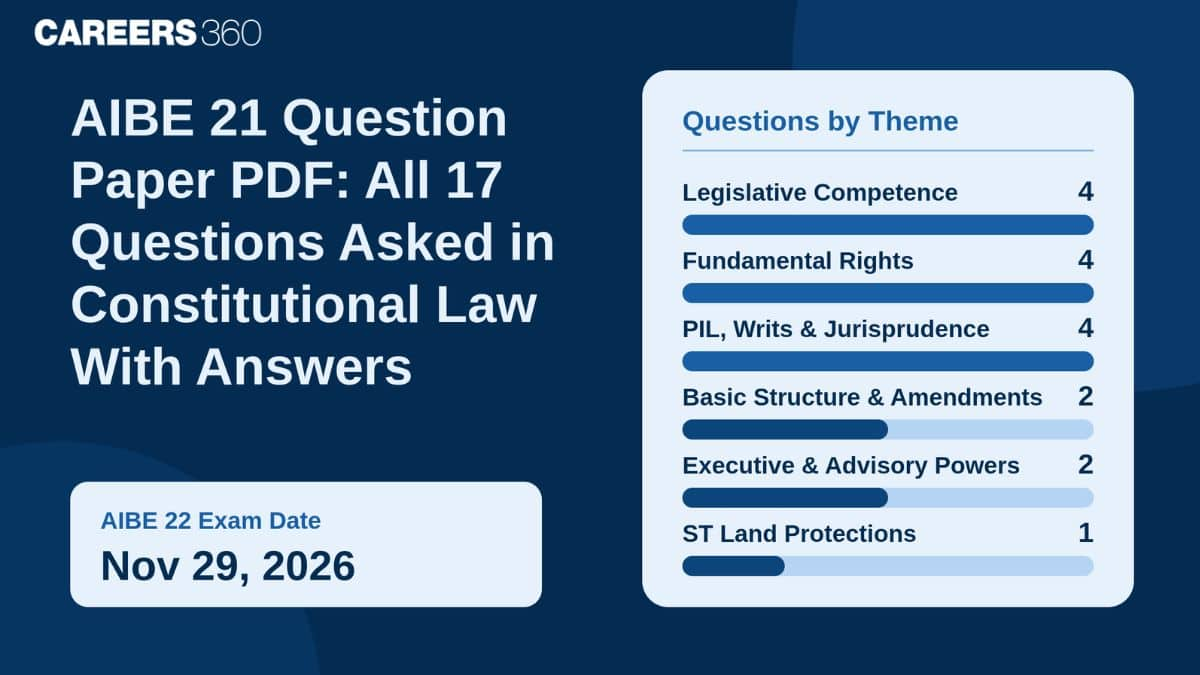
The AIBE 21 question paper on Constitutional Law focused on legislative concepts, fundamental rights, PIL, the Basic Structure of the Constitution, amendments, and case laws. 12 out of 17 questions were based on Legislative competence and federalism; rights, PIL, writ, and jurisprudence.
AIBE Constitutional Law Questions - Theme
Theme | Total number of questions |
Legislative competence and federalism | 4 |
Fundamental rights (Arts. 14, 21, 23) | 4 |
PIL, writs and jurisprudence | 4 |
Basic structure, amendments, separation of powers | 2 |
Executive and advisory powers | 2 |
Special protections (ST land) | 1 |
Total | 17 |
AIBE 21 Question Paper: All Constitutional Law Topics (From Set A)
Q No. in SET A | Topic | Answer | Key concept |
3 | Separation of powers (A-R) | B | Functional separation, limited overlap |
4 | Constitutional amendments | B: I and II | Judicial review of amendments; Coelho; Art. 368 limited |
12 | Pension cut-off date | D | Art. 14, classification (Nakara) |
14 | Acquisition of ST land | C | SIA and Gram Sabha mandatory (RFCTLARR 2013) |
19 | Article 23 | C: PUDR (1982) | Underpayment is forced labour |
20 | Parmanand Katara (1989) | A | Emergency medical care, Art. 21 |
22 | Locus standi | B | Relaxation produced PIL |
28 | Ordinances | D: D.C. Wadhwa (1987) | Fraud on the Constitution |
36 | Treaty legislation | C: Art. 253 | Implement international agreements |
40 | Roman jurisprudence | B: Jus Naturale | Natural law |
46 | First use of “PIL” | D: Abram Chayes | Coined by Chayes; developed in India by Bhagwati and Iyer |
47 | Habeas corpus | C: Greene (1942) | Lord Wright’s observation |
53 | Emergency | C: Art. 250 | Parliament legislates on State List during Emergency |
64 | Art. 143 opinion | B | Advisory, not binding |
70 | Air Act 1981 | C: Art. 253 | Stockholm Conference 1972 |
78 | Right to privacy (A-R) | C: A true, R false | Part of Art. 21, not separately enumerated (Puttaswamy, 2017) |
79 | Residuary power | B: Parliament | Art. 248, Entry 97 Union List |
Case Laws Asked in AIBE Question Paper
A total of seven questions were based on different case laws. There are high chances of these cases featuring again with different context and framing in AIBE 22. Therefore, candidates preparing for AIBE must be conceptually prepared to deal with these.
Case | Year | Proposition | Q |
PUDR v. Union of India | 1982 | Art. 23 covers underpayment of wages | 19 |
Parmanand Katara v. Union of India | 1989 | Emergency medical care | 20 |
D.C. Wadhwa v. State of Bihar | 1987 | Ordinance re-promulgation is fraud on the Constitution | 28 |
D.S. Nakara v. Union of India | 1983 | Arbitrary pension cut-off dates violate Art. 14 | 12 |
I.R. Coelho v. State of Tamil Nadu | 2007 | Post-1973 Ninth Schedule laws are reviewable | 4 |
K.S. Puttaswamy v. Union of India | 2017 | Privacy is part of Art. 21 | 78 |
Greene v. Secretary of State | 1942 | Lord Wright on habeas corpus | 47 |
Key Takeaways For AIBE 22
AIBE Constitutional Law remains the most important section in the exam. 13 questions are strictly based on this topic, which roughly falls in line with the official syllabus. 4 questions indirectly link to Constitutional Law.
For AIBE 22, candidates must read Articles 248, 249, 250, 252, and 253.
Recent legislative developments and Acts passed by Parliament are particularly very important.
Questions based on the Basic Structure of the Constitution and Fundamental Rights are asked frequently. So, candidates should have a strong understanding of these topics while practising Assertion and Reasoning-based questions.
Articles
Related Stories
|
Upcoming Law Exams

Certifications By Top Providers
Explore Top Universities Across Globe
Popular Courses and Specializations
Questions related to AIBE
On Question asked by student community
Have a question related to AIBE ?
Hello student!
AIBE question papers in Kannada medium are not explicitly available. Meanwhile, you can check these resources for AIBE previous-year question papers and the AIBE 21 (2026) Set A and Set B papers for practice.
AIBE Previous-Year Question Papers:
https://law.careers360.com/articles/aibe-previous-year-question-papers
AIBE 21 Set B Question Paper 2026:
https://law.careers360.com/articles/aibe-21-set-b-question-paper-pdf-2026
AIBE
Hello Student,
You can check the relevant article below
https://law.careers360.com/download/ebooks/aibe-preparation-guide
Hope it helps!
Hello Student,
You can access the AIBE previous year question papers in Hindi by clicking on the relevant link given below.
https://law.careers360.com/hi/articles/aibe-previous-year-question-papers
Hey there,
No. If you are currently in the 5th semester of a 3-year LL.B., you generally cannot register for AIBE yet.
Under the current BCI rules, a 3-year LL.B. student must be in the final semester (6th semester) and have no backlogs from previous semesters to register for AIBE.
Hello Dear Student,
The All India Bar Examination (AIBE) covers 19 major legal subjects, carrying a high-weightage focus on Constitutional Law (8–12 questions) and Family Law including Hindu and Muslim law (6–8 questions)
You can check, find and access more information here:
-
https://law.careers360.com/articles/aibe-important-topics
Hope it helps!

Applications for Admissions are open.
Ranked #18 amongst Institutions in India by NIRF | Get Upto 100% Scholarships | Spot Admissions via CUET
School of Law, Jain University, Bangalore
ApplyNAAC A++ Approved | Curriculum Aligned with BCI & UGC
Woxsen University, Hyderabad
ApplyEarn upto 50% merit Scholarship + 10% for top performers | EFMD Accredited | AACSB (USA) & AMDISA Member | Highest CTC 28 LPA
Parul Institute of Law, Vadodara
ApplyBA LLB, BBA LLB, or BCom LLB and LLB | LLM 1 Year – 4 Specializations | Approved by BCI | Highest CTC 9 LPA
Lovely Professional University, Phagwara
ApplyIndia's Largest University | NAAC A++ Accredited | THE-2027 Ranked 4th in India | Highest CTC: INR 2.5 Cr | Top 25% Average Salary: INR 10.2 LPA | 2225+ Recruiters
Institute of Law, Nirma University, Ahmedabad
ApplyGrade 'A+' Accredited by NAAC | Ranked 33rd in India by NIRF
AIBE Notifications
Never miss AIBE update
Get timely AIBE updates directly to your inbox. Stay informed!