ICFAI University Sikkim Law Admissions 2026
Approved by BCI


Pruthviraj Yede secured SEBC rank 17 in CLAT 2026 and is currently pursuing BA LLB (Hons.) at Maharashtra National Law University (MNLU), Nagpur. Looking back on his preparation journey, Pruthviraj says consistency, mock tests, and analysing mistakes played a key role in his performance. He advises CLAT aspirants to focus on consolidation, regular revision and targeted practice rather than constantly looking for new resources. He also shares how he handled low mock scores, preparation pressure, and comparisons with other aspirants.
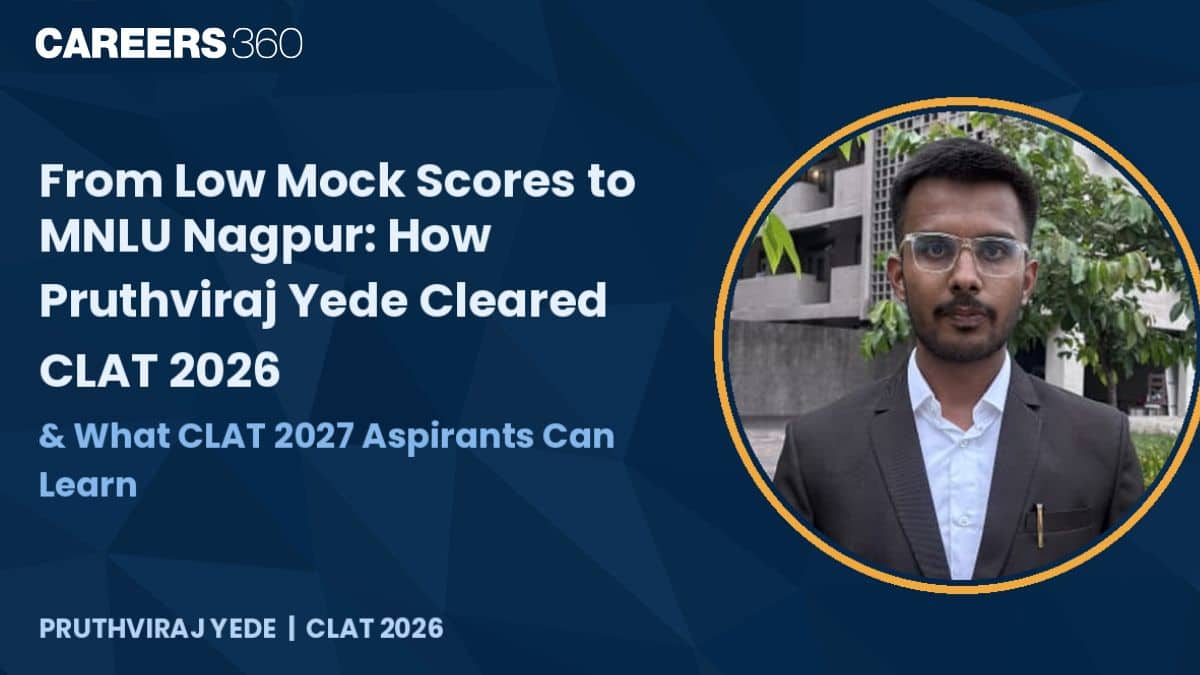
Careers360 spoke to CLAT 2026 topper Pruthviraj Yede about his preparation strategy, mock test approach, challenges and his first-year experience at MNLU Nagpur. Below are excerpts from the conversation.
Careers360: You secured AIR 17 (SEBC) in CLAT 2026 and are now pursuing BA LLB (Hons.) at MNLU Nagpur. Looking back at your preparation from where you are today, what do you think made the biggest difference to your performance?
Pruthviraj: Looking back, I think consistency mattered more than anything else. CLAT preparation is not something where one particular book, one particular mock, or studying for a very long number of hours suddenly changes your result. It was the habit of sitting down every day and working on the areas where I was actually making mistakes.
Mocks also played a very important role for me, but writing mocks alone was not enough. I tried to understand why I was getting questions wrong and whether the problem was conceptual, related to reading speed, or simply a silly mistake. Over time, this helped me become more aware of my own pattern of mistakes.
I would also say that I gradually became more comfortable with the uncertainty of the paper. You cannot predict exactly what CLAT will ask. So instead of trying to prepare for every possible question, I focused on building strong reading, reasoning and time-management skills.
Careers360: What was your reaction when you first saw AIR 17 (SEBC) on your CLAT result? Did the result match what you had expected going into the exam?
Pruthviraj: Honestly, it took me a little time to process it. I had obviously hoped for a good rank, but seeing AIR 17 (SEBC) on the result was still a very different feeling.
I think the biggest reaction was relief. There is so much uncertainty after the exam; you keep thinking about the questions you attempted, the ones you left, and whether your calculations are correct. Once I saw the rank, all of that suddenly felt worth it.
I had expected a good result based on how my preparation had gone, but I don't think I had gone into the result expecting a specific rank. So AIR 17 (SEBC) was definitely a very pleasant surprise.
Careers360: Now that you've spent some time at MNLU Nagpur, how has your first-year experience been so far? What has surprised you the most about law school?
Pruthviraj: My first-year experience has been a mix of excitement, adjustment and learning. One of the biggest differences from school is that you are expected to take much more responsibility for your own academics. Nobody is constantly reminding you to study or complete something.
What surprised me the most was probably the amount of reading involved. Before joining law school, I knew there would be a lot of reading, but experiencing it firsthand is different. Apart from regular classes, there are cases, articles, assignments, presentations and other academic activities.
At the same time, college life is not only about academics. Meeting people from different parts of the country and interacting with seniors and professors has also been a major part of my experience so far.
Careers360: Before joining MNLU, what did you imagine law school would be like, and how different has the reality been?
Pruthviraj: Before joining MNLU, I had a fairly textbook idea of law school. I expected a lot of studying, debates, moots and discussions. Those things are definitely there, but the reality is much broader.
I didn't realise how important time management would be. There are often multiple things happening at the same time, and you have to decide what needs your attention first.
I also expected everyone to be very competitive academically. After coming here, I realised that while academics are important, there is also a lot of collaboration. You learn from your batchmates and seniors, and everyone has different strengths and interests.
Careers360: What made you choose law, and has studying it at MNLU changed the way you see the career you want to build after graduation?
Pruthviraj: I was interested in law because I liked the combination of reading, reasoning and understanding how society and institutions work. I also liked that law offers several different career paths rather than leading to just one kind of job.
Studying at MNLU has actually made me more open-minded about my career plans. Before entering law school, I had a relatively broad idea of what I wanted to do. After being exposed to different subjects, seniors and areas of law, I have realised that there are many fields I haven't explored properly yet.
So at this point, I don't think I need to have my entire career figured out in first year. I would rather use the next few years to explore different areas and then make a more informed decision.
Careers360: For CLAT 2027 aspirants, September is almost over and the exam is only a few months away. If you were preparing for CLAT today, how would you use these final months?
Pruthviraj: If I were preparing today, I would focus much more on consolidation than on trying to learn everything from scratch. At this stage, the objective should be to identify your weak areas and make them manageable.
I would maintain a regular mock schedule and, more importantly, spend enough time analysing each mock. I would also revise whatever I have already studied instead of continuously collecting new material.
For current affairs, I would make sure that I have a systematic source of revision rather than trying to read everything available online. The final months are also the time to work on exam temperament—being able to stay calm when a section is difficult and not letting one bad passage affect the rest of the paper.
Careers360: At this stage of preparation, how should students divide their time between mocks, practice, revision and keeping up with current affairs?
Pruthviraj: I don't think there is one fixed percentage that will work for every student because it depends on where they are in their preparation.
For someone who already has a reasonable base, I would give significant importance to mocks and their analysis, along with revision. Practice should be targeted towards the areas where the student is making mistakes rather than just solving questions for the sake of increasing the number of questions attempted.
Current affairs should be handled consistently. I would not recommend leaving the entire backlog for the last few weeks. At the same time, current affairs should not take up the majority of your preparation time at the expense of the core sections.
The important thing is that all four mocks, practice, revision and current affairs should have a place in the routine.
Careers360: How did you approach mock tests during your preparation? Was there a particular way you analysed your mistakes or used your scores to improve?
Pruthviraj: For me, the mock itself was only half the exercise. The analysis after the mock was equally important.
Whenever I got a question wrong, I tried to understand the reason behind it. Sometimes I genuinely didn't know something, sometimes I had misunderstood the passage, and sometimes I knew the answer but made a careless mistake. These are very different problems and need different solutions.
I also looked at questions where I had spent too much time. A question doesn't have to be wrong to be a problem. If I spent three or four minutes on something that should have taken much less time, I wanted to understand why.
I tried not to judge my preparation based on one mock score. I looked more at the trend and whether the same mistakes were continuing to appear.
Careers360: What should an aspirant do if their mock scores are consistently lower than their expectations despite putting in the effort?
Pruthviraj: First, I would tell them not to panic. A low mock score doesn't automatically mean that their preparation is going badly.
Instead of simply writing more and more mocks, they should stop and analyse what is actually causing the score to remain low. Is it accuracy? Time management? Difficulty with a particular section? Getting stuck on difficult questions? Or perhaps not understanding the questions properly?
Once the problem is identified, the preparation can become much more targeted.
Also, don't compare your mock score directly with someone else's. Different mock series can have different difficulty levels, and more importantly, everyone starts from a different level. Your own improvement over time is much more useful information.
Careers360: The final few months can be stressful, and many students start comparing their preparation with their peers. How did you deal with pressure, self-doubt or the feeling that you weren't doing enough?
Pruthviraj: I definitely had moments when I felt that I should be doing more. I think that feeling is quite common during competitive exams.
What helped me was trying to focus on what I could control that day. If I spent the entire day thinking about what someone else was studying or how many questions they had solved, it wasn't going to improve my preparation.
I also tried not to make every bad mock or unproductive day into a major event. One bad day doesn't define your preparation.
There will always be someone who has read one more book, attempted one more mock or knows one more current-affairs topic. At some point, you have to accept that you cannot prepare infinitely. You can only make the preparation you have done as effective as possible.
Careers360: What is one mistake you made during your CLAT preparation that you would specifically tell CLAT 2027 aspirants not to repeat?
Pruthviraj: One mistake I would tell students to avoid is spending too much time looking for the “perfect” preparation strategy.
It is very easy to keep changing resources, teachers, mock series or study plans because you see someone else recommending something. I think once you have resources that work for you, consistency is more important than constantly searching for something better.
I would also avoid postponing revision. New material always looks more productive because you feel like you are learning something new, but revision is what helps you retain what you have already studied.
Careers360: Looking at CLAT from the other side now, is there anything you spent too much time worrying about during preparation that you realise wasn't as important as you thought?
Pruthviraj: I probably spent more time than necessary worrying about whether I was doing enough compared to other aspirants.
When you are preparing for an exam like CLAT, it is very easy to look at someone else's schedule and feel that you should also be doing the same thing. But preparation isn't identical for everyone.
Looking back, I think having a clear understanding of my own strengths and weaknesses was much more useful than constantly trying to measure myself against somebody else's preparation.
Careers360: Finally, if you could speak directly to a CLAT 2027 aspirant who is reading this on the night before the exam, what would you want them to remember?
Pruthviraj: At that point, there is nothing meaningful left to add to your preparation. Trust the work you have already put in.
Don't try to learn a completely new topic or change your strategy at the last minute because of something you suddenly saw online. Get enough rest, keep your mind calm and go into the exam with a simple plan.
And while writing the paper, remember that you don't have to solve every question. If something is taking too much time, move on and come back if required. CLAT is not just about what you know; it is also about how well you manage the paper in those few hours.
Most importantly, don't let one difficult passage or one unexpected section convince you that the paper is going badly. Everyone is attempting the same paper. Stay composed, keep moving, and give yourself the best chance to perform.

On Question asked by student community
Hello Student,
Here are the Careers360 CLAT 2027 Mock Test Resources for your exam preparation.
1. Online CLAT Mock Test
2. CLAT Mock Tests and Solutions
Hello student,
CLAT 2027 aspirants can access these monthly current affairs compilations for regular revision. Use these resources to stay updated with important events and topics for CLAT 2027.
|
Particular |
Download PDF |
|
CLAT Current Affairs- August Month (2026) |
|
|
CLAT Current Affairs- |
If you have only two months, use a highly structured plan: daily current affairs, English reading, legal reasoning practice, logical reasoning sets, basic quantitative practice and regular full-length mocks. Spend as much time analysing incorrect questions as taking the mock itself. Consistency during these two months can make a substantial
You can download the CLAT previous years' question papers from here:
https://law.careers360.com/articles/clat-previous-year-question-papers
https://law.careers360.com/download/clat-sample-papers-previous-years
For CLAT 2027 UG, candidates need to have passed Class 12/equivalent with at least 45% marks, or 40% for SC/ST/PwD candidates.
In your situation, having an RT in an additional subject but subsequently passing the required qualification through an improvement examination does not automatically make you ineligible. However, the important

Ranked #18 amongst Institutions in India by NIRF | Get Upto 100% Scholarships | Spot Admissions via CUET
Ranked 1 st among Top Law Schools of super Excellence in India - GHRDC | NAAC A+ Accredited | #36 by NIRF
NAAC A++ Accredited | Ranked #11 by NIRF
Bar Council of India (BCI) approved | Accredited by LAWASIA | Ranked 13th , among the Best Law Colleges (Private) in India by IIRF
Free Ebook - CLAT 2025 English Language questions with detailed solutions
Stay updated with current affairs & check your preparation with the CLAT General Knowledge Mock Tests Ebook