School of Law, UPES, Dehradun
Ranked #18 amongst Institutions in India by NIRF | Get Upto 100% Scholarships | Spot Admissions via CUET


Legal Reasoning is a potentially high-scoring part of the CLAT 2027 test, provided that aspirants are aware of the approach to CLAT 2027 Preparation. However, many aspirants end up losing valuable marks due to their mistakes while working through the questions rather than because of the difficulty of the questions themselves. Common mistakes in CLAT legal reasoning can often be avoided with the right approach.
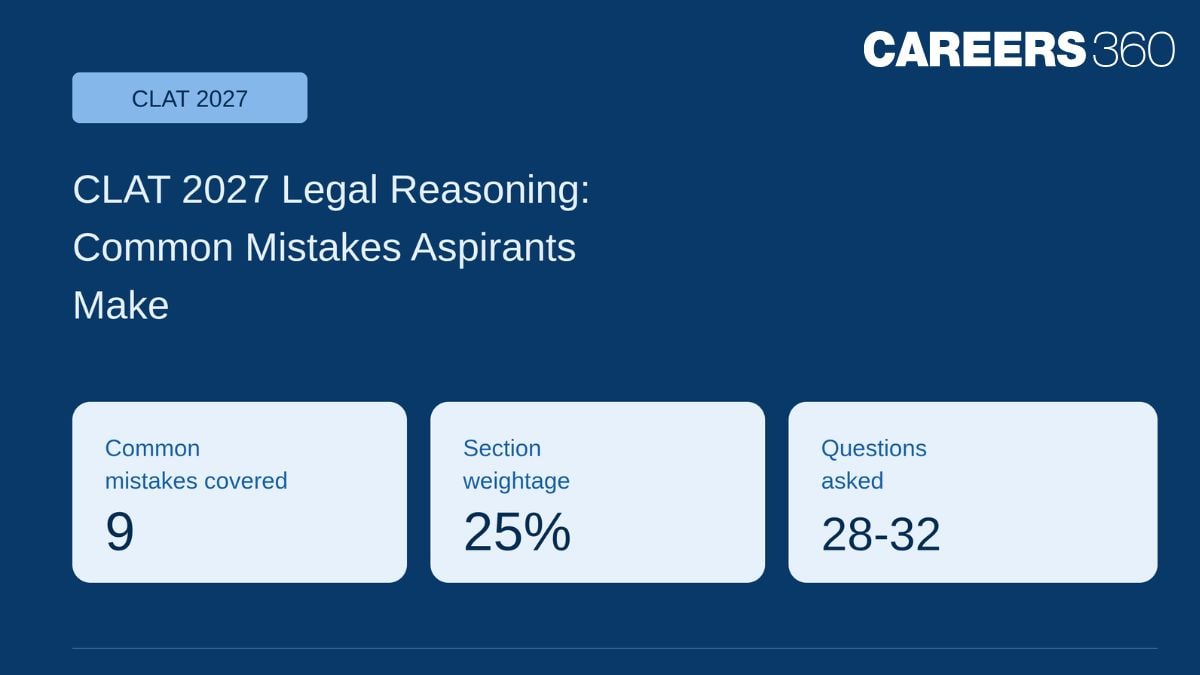
CLAT 2027 UG test is going to include 120 multiple-choice questions to be completed within 2 hours. There are supposed to be 28-32 questions in the Legal Reasoning section. Each question is worth one mark, with negative marking of 0.25 marks per incorrect answer.
According to the Consortium of NLUs, it is not necessary for candidates to possess any legal knowledge in order to take the CLAT 2027 legal reasoning mistakes. This part of the test measures the ability to detect rules and principles from passages, apply them to various scenarios and realise the effects of alterations to the principle on its applicability.
The CLAT 2027 legal reasoning is expected to contain approximately 28-32 questions.
CLAT 2027 Legal Reasoning preparation Questions are based on passages of around 300-450 words.
The passages may be on subjects that include legal principles, the constitution, judgments, and current developments in the law.
It is expected that students will be able to identify the legal principles and apply them to the facts in the questions.
Legal knowledge prior to writing the exam is not essential since all the relevant information will be available in the passage itself.
This demands a good grasp of concepts, understanding, analysis, and logic.
The questions assess the candidate’s ability to draw inferences using logic rather than recalling the laws.
Keeping up-to-date by reading newspapers about what goes on in the field of law is very beneficial for this part of the CLAT Exam.
Ranked #18 amongst Institutions in India by NIRF | Get Upto 100% Scholarships | Spot Admissions via CUET
Scholars’ Round Deadline: 14th Nov’26 | Earn upto 50% merit Scholarship + 10% for top performers | EFMD Accredited | AACSB (USA) & AMDISA Member | Highest CTC 28 LPA
In the CLAT 2027 legal reasoning preparation, passages ranging from 450 words will be provided. The topics for the passage may include law, public policy, a factual situation, and even philosophical issues.
The questions asked after these passages would require the candidates to comprehend, identify the principle(s) and apply them to the scenario given. This means that Legal Reasoning is not a test of knowledge of law only but also of understanding and application. Students can also practice 50+ legal reasoning passages for CLAT 2027 practice.
Also check: Last Year CLAT Question Paper
The weightage of CLAT 2027 legal reasoning preparation will be around 25%, with about 28-32 questions. This section basically assesses your skills to determine the legal principle, apply it to the set of facts, and recognise the implications that come from changes in the rule.
Students tend to believe that a large number of provisions, case laws, and definitions must be memorised to secure high marks in Legal Reasoning. Though some basic knowledge about law may be helpful, unnecessary memorisation is definitely not what CLAT 2027 tests. According to the official CLAT syllabus, no prior knowledge of law is required to attempt this subject.
Another common mistake is using a rule that is memorised by heart instead of the principle provided in the passage. Practice the 100 important legal maxims for CLAT 2027 with meanings for better understanding.
Though a candidate might know something about a particular legal concept, the answer should be found on the basis of the principle and facts of the passage. The most effective CLAT 2027 legal reasoning preparation is to find the principle, find the facts and to apply the principle exactly.
CLAT 2027 time management is essential; however, reading passages too fast lowers your accuracy levels. Legal Reasoning passages have conditions, exceptions, and significant factual information. If you miss out on any of these pieces of information, then the answer you would have gotten would definitely be wrong. As such, students should note down the key principle, key facts and any exceptions within the passages as they read them. It's not advisable to speed-read.
CLAT 2027 aspirants sometimes make assumptions that do not exist within the passage. They bring in facts that are not there. As a result, they apply the principle in the wrong way. If a certain aspect, such as intention, circumstances or conduct, is not mentioned in the passage, then students should not assume it.
Principles sometimes have many conditions. Even when aspirants have an idea about the principle, it may be possible that some of its conditions have been neglected. For instance, if there are two conditions in a particular principle, then it might be necessary to satisfy all of them together in order to choose an option.
Also check: CLAT Sample Question Paper
The differentiation between the two sections is crucial since a different approach is required to solve questions in each of them.
Both Legal Reasoning and Logical Reasoning call for analytical skills; however, they are not the same. In the case of Legal Reasoning, what candidates need to do is understand principles and apply them to factual problems.
In CLAT 2027 logical reasoning, it is arguments, premises, conclusions, assumptions and inferences that matter. Understanding this difference enables candidates to know the right approach to take in each case.
With 120 questions to answer within two hours, candidates cannot spend much time on one problem. If a problem in Legal Reasoning takes too much time, it would be wiser to leave it for the moment and come back to it later when it is possible. The goal here is to get as many marks as possible.
While a comprehensive knowledge of law may not be necessary, contemporary legal and moral issues would make it easier for candidates to understand and apply principles.
Candidates must pay attention to key developments in relation to constitutional matters, fundamental rights, technology and privacy, environment and any other significant legal development and public policy. CLAT 2027 current affairs preparation is meant to complement Legal Reasoning preparation, not vice versa.
Solving a thousand questions will not bring much success unless aspirants analyse their errors. Students can also practice 200 important legal terms every CLAT 2027 aspirant should know for understanding.
After each mock test and practice session, candidates must know the reason why they were wrong. Was there any misunderstanding of a principle? Did they miss an important fact? Had they made any assumptions? Had they misunderstood the question? An error log can prove extremely helpful in pointing out the problem areas.
Also check: How To Solve CLAT 2027 Legal Reasoning Passages Faster
Given below are the CLAT 2027 legal reasoning preparation Tips:CLAT 2027 legal reasoning preparation should focus on understanding principles and applying them correctly.
A simple three-step method can make CLAT 2027 Legal Reasoning questions easier:
Principle: Identify the rule given in the passage.
Facts: List the facts that pertain to the question.
Application: Use the above-stated principle to arrive at an answer to the question.
The process will be made easier through constant practice.
Instead of continuously practising similar examples, candidates should try questions with diverse fact scenarios. CLAT 2027 assesses the capability of applying the principles to unique situations. As you continue to work with texts that are unfamiliar to you, you will become more adaptable and will not have to depend on memorisation so much.
CLAT 2027 carries negative marking, so it would not be wise to attempt random questions. Candidates need to work towards achieving efficiency and accuracy through regular CLAT 2027 mock tests.
Speed and accuracy must be practised such that the candidate can read effectively, comprehend the principle well and avoid careless mistakes.
Also check: CLAT Model Paper
CLAT 2027 Legal Reasoning is not mainly an assessment of the amount of law that the candidate knows. The exam tests the capability of understanding the passage, extracting the principle and applying it to the scenario. Errors such as excessive memorisation, using one’s opinions, unsupported assumptions, ignoring conditions and wasting time on hard questions can be avoided easily.
CLAT 2027 Legal Reasoning is a topic that will become quite easy and scoring for candidates with constant practice and by reading and analysing their mistakes. The mantra for the CLAT 2027 aspirants is to know the principle, keep the facts in mind and apply the rule.
Also check: How to Read Court Judgments for CLAT 2027

On Question asked by student community
Hello Student,
Here are the Careers360 CLAT 2027 Mock Test Resources for your exam preparation.
1. Online CLAT Mock Test
2. CLAT Mock Tests and Solutions
Hello student,
CLAT 2027 aspirants can access these monthly current affairs compilations for regular revision. Use these resources to stay updated with important events and topics for CLAT 2027.
|
Particular |
Download PDF |
|
CLAT Current Affairs- August Month (2026) |
|
|
CLAT Current Affairs- |
If you have only two months, use a highly structured plan: daily current affairs, English reading, legal reasoning practice, logical reasoning sets, basic quantitative practice and regular full-length mocks. Spend as much time analysing incorrect questions as taking the mock itself. Consistency during these two months can make a substantial
You can download the CLAT previous years' question papers from here:
https://law.careers360.com/articles/clat-previous-year-question-papers
https://law.careers360.com/download/clat-sample-papers-previous-years
For CLAT 2027 UG, candidates need to have passed Class 12/equivalent with at least 45% marks, or 40% for SC/ST/PwD candidates.
In your situation, having an RT in an additional subject but subsequently passing the required qualification through an improvement examination does not automatically make you ineligible. However, the important

Ranked #18 amongst Institutions in India by NIRF | Get Upto 100% Scholarships | Spot Admissions via CUET
Scholars’ Round Deadline: 14th Nov’26 | Earn upto 50% merit Scholarship + 10% for top performers | EFMD Accredited | AACSB (USA) & AMDISA Member | Highest CTC 28 LPA
Moot Court | Mock trials | Legal Aid Clinic | Recruiting Partners: FICCI, TCS, Adani, Trilegal, and many others
NAAC A+ Accredited University
Law Admissions 2026 Open | Avail Merit-Based Scholarships
NAAC A++ Accredited | Ranked #11 by NIRF