
Search Colleges, Exams, Schools & more


Login
CLAT 2027: Skipped Pre-Boards, Prioritised CLAT; How Jatin Shamnani Secured NUSRL Ranchi

Jatin Shamnani secured AIR 1508 in CLAT 2026 with 88.5 out of 119 marks and is now pursuing BBA LLB (Hons.) at NUSRL. A fresher from Jaipur, he prepared for CLAT alongside Class 12, prioritising whichever exam was closer at the time, and even skipped his pre-boards to focus on the CLAT exam.
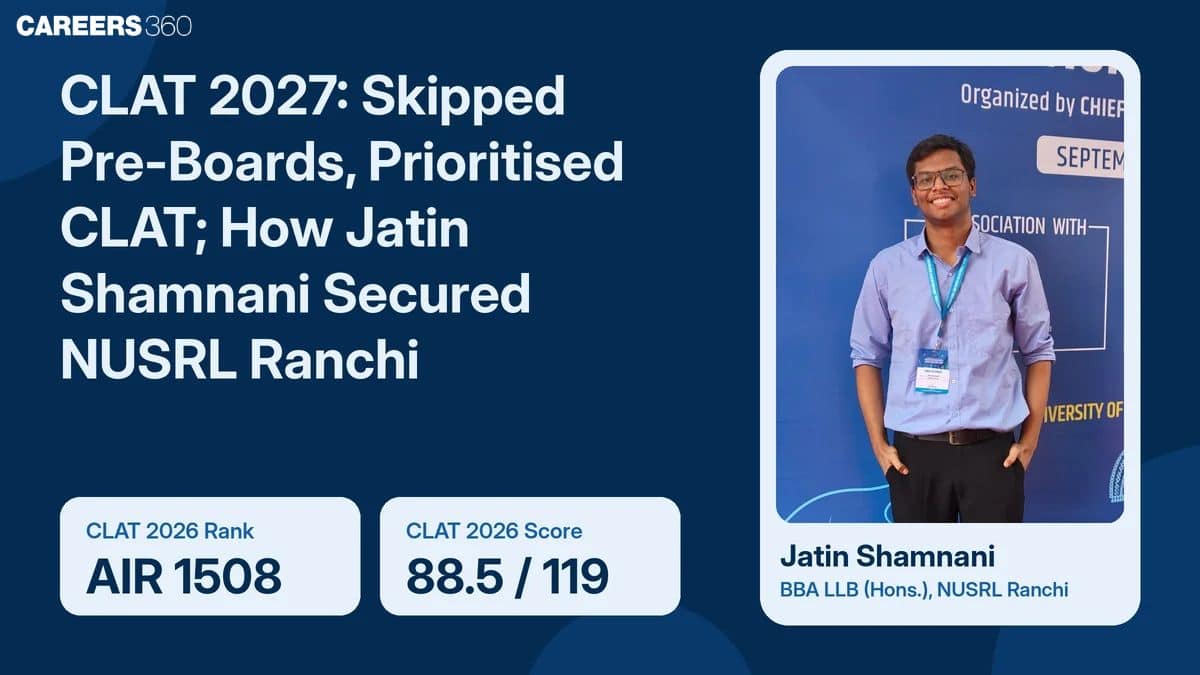
In an interview with Careers360, Jatin talks about combining coaching with CLAT self-study, learning from CLAT mock tests, analysing mistakes and preparing for CLAT Legal Reasoning through consistent practice.
Careers360: You prepared for CLAT 2026 as a fresher. What did your preparation look like alongside your Class 12 boards and school practicals, and how did you manage everything?
Jatin: Honestly, I prioritised CLAT over boards. I had school from 8 AM to 2 PM and coaching from 4 PM to 7 PM; after that, I did homework and solved questions from Monday to Saturday. Sundays were generally for CLAT mock tests and analysing them.
I even skipped my pre-boards and missed around half of November in school because I wanted to focus more seriously on CLAT. Once CLAT was over, I shifted my focus towards boards. So I didn't really try to balance both equally throughout the year. I prioritised whichever exam was more immediate at that point.
The biggest challenge was to maintain 75% school attendance as I was in a regular school. I made a strategy to go to school as much as I could in the months before October.
Careers360: Did you take any coaching for CLAT, or was your preparation mainly self-study?
Jatin: Yes, I took coaching. I had classes from 4 to 7 on weekdays and Saturdays. But coaching wasn't enough by itself. I still had to do a lot of reading, practice questions, mocks and, most importantly, analyse my mistakes.
So I would say it was a combination of coaching and self-study.
Careers360: You scored 88.5 in CLAT 2026. Was there a particular change in your mock strategy or attempt pattern that helped you improve?
Jatin: I think the biggest change was that I stopped treating mocks as just tests and started treating them as a way to understand my mistakes.
After every mock, I'd look at what I got wrong, where I wasted time and which questions I probably shouldn't have attempted. That gradually improved my accuracy and question selection.
There wasn't really one magic change. It was more about consistently improving my approach.
Careers360: You enjoy reading judgments and following legal news. Did this interest help with CLAT's Legal Reasoning, or did you keep it separate from exam preparation?
Jatin: It definitely helped me develop an interest in legal issues, but I wouldn't say that knowing judgments directly helped me solve CLAT legal reasoning.
CLAT is more about understanding the principle given in the passage and applying it to the facts. So I kept my interest in law alongside my actual CLAT preparation rather than depending on it.
Careers360: During your preparation, did advice from NLU seniors or CLAT toppers ever change the way you approached the exam?
Jatin: Yes. Their experiences made me realise that there isn't one perfect way to prepare for CLAT.
One thing I particularly picked up was the importance of CLAT mock analysis. A bad mock doesn't necessarily mean your preparation is bad. You have to understand why you performed badly and then work on that particular issue.
Careers360: CLAT can include a difficult section unexpectedly. When a mock did not go as planned, how did you figure out whether the problem was your preparation or your approach to the paper?
Jatin: I would go through my mistakes and identify the reason behind each one. I even used to analyse the question which was right because I wanted to understand the difference or similarity between my reasoning and the author's reasoning for the answer.
If I didn't know the concept, it was a preparation issue. But if I knew the concept and still got it wrong because I rushed or misread something or spent too much time on it, then it was an approach issue.
That helped me focus on the actual problem instead of simply studying more after every bad mock.
Careers360: Now that you have started at NUSRL, what is one thing about law school that has been different from what you expected while preparing for CLAT?
Jatin: Law school has given me a fresh environment to explore different areas of law. I am interested in constitutional law, contracts and criminal law, and I am looking forward to exploring mooting, legal research and publications alongside academics.
Careers360: What is one practical piece of advice you would give a CLAT 2027 aspirant who is preparing without a strong coaching background?
Jatin: Don't think that not having coaching automatically puts you at a disadvantage.
Have good study material, take CLAT mock tests regularly and, most importantly, analyse them properly. Don't just look at the score and move on.
And don't blindly copy someone else's timetable. Find a routine you can actually sustain, because consistency matters much more than studying for huge hours.
Articles
Related Stories
|
Upcoming Law Exams

Certifications By Top Providers
Explore Top Universities Across Globe
Popular Courses and Specializations
Popular Degrees
List of colleges accepting CLAT
Browse Law Colleges by State
Questions related to CLAT
On Question asked by student community
Have a question related to CLAT ?
Hello Miruthula,
For CLAT PG 2027, you need to focus on the core subjects of your LLB curriculum, particularly the following:
-
Constitutional Law
-
Jurisprudence
-
Administrative Law
-
Law of Contract
-
Law of Torts
-
Family Law
-
Criminal Law
-
Property Law
-
Company Law
-
Public International Law
-
Tax Law
-
Environmental Law
-
Labour and Industrial
Hello Student,
The full form of the CLAT exam is the Common Law Admission Test. You can check the link related to the CLAT exam
https://law.careers360.com/articles/what-is-clat-full-form-all-about-nlus-entrance-exam
Hello Student,
Here are the Careers360 CLAT 2027 Mock Test Resources for your exam preparation.
1. Online CLAT Mock Test
2. CLAT Mock Tests and Solutions
Hello student,
CLAT 2027 aspirants can access these monthly current affairs compilations for regular revision. Use these resources to stay updated with important events and topics for CLAT 2027.
CLAT 2027 Current Affairs - Monthly Compilations
|
Particular |
Download PDF |
|
CLAT Current Affairs- August Month (2026) |
|
|
CLAT Current Affairs- |
If you have only two months, use a highly structured plan: daily current affairs, English reading, legal reasoning practice, logical reasoning sets, basic quantitative practice and regular full-length mocks. Spend as much time analysing incorrect questions as taking the mock itself. Consistency during these two months can make a substantial

Applications for Admissions are open.
Experiential Learning through Legal Aid Camps, Lok Adalats, Court Visits, Community Lawyering and regular Moot Court sessions
School of Law, UPES, Dehradun
ApplyRanked #18 amongst Institutions in India by NIRF | Get Upto 100% Scholarships | Spot Admissions via CUET
School of Law, Jain University, Bangalore
ApplyNAAC A++ Approved | Curriculum Aligned with BCI & UGC
Woxsen University, Hyderabad
ApplyUG Scholar's Round Deadline: 1st Dec'26 | PG Early Decision Round Deadline: 24th Dec'26 | Earn upto 50% merit Scholarship + 10% for top performers | AACSB (USA) & AMDISA Member | Highest CTC 28 LPA
Lovely Professional University, Phagwara
ApplyIndia's Largest University | NAAC A++ Accredited | THE-2027 Ranked 4th in India | Highest CTC: INR 2.5 Cr | Top 25% Average Salary: INR 10.2 LPA | 2225+ Recruiters
Institute of Law, Nirma University, Ahmedabad
ApplyGrade 'A+' Accredited by NAAC | Ranked 33rd in India by NIRF
CLAT Notifications
Never miss CLAT update
Get timely CLAT updates directly to your inbox. Stay informed!