ICFAI University Sikkim Law Admissions 2026
Approved by BCI


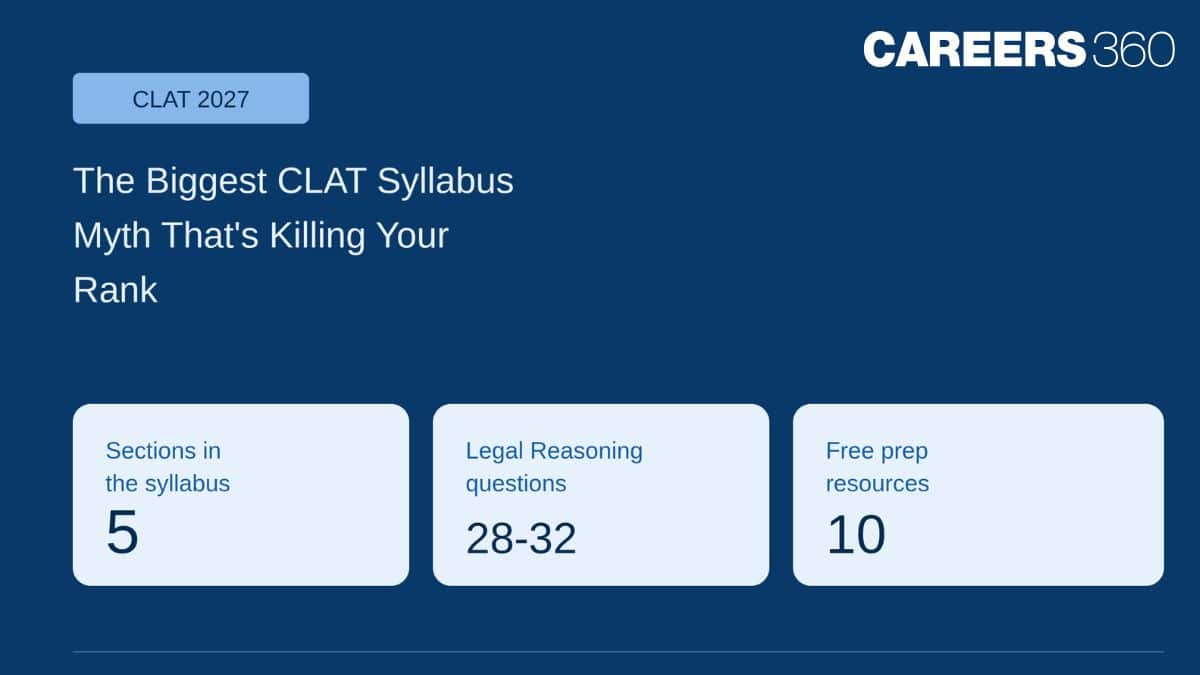
The biggest CLAT syllabus myth is that a good rank depends on memorising legal provisions, static GK facts and long vocabulary lists. But the exam also tests how well candidates handle passage-based questions, analyse information and apply concepts. The CLAT syllabus has five sections. Preparation is not just about how much candidates study, but what they practise and how well they apply their knowledge during the exam.
Subject and weightage | The myth | The reality |
Current affairs including GK (28-32 questions) | Memorise as many daily current affairs and static GK as possible | Focus on major events, their context and the information given in the passage |
Logical reasoning (22-26 questions) | Learn shortcut tricks and solve questions mechanically | Understand arguments, assumptions, conclusions and inferences |
English language (22-26 questions) | Improve vocabulary by memorising long word lists | Build reading comprehension, inference and passage-analysis skills |
Quantitative techniques (10-14 questions) | CLAT requires advanced maths and algebra calculations | Practise passage-based data interpretation using basic Class 10 concepts like percentages, ratios, and averages. |
Legal reasoning (28-32 questions) | Memorise laws, section numbers, and historical case laws | Understand the legal principle in the passage and apply it to the given facts |
Given below is a section-wise breakdown of the CLAT 2027 syllabus topics and skills that aspirants should focus on:
CLAT Legal Reasoning
This is the first section where students overestimate the importance of prior legal knowledge. This section is passage-based. Reading laws and case summaries can take up a large part of a candidate’s preparation without improving the actual skill the section tests in the CLAT examination.
What to focus on: Understand the legal principle given in the passage and apply it strictly to the facts. Practise different types of legal reasoning passages such as legal principles of contract, torts, criminal law and constitutional law, and check where the reasoning went wrong.
CLAT Current Affairs Including GK
This section covers important national and international events, along with static GK questions. These questions can test the background and context of an event, not just the headline.
What to focus on: Cover major government schemes, appointments, awards, international organisations, legal developments and important national and global events. Revise regularly.
CLAT Logical Reasoning
This section tests how well candidates analyse arguments and draw conclusions from a passage.
What to focus on: Practise questions on arguments, assumptions, conclusions, inferences and flaws in reasoning. Solve CLAT Previous Year Question Papers (PYQs) to understand the question pattern.
CLAT English Language
CLAT English is mainly based on reading comprehension. Questions can test the central idea, inference, tone, purpose and meaning of words in context.
What to focus on: Read editorials and long-form articles regularly and practise passage-based questions. Focus on comprehension and contextual vocabulary rather than only word lists.
CLAT Quantitative Techniques
CLAT Quantitative techniques use numerical information presented through passages, tables and data sets. The questions mainly require basic mathematical concepts.
What to focus on: Prepare percentages, ratios, averages, profit and loss, interest and basic data interpretation. Practise extracting the relevant figures and solving questions within a time limit.
Resource | Download links |
CLAT UG Preparation Guide | |
CLAT Last 5 Years Question Papers with Detailed Solutions (2021-2026) | |
CLAT Sample Paper 2027 with Answer Key by Careers360 | |
CLAT Online Free Mock Test by Careers360 | |
CLAT 2027 10 Free Mock Test Sets with Detailed Solutions | |
50+ Legal Reasoning Passages for CLAT 2027 Practice | |
CLAT English Practice Questions with Detailed Solutions (50 Sets) | |
CLAT 2027 GK & Current Affairs: 5 Best Sources to Follow Daily | |
100+ CLAT Quantitative Techniques Questions with Answers and Detailed Solutions | |
How To Score 25+ In Logical Reasoning of CLAT 2027 |

On Question asked by student community
Hello Student,
Here are the Careers360 CLAT 2027 Mock Test Resources for your exam preparation.
1. Online CLAT Mock Test
2. CLAT Mock Tests and Solutions
Hello student,
CLAT 2027 aspirants can access these monthly current affairs compilations for regular revision. Use these resources to stay updated with important events and topics for CLAT 2027.
|
Particular |
Download PDF |
|
CLAT Current Affairs- August Month (2026) |
|
|
CLAT Current Affairs- |
If you have only two months, use a highly structured plan: daily current affairs, English reading, legal reasoning practice, logical reasoning sets, basic quantitative practice and regular full-length mocks. Spend as much time analysing incorrect questions as taking the mock itself. Consistency during these two months can make a substantial
You can download the CLAT previous years' question papers from here:
https://law.careers360.com/articles/clat-previous-year-question-papers
https://law.careers360.com/download/clat-sample-papers-previous-years
For CLAT 2027 UG, candidates need to have passed Class 12/equivalent with at least 45% marks, or 40% for SC/ST/PwD candidates.
In your situation, having an RT in an additional subject but subsequently passing the required qualification through an improvement examination does not automatically make you ineligible. However, the important

Ranked #18 amongst Institutions in India by NIRF | Get Upto 100% Scholarships | Spot Admissions via CUET
Ranked 1 st among Top Law Schools of super Excellence in India - GHRDC | NAAC A+ Accredited | #36 by NIRF
NAAC A++ Accredited | Ranked #11 by NIRF
Bar Council of India (BCI) approved | Accredited by LAWASIA | Ranked 13th , among the Best Law Colleges (Private) in India by IIRF
Free Ebook - CLAT 2025 English Language questions with detailed solutions
Stay updated with current affairs & check your preparation with the CLAT General Knowledge Mock Tests Ebook