
Search Colleges, Exams, Schools & more


Login
The CLAT Syllabus Hack Toppers Don't Share
The CLAT syllabus is divided into five parts: English language, legal reasoning, logical reasoning, current affairs including GK and Quantitative Techniques. The CLAT syllabus is expansive, and candidates must have a strong preparation strategy to cover the entire syllabus in time. CLAT toppers often have unique strategies for covering the CLAT syllabus that set them apart from the rest. Most of the candidates prepare for the CLAT exam as they do for their boards. It is the difference in preparation strategies that differentiates the toppers from the rest of the candidates.
CLAT 2027 Syllabus - Subject-wise Weightage
Sections | Weightage | Number of Questions |
Current affairs & GK | 25% | 28-32 |
Legal reasoning | 25% | 28-32 |
English | 20% | 22-26 |
Logical reasoning | 20% | 22-26 |
Quantitative techniques | 10% | 10-14 |
CLAT Syllabus Hacks Toppers Don’t Share
Here are some of the simple CLAT syllabus hacks that toppers usually don’t share:
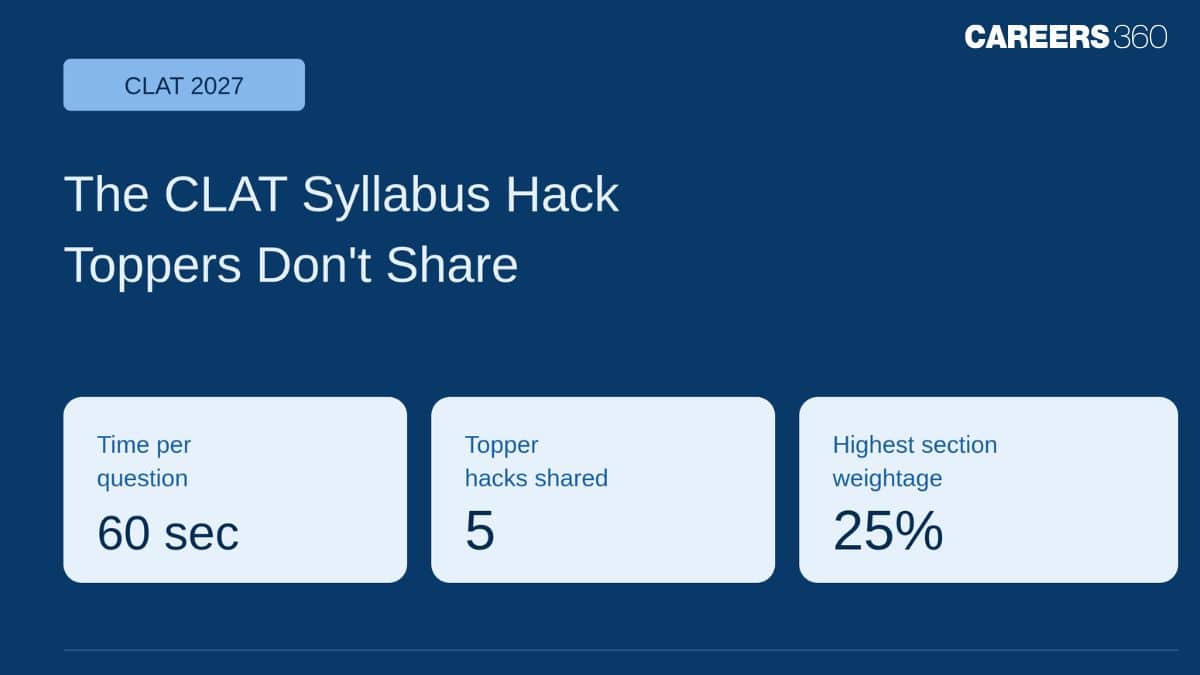
CLAT Tests Reading Speed and Comprehension, Not Knowledge: Most of the students who crack the CLAT exam know that it is a test of speed and comprehension abilities rather than knowledge. There are 120 passage-based questions that candidates need to answer in 120 minutes, 60 seconds for one question. All sections in the exam are reading tasks and the real challenge is how fast candidates can extract the essence and meaning of the 400-word passages.
Put Effort Based on Section Weightage
All five sections carry specific weightage, and candidates must give each section time and effort as per the weightage it holds in the exam. For example, current affairs, including GK and legal reasoning, hold the maximum weightage of 25% each, followed by logical reasoning and English language with 20% weightage and quantitative techniques with 10% weightage.
Current Affairs is a Regular Game, Not a One-Time Learning Exercise
Current affairs is one of the most crucial sections of the CLAT exam and carries 25% weightage. Most students do not understand the right approach to tackle this section. Toppers take the current affairs section as a regular exercise rather than learning topics once in a while. Most toppers have the habit of daily newspaper reading, which keeps them ahead in this section.
Mocks are Important, but Mocks Analysis is More Important
Most of the candidates take CLAT mock tests time and again and judge their preparation based on their scores. What toppers do differently is they carefully analyse their performance in every mock test they take. Identifying weak areas, common mistakes, and speed analysis is a major part of every topper’s mock test routine.
Legal Reasoning means Principle to Facts Application
Legal reasoning is also among the most important sections of the CLAT exam with the highest weightage. One thing that toppers know very clearly is that no prior legal knowledge is required for CLAT legal reasoning, and they do not devote any time to learning legal topics. The CLAT legal reasoning passage gives a simple principle, and candidates are just required to apply it ot facts. Toppers only focus on identifying the principle and applying it as given instead of using any moral instincts.
CLAT Preparation Books Recommended by Toppers
Section | Top Recommended Books |
Legal Reasoning | Universal's CLAT Guide; Objective Legal Aptitude (R.S. Aggarwal); Legal Aptitude by A.P. Bhardwaj |
Current Affairs & GK | Manorama Yearbook; Lucent's General Knowledge; PIB summaries; The Hindu (newspaper) |
English | Objective General English (S.P. Bakshi); Word Power Made Easy (Norman Lewis); Wren & Martin |
Logical Reasoning | Verbal & Non-Verbal Reasoning (R.S. Aggarwal); Analytical Reasoning (M.K. Pandey); Logical Reasoning (Arun Sharma) |
Quantitative Techniques | Class 10 NCERT Mathematics; Quantitative Aptitude (R.S. Aggarwal); Fast Track Objective Arithmetic (Arihant) |
Articles
Related Stories
|
Upcoming Law Exams

Certifications By Top Providers
Explore Top Universities Across Globe
Popular Courses and Specializations
Popular Degrees
List of colleges accepting CLAT
Browse Law Colleges by State
Questions related to CLAT
On Question asked by student community
Have a question related to CLAT ?
Hello Student,
Here are the Careers360 CLAT 2027 Mock Test Resources for your exam preparation.
1. Online CLAT Mock Test
2. CLAT Mock Tests and Solutions
Hello student,
CLAT 2027 aspirants can access these monthly current affairs compilations for regular revision. Use these resources to stay updated with important events and topics for CLAT 2027.
CLAT 2027 Current Affairs - Monthly Compilations
|
Particular |
Download PDF |
|
CLAT Current Affairs- August Month (2026) |
|
|
CLAT Current Affairs- |
If you have only two months, use a highly structured plan: daily current affairs, English reading, legal reasoning practice, logical reasoning sets, basic quantitative practice and regular full-length mocks. Spend as much time analysing incorrect questions as taking the mock itself. Consistency during these two months can make a substantial
You can download the CLAT previous years' question papers from here:
https://law.careers360.com/articles/clat-previous-year-question-papers
https://law.careers360.com/download/clat-sample-papers-previous-years
For CLAT 2027 UG, candidates need to have passed Class 12/equivalent with at least 45% marks, or 40% for SC/ST/PwD candidates.
In your situation, having an RT in an additional subject but subsequently passing the required qualification through an improvement examination does not automatically make you ineligible. However, the important

Applications for Admissions are open.
Ranked #18 amongst Institutions in India by NIRF | Get Upto 100% Scholarships | Spot Admissions via CUET
Woxsen University, Hyderabad
ApplyScholars’ Round Deadline: 14th Nov’26 | Earn upto 50% merit Scholarship + 10% for top performers | EFMD Accredited | AACSB (USA) & AMDISA Member | Highest CTC 28 LPA
Unitedworld School of Law, Karnavati University, Gandhinagar
ApplyMoot Court | Mock trials | Legal Aid Clinic | Recruiting Partners: FICCI, TCS, Adani, Trilegal, and many others
Chitkara University
ApplyNAAC A+ Accredited University
Parul Institute of Law, Vadodara
ApplyBA LLB, BBA LLB, or BCom LLB and LLB | LLM 1 Year – 4 Specializations | Approved by BCI | Highest CTC 9 LPA
Institute of Law, Nirma University, Ahmedabad
ApplyGrade 'A+' Accredited by NAAC | Ranked 33rd in India by NIRF
CLAT Notifications
Never miss CLAT update
Get timely CLAT updates directly to your inbox. Stay informed!