School of Law, UPES, Dehradun
Ranked #18 amongst Institutions in India by NIRF | Get Upto 100% Scholarships | Spot Admissions via CUET


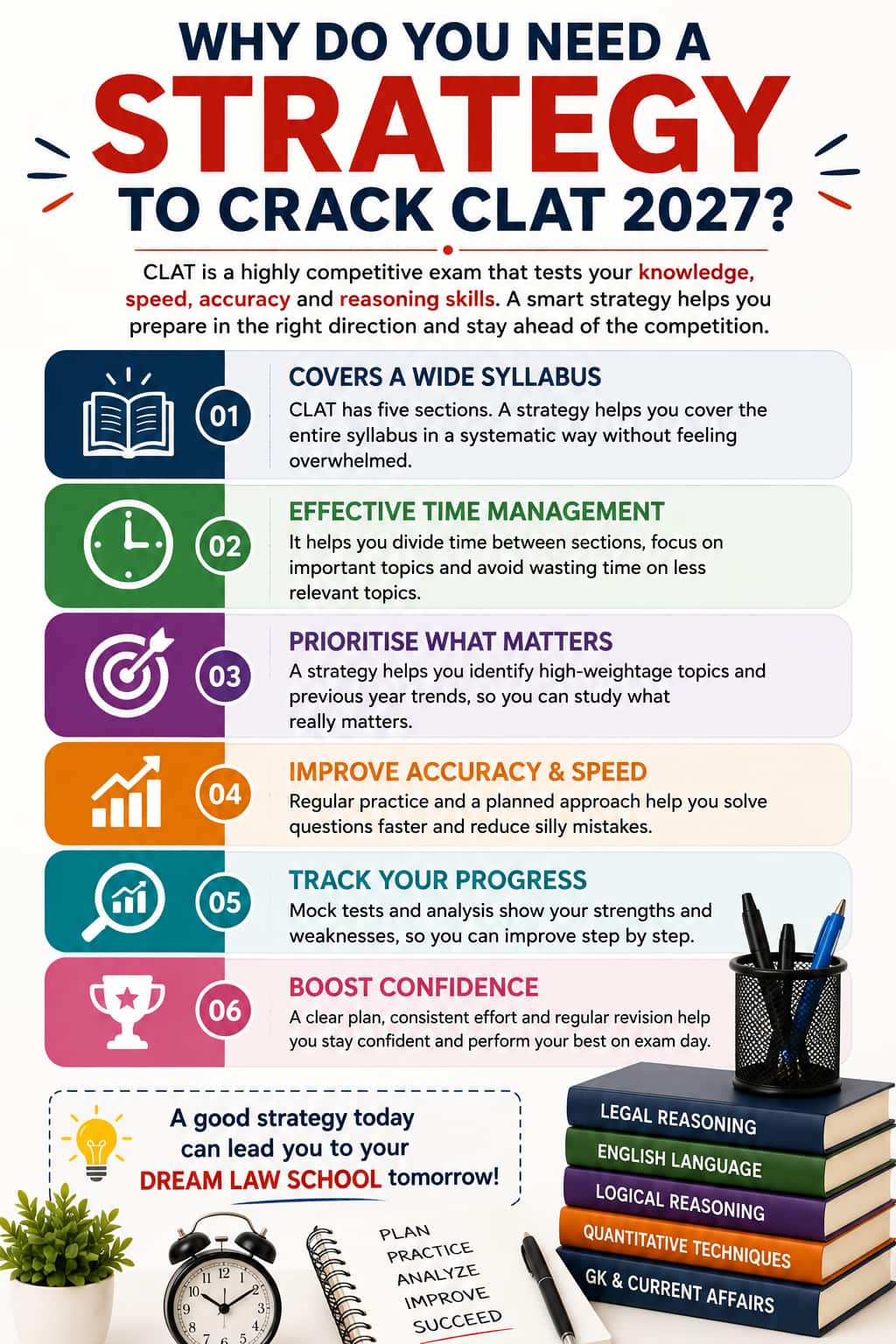
Preparation for CLAT 2027 does not only mean studying for a few hours daily. With five different sections such as English Language, Current Affairs including GK, Legal Reasoning, Logical Reasoning and Quantitative Techniques, there has to be a strategy that helps you cover the entire syllabus and not get stressed out while preparing for the same. Common Law Admission Test (CLAT) 2027 will be held on Sunday, December 6, 2026, between 2:00 PM and 4:00 PM. Now that the date for the test has been announced, aspirants have a well-laid-out timetable to prepare effectively and secure admission to NLUs in India.

Whichever be the case, whether you have started preparing for CLAT 2027 or you are just about to begin your preparation for CLAT 2027, you need to know the format of the exam, your strengths and weaknesses, and the targets to achieve within your preparation time period. Solving past years' papers is also essential, along with understanding the concepts.
In this article, you will be provided with a complete CLAT 2027 Preparation guide for the CLAT 2027 exam.
Know About CLAT 2027 Exam
The Common Law Admission Test (CLAT) is a centralised national-level entrance examination. It is conducted for admission to undergraduate (UG) and postgraduate (PG) law programs. Admissions are offered across 26 National Law Universities (NLUs) in India.
The exam consists of 120 multiple-choice questions (MCQs).
It is divided into five sections:
English Language
Current Affairs (including General Knowledge)
Legal Reasoning
Logical Reasoning
Quantitative Techniques
Each question carries 1 mark.
A negative marking of 0.25 marks is applied for every incorrect answer.
Here’s a breakdown of the CLAT 2027 Syllabus and Preparation Tips:
Section | Key Topics Covered | What to prioritise |
English Language | Comprehension passages, Grammar, Vocabulary, Word meanings, Correct/Incorrect sentences | Daily reading + timed RC sets |
Quantitative Techniques | Algebra, Profit & Loss, Time & Work, Averages, Speed & Distance, Permutation & Combination, Venn Diagrams, Statistical Estimation, Mensuration | DI sets + core arithmetic basics |
General Knowledge & Current Affairs | Static GK: History, Politics, Geography, Environment Current Affairs: National & International events, Sports, Appointments, Awards & Honours | Daily news + weekly revision |
Logical Reasoning | Logical and Analytical reasoning, Pattern-based thinking, Critical reasoning | Timed sets + error pattern tracking |
Legal Reasoning | Basic law concepts, Research aptitude, Problem-solving, Hypothetical legal situations, Important court judgments | Passage practice + logic of options |
Accurate responses are important in CLAT 2027 as there is a penalty for wrong answers. It is necessary to read the passage and the questions attentively, not rush while dealing with known topics, and do timed questions. Analysing the mistakes made each time will also be useful.
Candidates need to select the study material in accordance with the CLAT 2027 syllabus and exam pattern. Candidates need to resort to a few limited sources for preparing each section rather than jumping from one book and website to another. Previous years’ question papers and mock tests are a necessary component of the preparation process.
Candidate performance can be measured through the recording of practice test results, speed, accuracy, and the errors made. This will be used to determine the areas that are performing poorly and the changes that should be made to the study schedule.
Preparing for the CLAT Entrance Exam 2027 requires a smart and balanced study plan, as every section plays a crucial role in qualifying. CLAT 2027 preparation is all about maintaining equilibrium across subjects — relying on just a few sections is not a reliable strategy, especially since section-wise difficulty levels vary each year.
To stay on track, divide your preparation into two key phases: concept building and regular practice with question papers along with performance analysis. With the right approach and consistent effort, you can significantly enhance your preparation and boost your chances of success.
Another common error is studying from predicted topic lists. While such topic lists may be handy in revising topics, they should never be considered instead of the official syllabus and past year papers.
Another mistake is avoiding the parts of the paper which appear tough. Skipping quantitative techniques or logical reasoning may lower the overall score. One should rather try to improve their weak areas progressively.
The candidates must avoid spending excessive time on memorising legal provisions and vocabulary without understanding their application. CLAT is all about comprehension and application; thus, practice should not be overlooked during preparation. Students can also check out " Biggest Myths About CLAT 2027 You Should Stop Believing’’ for CLAT 2027 preparation.
CLAT demands that aspirants answer many questions in a fixed period of time with high accuracy. CLAT 2027 Time management is possible only through continuous practice. The aspirants need to take CLAT mock test series regularly so that their speed increases and they get to know about their weak areas. They can even download the CLAT 2027 Mock Test.
Instead of evaluating knowledge, CLAT tests your analytical skills to make sense of the information presented to you. Reasoning-based questions and solving CLAT 2027 sample papers will definitely help in understanding the type of questions asked. Candidates can even try using CLAT Last 10 Years Question Papers
Below are subject-wise preparation tips for CLAT 2027.
The CLAT 2027 English section will have 5-6 passages to check candidates’ English communication, comprehension, and vocabulary skills. Here are a few tips for the section’s preparation
Improve your vocabulary by reading novels and newspaper editorials
For reading speed, make a slot for reading novels every day. Reading regularly improves speed, which will eventually help in time management on the D-Day.
After reading a book or newspaper article, try to write down the summary or conclusion. This will help candidates improve their summarising skills.
Candidates can also make a separate vocabulary diary, where they keep adding all the new words they read along with their meanings, synonyms, and antonyms.
Do reading comprehension practice regularly.
Ranked #18 amongst Institutions in India by NIRF | Get Upto 100% Scholarships | Spot Admissions via CUET
Scholars’ Round Deadline: 14th Nov’26 | Earn upto 50% merit Scholarship + 10% for top performers | EFMD Accredited | AACSB (USA) & AMDISA Member | Highest CTC 28 LPA
In the CLAT 2027 current affairs and general knowledge section, passages will be given that will be derived from news, articles, and other non-fictional books. From those passages, questions will be given to the candidates. This is to assess whether the aspirant has general knowledge or not. Here are a few things that a candidate can do to prepare for this section.
Read newspaper articles and editorials daily. Stay up to date with news and the world.
Candidates can also refer to the current affairs booklets provided by various coaching centres. Some examples are Drishti IAS, Vision IAS, Insights on India, etc.
Aspirants can also refer to the Indian Yearbook as it covers news from 10-12 months.
In question papers, generally, basic law knowledge is asked in a passage; for that, students can refer to the Bare Act of India and study things like Fundamental Rights, Fundamental Duties, DPSP, Schedules, etc.
Questions asked in CLAT legal reasoning will be related to various scenarios involving legal or moral-ethical questions. No prior legal knowledge is necessary to attempt this part; however, having basic knowledge of articles will benefit the students. This section is to assess the critical thinking of the aspirants. Below are a few preparation tips that can help candidates in this section
In this section, having a general knowledge of contemporary laws and modern issues helps. To grasp such knowledge, candidates should read the newspaper daily.
Apart from having general knowledge, attempting lots of questions and mocks can also help. Attempting questions helps in building critical thinking.
Analyse various case studies, practice applying relevant laws, and draw logical conclusions.
Stay up to date with current legal developments and amendments in the Constitution.
In the CLAT logical reasoning section, questions will be asked from a series of short passages of about 450 words each. It evaluates the problem-solving skills of the students.
Candidates can master puzzle practice, seating arrangement, and logical sequencing to improve their analytical skills.
Practising mock papers can help build problem-solving skills
Read the questions carefully and understand what has been asked; identify the conclusions and premises.
Strengthen your deductive reasoning skills.
The CLAT 2027 quantitative section in the paper will be at the 10th standard level. This section aims to judge the mathematical skills of the candidate. Even though the weightage of this section is a mere 10%, for students with a maths background, this can be a scoring section. Below are the tips that students can keep in mind while preparing
Candidates should maintain a formula diary which they can revise regularly.
The most important key in studying quantitative is to practice daily and attempt lots of questions and mocks. Solve a wide range of questions and sets
Aspirants should learn tricks, shortcuts, and speed maths, which will help them save time in the main examination.
Starting early is one of the biggest advantages in CLAT preparation. Ideally, aspirants should begin preparing 12 to 15 months before the exam. If you are targeting CLAT 2027, commencing preparation in early 2025 gives you sufficient time to cover the extensive syllabus, understand legal concepts thoroughly, and develop strong reading and comprehension skills. Early preparation also allows room for repeated revisions and regular mock tests, which are essential for success.
For Class 12 students, balancing board exams and CLAT preparation can be challenging. Beginning early helps distribute the workload evenly and reduces last-minute stress. However, even if you are starting later, consistent effort, focused study, and smart time management can still lead to strong results. The key is to make the most of the available time by prioritising important topics and practising with previous years’ question papers.
Yes, without coaching, students can prepare for the CLAT. The first step is to familiarise yourself with the CLAT syllabus and exam format. Gather sufficient study materials and recommended readings to cover all topics. Regular practice with CLAT mock exams and sample papers is crucial, and it’s important to follow a smart practice plan—knowing the Smart Practice Plan: When to Start Taking CLAT Mocks (and When to Stop) ensures that your preparation is balanced and effective. Stay updated with current events, engage in study groups or online forums for discussions and doubt-solving, and maintain consistent time management and revision to guarantee comprehensive preparation.

On Question asked by student community
Hello Student,
Here are the Careers360 CLAT 2027 Mock Test Resources for your exam preparation.
1. Online CLAT Mock Test
2. CLAT Mock Tests and Solutions
Hello student,
CLAT 2027 aspirants can access these monthly current affairs compilations for regular revision. Use these resources to stay updated with important events and topics for CLAT 2027.
|
Particular |
Download PDF |
|
CLAT Current Affairs- August Month (2026) |
|
|
CLAT Current Affairs- |
If you have only two months, use a highly structured plan: daily current affairs, English reading, legal reasoning practice, logical reasoning sets, basic quantitative practice and regular full-length mocks. Spend as much time analysing incorrect questions as taking the mock itself. Consistency during these two months can make a substantial
You can download the CLAT previous years' question papers from here:
https://law.careers360.com/articles/clat-previous-year-question-papers
https://law.careers360.com/download/clat-sample-papers-previous-years
For CLAT 2027 UG, candidates need to have passed Class 12/equivalent with at least 45% marks, or 40% for SC/ST/PwD candidates.
In your situation, having an RT in an additional subject but subsequently passing the required qualification through an improvement examination does not automatically make you ineligible. However, the important

Ranked #18 amongst Institutions in India by NIRF | Get Upto 100% Scholarships | Spot Admissions via CUET
Scholars’ Round Deadline: 14th Nov’26 | Earn upto 50% merit Scholarship + 10% for top performers | EFMD Accredited | AACSB (USA) & AMDISA Member | Highest CTC 28 LPA
Moot Court | Mock trials | Legal Aid Clinic | Recruiting Partners: FICCI, TCS, Adani, Trilegal, and many others
Law Admissions 2026 Open | Avail Merit-Based Scholarships
NAAC A++ Accredited | Ranked #11 by NIRF
Law Admissions Open 2026 | #2nd in India by The World University Rankings for Innovation | 200+ Collaborations | 700+ Industry Recruiters