
Search Colleges, Exams, Schools & more


Login
CLAT 2027 Previous Year Papers: 2023 Question Paper PDF, Highlights and Analysis With Topics and Sources
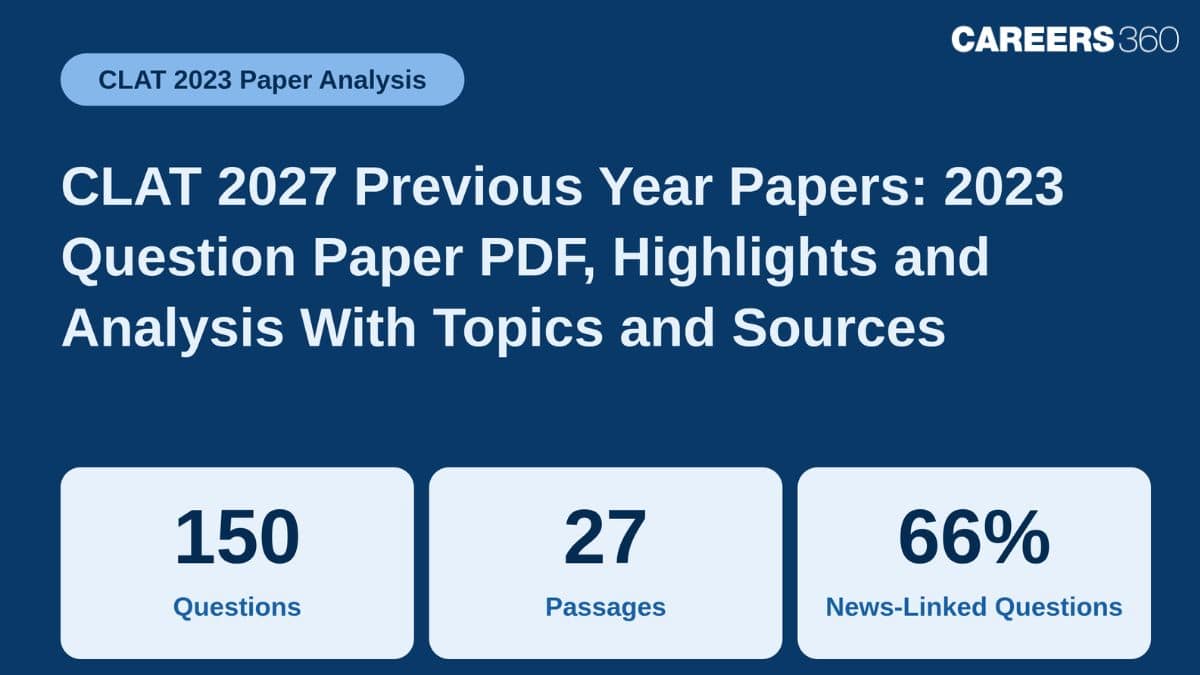
With CLAT 2027 approaching, closely reviewing previous-year papers is as important as taking mock tests. CLAT 2023 was the last paper under the old pattern, with questions from newspapers, current affairs, laws, editorials, books and data reports. It had 150 questions across 27 passages in 120 minutes, giving 48 seconds per question. From 2024, the paper changed to 120 questions and around 20-21 CLAT passages, giving one minute per question. Analysing past years' CLAT question papers shows which sections lean on reading, where passages come from and how questions are framed.
CLAT 2023 Section-wise Question Paper Analysis
Section | Passages | Questions | Question numbers | News-linked questions |
English Language | 6 | 30 | 1-30 | 0 |
Current affairs including GK | 5 | 35 | 31-65 | 35 (100%) |
Legal reasoning | 8 | 40 | 66-105 | 40 (100%) |
Logical reasoning | 5 | 30 | 106-135 | 24 (80%) |
Quantitative techniques | 3 | 15 | 136-150 | 0 |
Total | 27 | 150 | 1-150 | 99 (66%) |
In the CLAT 2023 question paper, newspapers and press statements accounted for the largest share, with 12 passages carrying 70 questions. Adding magazines, news websites, explainers and official sources, 17 of the 27 passages, carrying 99 questions, were news-linked.
All 35 questions in the current affairs section and all 40 questions in legal reasoning came from news-linked passages. Logical reasoning had 24 such questions out of 30. English and mathematics did not rely on news and had questions from textbooks, reports and original material.
CLAT 2023 English: 30 Questions, Books and Magazines
Passage | Question numbers | Questions | Type | Source | Topic |
I | 1-5 | 5 | Essay | Sumana Roy, "The Provincial Reader", Los Angeles Review of Books | A provincial reader's life, belatedness, the kabadiwala and old magazines |
II | 6-10 | 5 | Long-form reportage | Sowmiya Ashok, "The Dig", Fifty-Two | Keeladi excavation, Tamili script and urbanisation of Tamil Nadu |
III | 11-15 | 5 | Non-fiction book | Jia Tolentino, Trick Mirror | Internet, self-expression and performance on social media |
IV | 16-20 | 5 | Reported journalism | Aman Sethi, "At the Mercy of the Water Mafia", Foreign Policy | Delhi's water-tanker mafia and illegal groundwater supply |
V | 21-25 | 5 | Non-fiction book | Snigdha Poonam, Dreamers | English and class, Gandhi, Chetan Bhagat's E1/E2 |
VI | 26-30 | 5 | Fiction | Salman Rushdie, Haroun and the Sea of Stories | Iff and Haroun, naming, imagination and belief |
CLAT 2023 English Section Analysis
The English section had 6 passages with 5 questions each. Three came from books by Jia Tolentino (Trick Mirror), Snigdha Poonam (Dreamers) and Salman Rushdie (Haroun and the Sea of Stories). The other three came from Sumana Roy, Sowmiya Ashok and Aman Sethi.
Only one passage, by Rushdie, was fiction. The rest were essays, reportage and non-fiction, and four of the six dealt with India directly, from the kabadiwala to the Keeladi excavation.
CLAT English had a 20% share of the overall paper. The takeaway is that this section has moved from essays to classics and idea-heavy books.
CLAT 2023 Current Affairs: 35 Questions, 100% News-Based
Passage | Question numbers | Questions | Type | Source | Topic |
VII | 31-37 | 7 | Newspaper | The Hindu, "Droupadi Murmu elected 15th President of India" | Presidential election, Droupadi Murmu and the 2022 Vice-President election |
VIII | 38-44 | 7 | Magazine | Leonardo De Cosmo, Scientific American | Google's engineer's sentient-AI claim, LaMDA, Turing test and SUPACE |
IX | 45-51 | 7 | Newspaper | The Economic Times | FIFA World Cup 2022, OneLove armband, CAS, Kafala and Indian football |
X | 52-58 | 7 | Newspaper | Hindustan Times | FTX collapse, Alameda Research, Digital Rupee, cryptocurrency and Satyam |
XI | 59-65 | 7 | Newspaper | NS Ramaswamy, The Economic Times | Agriculture, Green Revolution, GHI 2022, MSP, Swaminathan Commission and stubble burning |
CLAT 2023 Current Affairs and GK Analysis
All 35 questions came from 5 news items, with 7 questions each. Each passage covered a different area: polity (Droupadi Murmu’s election), technology (the LaMDA AI claim), sports (the FIFA World Cup armband row), finance (the FTX collapse) and agriculture. All five stories were from 2022.
Questions also asked about related topics such as Kafala, the Digital Rupee, SUPACE and the Swaminathan Commission.
For CLAT 2027, the takeaway is that merely reading the news headline is not enough; connect those news items to bigger events and read the background topics and their related developments.
CLAT 2023 Legal Reasoning: 8 Passages, 40 Questions
Passage | Question numbers | Questions | Type | Source | Topic |
XII | 66-70 | 5 | News website | The Wire | Section 498A IPC, cruelty and Bombay HC's "maid servant" remark |
XIII | 71-75 | 5 | Newspaper explainer | Vijaita Singh, The Hindu | Criminal Procedure (Identification) Act, 2022, measurements and Magistrate's order |
XIV | 76-80 | 5 | News website | Gaurav Vivek Bhatnagar, The Wire | Electoral Bond Scheme 2018, amendment, validity and eligibility |
XV | 81-85 | 5 | News website | The Wire | Twitter's challenge to blocking orders, IT Act Section 69A and Section 79(1) safe harbour |
XVI | 86-90 | 5 | Official statement | NALSA, "FAQs" | Legal Services Authorities Act, 1987, free legal aid, Sections 12 and 13 |
XVII | 91-95 | 5 | Newspaper | The Indian Express | Surrogacy (Regulation) Act, 2021, eligibility, Article 21 and contract validity |
XVIII | 96-100 | 5 | News website | Diksha Munjal, Newslaundry | Internet shutdowns, Temporary Suspension Rules, 2017, Anuradha Bhasin, Article 19(1)(a) and (g) |
XIX | 101-105 | 5 | Web explainer | Nyaaya India, "Who is a Consumer?" | Consumer Protection Law, definition of consumer and commercial purpose |
CLAT 2023 Legal Reasoning Analysis
This was the biggest section, with 8 passages of 5 questions each, or 40 questions. All passages were based on laws, rules or schemes, with no court judgment passage. The Wire alone supplied 3 passages, accounting for 15 questions or 37.5% of the section.
Topics included Section 498A IPC, the Criminal Procedure (Identification) Act, 2022, the Electoral Bond Scheme and the Surrogacy (Regulation) Act, 2021.
The takeaway is that legal reading has moved from news explainers on laws to judgments and editorials on them. Follow new laws and recent court rulings, and note the principle behind each.
CLAT 2023 Logical Reasoning: 80% From Editorials and Magazines
Passage | Question numbers | Questions | Type | Source | Topic |
XX | 106-111 | 6 | Editorial | The Telegraph, "Stiff test" | Rupee depreciation, RBI's dilemma, inflation vs growth |
XXI | 112-117 | 6 | Editorial | The Telegraph, "Good news" | Print media as the most trusted source and trust in newspapers |
XXII | 118-123 | 6 | Magazine | Sunita Narain, "New energy conundrum", DownToEarth | Energy crisis, fossil fuels, US climate bill and carbon budget |
XXIII | 124-129 | 6 | Web news | Ananya Singh, The Swaddle | Ageing, gender stereotypes, motherhood penalty and gendered networks |
XXIV | 130-135 | 6 | Non-fiction book | Rutger Bregman, Humankind (Bloomsbury, 2021) | Negativity bias, availability bias and sensational news |
CLAT 2023 Logical Reasoning Analysis
Four of the five passages (24 of 30 questions) came from editorials, magazines, and a news website. Sources included The Telegraph, DownToEarth and The Swaddle. Topics in legal reasoning covered the rupee’s fall, trust in print media, the energy crisis and stereotypes in women’s careers. The fifth passage, from Rutger Bregman’s Humankind, was on negativity bias.
All four passages were based on original puzzles and factual situations. The takeaway is that candidates’ skills for finding assumptions and weak arguments were tested, and the answers were inside the passage itself.
For CLAT 2027, this section can no longer be prepared by reading editorials alone, so practice questions on puzzles and seating arrangements.
CLAT 2023 Quantitative Techniques Analysis: 15 Questions, 67% From Real Reports
Set | Question numbers | Questions | Type | Source | Topic |
XXV | 136-140 | 5 | Report data | Oxfam India, India Discrimination Report 2022 (with MoSPI/World Bank LFPR data) | Earnings gap by gender and SC/ST, LFPR, percentages, simple interest and ratios |
XXVI | 141-145 | 5 | Report data | FAO, world fruit production data | Fruit production in 2000 vs 2019, percentage share, quantities and discounts (Q145 is a standalone marked-price question) |
XXVII | 146-150 | 5 | Original | Not cited | Judo weight groups, averages and group membership |
CLAT 2023 Mathematics Section Analysis
Two of the three maths passages (10 of 15 questions, 67%) used real data, from Oxfam India’s India Discrimination Report 2022 and FAO fruit production figures. The third set, on judo weight groups, was original. Questions tested percentages, ratios, simple interest and averages.
Over the years, the topics have mostly stayed the same - ratios, percentages and averages. Practise reading tables fast, since interpretation takes more time than calculation.
CLAT 2023 vs CLAT 2026: What Changed and What Didn't
Section | CLAT 2023 share | CLAT 2026 share |
English language | 20% | 20% |
Current affairs including GK | 23.3% | 23.3% |
Legal reasoning | 26.7% | 25% |
Logical reasoning | 20% | 21.7% |
Quantitative techniques | 10% | 10% |
The section-wise weightage remained almost the same between CLAT 2023 and 2026, even though the paper was reduced from 150 to 120 questions. The 2023 paper helps CLAT 2027 aspirants understand how news and reading material become exam questions.
CLAT Previous Year Question Papers PDF Download
Year | Free PDF |
CLAT 2023 Question Paper with Solutions | |
CLAT 2020 Question Paper and Answer Key | |
CLAT 2019 Question Paper and Answer Key | |
CLAT 2018 Question Paper and Answer Key | |
CLAT 2016 Question Paper and Answer Key |
Candidates can download the previous years' papers to compare the old and revised patterns and practise questions from both formats for CLAT 2027.
Articles
Related Stories
|
Upcoming Law Exams

Certifications By Top Providers
Explore Top Universities Across Globe
Popular Courses and Specializations
Popular Degrees
List of colleges accepting CLAT
Browse Law Colleges by State
Questions related to CLAT
On Question asked by student community
Have a question related to CLAT ?
Hello Student,
The full form of the CLAT exam is the Common Law Admission Test. You can check the link related to the CLAT exam
https://law.careers360.com/articles/what-is-clat-full-form-all-about-nlus-entrance-exam
Hello Student,
Here are the Careers360 CLAT 2027 Mock Test Resources for your exam preparation.
1. Online CLAT Mock Test
2. CLAT Mock Tests and Solutions
Hello student,
CLAT 2027 aspirants can access these monthly current affairs compilations for regular revision. Use these resources to stay updated with important events and topics for CLAT 2027.
CLAT 2027 Current Affairs - Monthly Compilations
|
Particular |
Download PDF |
|
CLAT Current Affairs- August Month (2026) |
|
|
CLAT Current Affairs- |
If you have only two months, use a highly structured plan: daily current affairs, English reading, legal reasoning practice, logical reasoning sets, basic quantitative practice and regular full-length mocks. Spend as much time analysing incorrect questions as taking the mock itself. Consistency during these two months can make a substantial
You can download the CLAT previous years' question papers from here:
https://law.careers360.com/articles/clat-previous-year-question-papers
https://law.careers360.com/download/clat-sample-papers-previous-years

Applications for Admissions are open.
Ranked #18 amongst Institutions in India by NIRF | Get Upto 100% Scholarships | Spot Admissions via CUET
Woxsen University, Hyderabad
ApplyScholars’ Round Deadline: 14th Nov’26 | Earn upto 50% merit Scholarship + 10% for top performers | EFMD Accredited | AACSB (USA) & AMDISA Member | Highest CTC 28 LPA
Parul Institute of Law, Vadodara
ApplyBA LLB, BBA LLB, or BCom LLB and LLB | LLM 1 Year – 4 Specializations | Approved by BCI | Highest CTC 9 LPA
Institute of Law, Nirma University, Ahmedabad
ApplyGrade 'A+' Accredited by NAAC | Ranked 33rd in India by NIRF
Unitedworld School of Law, Karnavati University, Gandhinagar
ApplyMoot Court | Mock trials | Legal Aid Clinic | Recruiting Partners: FICCI, TCS, Adani, Trilegal, and many others
KCC Institute of Legal and Higher Education, Greater Noida
ApplyLaw Admissions 2026 Open | Avail Merit-Based Scholarships
CLAT Notifications
Never miss CLAT update
Get timely CLAT updates directly to your inbox. Stay informed!