SAGE University Bhopal Law Admissions 2026
100% Placement Assistance | Avail up to 100% Scholarships


Studying for the CLAT 2027 exam may be tough due to a large syllabus that requires coverage. But preparation should be intelligent in the sense that the student is aware of which topics require more coverage than the rest. The use of previous years' papers can give the students an idea of the kinds of questions asked, the recurring topics, and the topics that would challenge them.
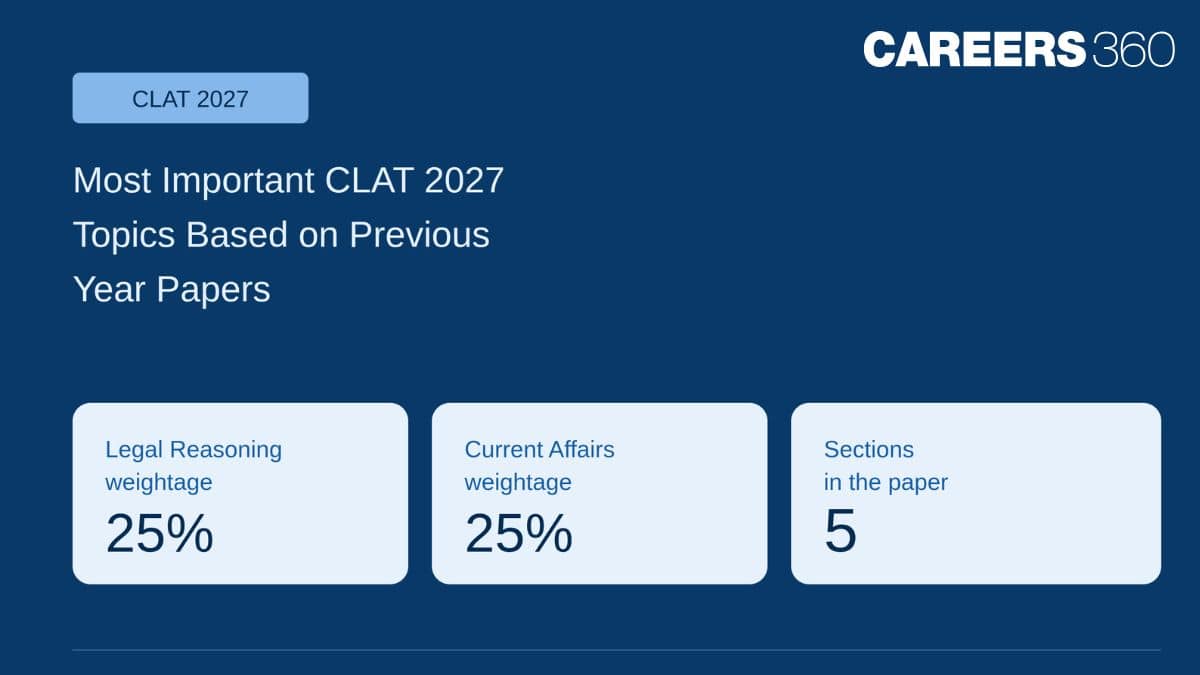
Unlike other exams, CLAT 2027 does not just require memorisation. CLAT 2027 has 120 questions for 120 marks, with 0.25 negative marking. The paper has five sections. The examination assesses reading comprehension, logical reasoning, law, general knowledge, and mathematics. Through proper analysis of previous years’ papers, the candidate will know which CLAT important topics to cover in the CLAT exam.
It becomes challenging for candidates to prepare for the CLAT 2027 exam due to the large number of subjects that one needs to study. However, rather than spending time learning all topics, preparing intelligently means knowing which CLAT important topics to focus on. CLAT previous year question papers can give a good idea about the types of questions asked in the paper, common topics, and those that have a high chance of testing a candidate's knowledge.
The Common Law Admission Test does not check how well a person can memorise things; instead, it focuses on reading and comprehension skills, logical reasoning, law-related knowledge, general knowledge, and basic math skills and CLAT subject-wise important topics.
The CLAT 2027 UG paper consists of five sections: English Language, Current Affairs including General Knowledge, Legal Reasoning, Logical Reasoning and Quantitative Techniques. As per the CLAT 2027 exam pattern, English carries around 20% of the paper, Current Affairs including GK 25%, Legal Reasoning 25%, Logical Reasoning 20% and Quantitative Techniques 10%.
When studying for CLAT 2027 preparation, students should pay heed to those aspects which are in tune with the skills listed in the CLAT syllabus. The previous year's papers could also be of help in this regard, along with CLAT subject-wise important topics.
The CLAT English language passages 2027 primarily assess reading comprehension, vocabulary, and understanding of the argument and idea conveyed in a passage.
Reading comprehension is one of the most essential skills tested through the English portion of the CLAT 2027 exam. Previously, the exam had reading comprehension passages from various genres such as literary works, social issues, historical events, technological aspects, and others.
Students must practice how to understand the theme of a passage, the tone used by the writer, key arguments in the passage, supporting details, and the conclusion drawn from a passage.
Rather than concentrating on learning difficult words, CLAT 2027 students must understand the usage of words in sentences. There will be questions based on the meaning of words, synonyms, antonyms, or the meaning of a word in context.
CLAT 2027 Candidates must keep practising questions regarding the main idea of the passage, purpose of the passage, opinion and tone of the author. Such questions can be attempted better when the habit of careful reading is developed by the students from CLAT important topics based on PYQs.
Current Affairs and General Knowledge can make a huge impact on the CLAT 2027
marks. This section needs regular preparation because CLAT 2027 current affairs can come from different fields.
CLAT 2027 Students should pay attention to national and international events taking place in India and across the globe. These include important governmental events, international events, appointments, summits, and important national events that must be revised by students.
Supreme Court and High Court cases, important constitutional questions, new laws, amendments, and other legal events are vital for law entrance exams.
Students must emphasise comprehending the significance of an event rather than remembering facts.
Other areas where students need to keep track of events include economics, science, and environment-related events.
The CLAT 2027 legal reasoning preparation is perhaps the most crucial one for candidates taking the CLAT 2027 exam. Candidates are normally given a passage where a legal principle or scenario is explained and then are asked to use the provided information to answer the questions.
Candidates must acquaint themselves with some basics and CLAT important topics, including fundamental rights, constitutional principles, equality, freedom, negligence, contracts, liability, and criminal law principles.
It is not necessary for CLAT 2027, however, that students go to the extent that a law student would. It will be much better to know how a principle works than to learn long legal definitions.
This is an important aspect of the legal reasoning section. CLAT 2027 Candidates must practise reading the principle carefully and then applying it only to the provided facts in the question.
It is often found that students use their legal knowledge from outside even when the passage contains everything needed. The candidate first needs to understand the provided principle and then logically apply it.
New legal trends and issues relating to the Constitution are equally valuable for preparation. One needs to follow significant judgments and legal events and their basic points.
CLAT 2027 Logical Reasoning assesses the student’s understanding of arguments and the relationship between concepts. It goes beyond the simple task of answering typical reasoning questions; it involves analysing the passage.
CLAT 2027 Students must practice CLAT 2027 important topics that is identifying the arguments, conclusion, assumptions, and supporting statements in a passage.
Some CLAT 2027 important topics will ask students to identify which statements support or weaken the argument, what assumption is made, or which conclusion can be drawn from the argument.
It is essential to understand the difference between assumption and inference. An assumption is an assumption in an argument. On the other hand, an inference is the conclusion that is likely to be made on the basis of the information. Practice will certainly help in doing these questions more quickly and accurately.
Another good type of question to practise is the cause and effect question and CLAT 2027 important topics. Students must be able to differentiate between the events that really do have a connection and those that happen to happen at the same time.
Though Quantitative Techniques has fewer questions than some other CLAT 2027 subjects, it is still worth paying attention to this subject and its CLAT 2027 important topics.
CLAT 2027 Questions based on percentages form one of the most useful topics to practice. Students must have a good command over percentage increase, decrease, and comparison. Students should practice from CLAT previous year paper analysis.
Ratio & proportion form an important topic because it may come in varied forms such as questions related to quantities, comparisons and data.
CLAT 2027 Students should be proficient at solving questions based on averages and also know how to calculate averages rapidly when data is given in the form of passages or tabulation.
Other arithmetic topics such as profit & loss, discounts, and simple interest should be revisited. The main emphasis should be on knowing the approach rather than remembering complex formulas.
Data interpretation is yet another vital topic. The CLAT 2027 students may need to interpret various forms of numeric data such as tabulations and graphs, etc.
It is not wise for students to allocate the same number of hours for each CLAT 2027 topic. Students must first start preparing for topics that have high frequency and where they lack knowledge through CLAT 2027 study material.
In the case of CLAT 2027 English and Logical Reasoning, preparation through solving passages is better than reading theoretical stuff. Legal reasoning requires preparation based on understanding and application of principles, while Current Affairs requires daily reading and monthly revision. Quantitative Techniques require constant numerical practice.
CLAT 2027 previous-year papers and CLAT previous year paper analysis must be solved within set time limits once they are done with basic preparation. Students must review not only the incorrect answers but also the questions that take too much time.
Also check: How to Improve Logical Reasoning Accuracy for CLAT 2027
Another common error is studying from predicted topic lists. While such topic lists may be handy in revising topics, they should never be considered instead of the official syllabus and past year papers.
Another mistake is avoiding the parts of the paper which appear tough. Skipping quantitative techniques or logical reasoning may lower the overall score. One should rather try to improve their weak areas progressively.
The candidates must avoid spending excessive time on memorising legal provisions and vocabulary without understanding their application. CLAT is all about comprehension and application; thus, practice should not be overlooked during preparation. Students can also check out " biggest myths about CLAT 2027 you should stop believing’’ for CLAT 2027 preparation.
Also check: CLAT 2027 Study Plan with Class 12 Board
Past year papers can serve as helpful tools for knowing what to expect in CLAT important topics based on PYQs. The major areas include reading comprehension and vocabulary in English, major current affairs and legal affairs in General Knowledge, legal principles and their application in Legal Reasoning, arguments and inference in Logical Reasoning, and basics of arithmetic and data interpretation in Quantitative Techniques.
Nevertheless, there is no set list of questions that will be in the exam. The best strategy would be to recognise the pattern and then practice well and CLAT subject-wise important topics. Regular preparation, CLAT previous year paper analysis, and CLAT important topics based on PYQs can make the preparation for CLAT more effective and efficient for students.
Also check: Contract Law and Tort Basics for CLAT 2027 Legal Reasoning

On Question asked by student community
Hello student,
CLAT 2027 aspirants can access these monthly current affairs compilations for regular revision. Use these resources to stay updated with important events and topics for CLAT 2027.
|
Particular |
Download PDF |
|
CLAT Current Affairs- August Month (2026) |
|
|
CLAT Current Affairs- |
If you have only two months, use a highly structured plan: daily current affairs, English reading, legal reasoning practice, logical reasoning sets, basic quantitative practice and regular full-length mocks. Spend as much time analysing incorrect questions as taking the mock itself. Consistency during these two months can make a substantial
You can download the CLAT previous years' question papers from here:
https://law.careers360.com/articles/clat-previous-year-question-papers
https://law.careers360.com/download/clat-sample-papers-previous-years
For CLAT 2027 UG, candidates need to have passed Class 12/equivalent with at least 45% marks, or 40% for SC/ST/PwD candidates.
In your situation, having an RT in an additional subject but subsequently passing the required qualification through an improvement examination does not automatically make you ineligible. However, the important
Here's the link to download the CLAT mock test:

Approved by BCI | Ranked #4 among Law Institutes in UP | NAAC A+ Accredited
Ranked 1 st among Top Law Schools of super Excellence in India - GHRDC | NAAC A+ Accredited | #36 by NIRF
Admission Against Cancellation/Lapsed Seats | Pay 500 Application Fee instead of ₹1500 | NIRF Ranked 87 | NAAC A+ Grade | Upto 100% scholarship
NAAC A+ Accredited | Students | Moot Court Session | Legal Aid Clinics | | Scholarships to Meritorious
Last Date to Apply: 17th August | QS I-Gauge Diamond Rated | NAAC A+ Accredited | 621 Recruitment Partners | INR 40 LPA Highest CTC | 4482 Job offers
Law at SCSVMV | NAAC 'A' Grade | AICTE, BCI & UGC Aproved | 100% Placement Support | Merit-based Scholarships