School of Law, UPES, Dehradun
Ranked #18 amongst Institutions in India by NIRF | Get Upto 100% Scholarships | Spot Admissions via CUET


Brazil’s presidential runoff on October 25, 2026 ended with Luiz Inácio Lula da Silva winning a fourth, non-consecutive term. Lula, 80, had trailed in the first round, and it is the first time since 1985 that the first-round runner-up has won the presidency. The result matters for India because New Delhi holds the 2026 BRICS chairmanship, is negotiating with the Mercosur trade bloc to expand the existing preferential trade agreement, and shares Brazil’s push for UN Security Council reform. For CLAT 2027 aspirants, the Brazil election is an important current affairs topic, covering BRICS, the G4, India-Mercosur trade ties and the difference between presidential and parliamentary systems. Understanding the result and its impact on India’s foreign policy can help candidates prepare for the CLAT 2027 Current Affairs and general knowledge section of the CLAT 2027 preparation.
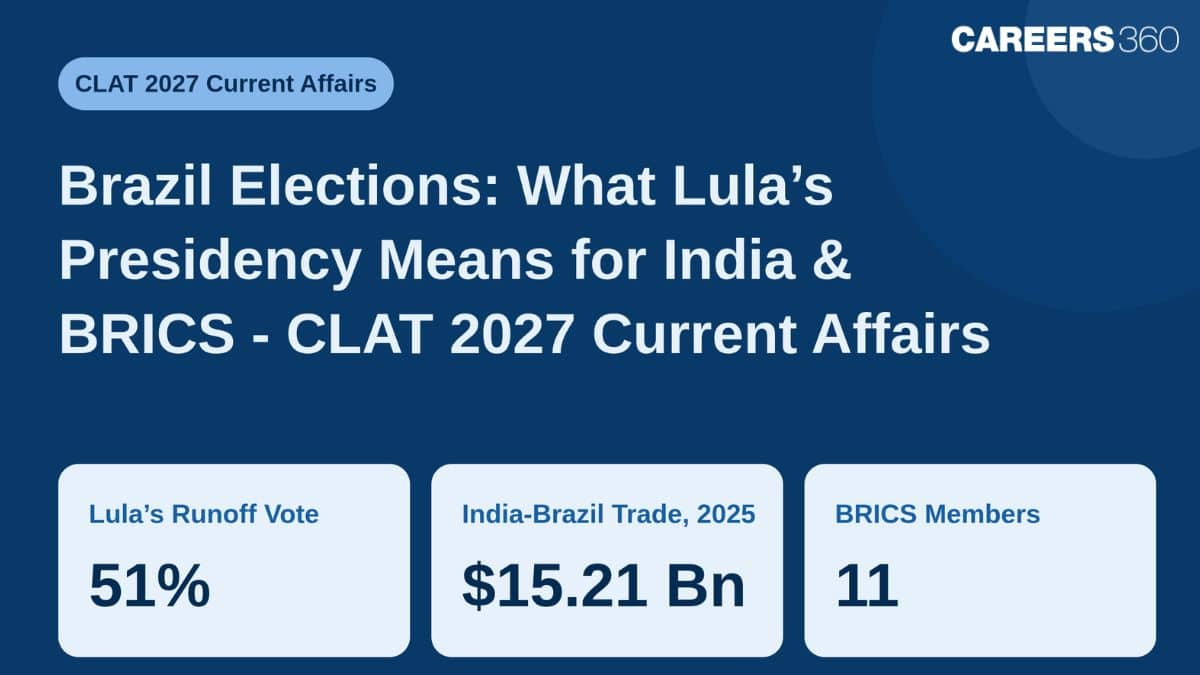
Why in News: On October 25, 2026, Lula won Brazil’s presidential runoff with just over 51% of the vote against Flávio Bolsonaro’s 48%, a lead of about 4.4 million votes.
A comeback: He trailed in the first round and still won. It is the first time since 1985 that the first-round runner-up has taken the presidency.
Regional shift: His win runs counter to a trend of right-of-centre candidates winning across Latin America.
India’s BRICS chairship: India chairs BRICS in 2026, its 20th anniversary year, and Brazil is a founding member. China and Russia both congratulated Lula.
Trade talks: India and Mercosur announced on September 14, 2026, that they would begin negotiating an expansion of their preferential trade agreement.
Strategic ties: Modi’s July 2025 state visit led to agreements on counter-terrorism, renewable energy and digital solutions. Both countries back each other’s UN Security Council bids.
Brazil’s elections are run by a special branch of the judiciary, the Electoral Court.
The Superior Electoral Court (TSE) in Brasília is the top body, with a Regional Electoral Court (TRE) in each state and the Federal District.
It registers voters, vets candidates, audits campaign money, monitors election law and settles election disputes.
It oversees the entire process, from registration to the winners' inauguration.
Brazil has used electronic voting machines since 2000.
Biometric voter ID began in 2008, and by June 2026, about 141 million voters (89%) were registered.
CLAT link: In Brazil, a court runs elections, while in India, the Election Commission does.
Ranked #18 amongst Institutions in India by NIRF | Get Upto 100% Scholarships | Spot Admissions via CUET
Scholars’ Round Deadline: 14th Nov’26 | Earn upto 50% merit Scholarship + 10% for top performers | EFMD Accredited | AACSB (USA) & AMDISA Member | Highest CTC 28 LPA
Brazil: The Electoral Justice system, including the Superior Electoral Court (TSE), administers and supervises elections.
India: The Election Commission of India is a constitutional body under Article 324 of the Constitution.
Key distinction: India’s Election Commission is independent of the executive and is not a court. Brazil assigns election administration to a specialised judicial system.
Continuity: Lula’s return keeps an established relationship steady amid shifting trade patterns, US-China rivalry and calls from developing economies for more say in global institutions.
Political context: Right-wing leaders aligned with US President Trump have gained ground across Latin America. Lula, by contrast, backs multilateralism, strategic autonomy and cooperation among developing economies, which fits India’s own priorities.
Trade: Bilateral trade rose by over 25% in 2025 to $15.21 billion, up from $12.20 billion in 2024. In the first six months of 2026, it reached about $8.77 billion, nearly 37% higher than a year earlier. The target is $30 billion by 2030.
Areas of cooperation: Trade, energy, pharmaceuticals, technology, critical minerals and global governance.
Mercosur talks: The India-Mercosur Preferential Trade Agreement has been in force since 2009. Talks to expand it began on September 14, 2026, with a long-term aim of a full FTA.
Leader-level ties: Modi made a state visit to Brazil in July 2025, and Lula visited India in February 2026.
A caution: Lula’s win does not mean Brazil will align with India on every issue or distance itself from the US. Both countries keep diverse partnerships, and real gains depend on trade negotiations and implementing existing agreements.
Founding member: Brazil was part of the original BRIC, and South Africa joined in 2010.
Bloc size: BRICS has 11 members and holds over 40% of the world’s population and over 32% of global GDP.
Global governance reform: India and Brazil both want developing economies to have a bigger role in global decision-making. This includes reform of the UN Security Council, where both seek permanent seats as members of the G4.
Local currencies: Lula has backed using national currencies in bilateral trade.
India’s chairship: India chairs BRICS in 2026, its 20th year, and hosted the 18th summit in New Delhi on September 12-13, adopting the New Delhi Declaration.
Partners’ reaction: Russia praised Lula’s contribution to the bloc, and China said it wants to keep building ties.
Differing styles: In 2025, Lula said BRICS would not accept complaints about its meeting after US tariff threats, while Modi did not address the issue. India has generally been more cautious than Russia or China.
Recent global news: CLAT’s current affairs section picks up big international events from the past year, and this is one.
Direct India link: India chairs BRICS in 2026 and is negotiating a trade deal with Mercosur.
Static plus current: Questions often pair news with basics like BRICS members, the G4 and the difference between a PTA and an FTA.
Law angle: Brazil’s presidential system and court-run elections contrast with India’s parliamentary system and Election Commission.
UN reform: India and Brazil both want permanent UN Security Council seats, a recurring exam theme.
Likely formats: Direct fact questions, group memberships, and statement-based questions.
CLAT 2027 aspirants can read the following current affairs topics to stay updated on key national and international events and strengthen their CLAT 2027 GK and Current Affairs preparation.
Delhi CJP Protest Explained: Preventive Detention, Article 22 and the NSA for CLAT 2027
SIR Controversy Explained: Election Commission Powers, Voter Rights For CLAT 2027
New Zealand FTA Explained for CLAT 2027: Key Facts, Benefits and Legal Implications
CLAT 2027 Current Affairs: Right to Internet Access as a Fundamental Right

On Question asked by student community
Hello Student,
Here are the Careers360 CLAT 2027 Mock Test Resources for your exam preparation.
1. Online CLAT Mock Test
2. CLAT Mock Tests and Solutions
Hello student,
CLAT 2027 aspirants can access these monthly current affairs compilations for regular revision. Use these resources to stay updated with important events and topics for CLAT 2027.
|
Particular |
Download PDF |
|
CLAT Current Affairs- August Month (2026) |
|
|
CLAT Current Affairs- |
If you have only two months, use a highly structured plan: daily current affairs, English reading, legal reasoning practice, logical reasoning sets, basic quantitative practice and regular full-length mocks. Spend as much time analysing incorrect questions as taking the mock itself. Consistency during these two months can make a substantial
You can download the CLAT previous years' question papers from here:
https://law.careers360.com/articles/clat-previous-year-question-papers
https://law.careers360.com/download/clat-sample-papers-previous-years
For CLAT 2027 UG, candidates need to have passed Class 12/equivalent with at least 45% marks, or 40% for SC/ST/PwD candidates.
In your situation, having an RT in an additional subject but subsequently passing the required qualification through an improvement examination does not automatically make you ineligible. However, the important

Ranked #18 amongst Institutions in India by NIRF | Get Upto 100% Scholarships | Spot Admissions via CUET
Scholars’ Round Deadline: 14th Nov’26 | Earn upto 50% merit Scholarship + 10% for top performers | EFMD Accredited | AACSB (USA) & AMDISA Member | Highest CTC 28 LPA
Moot Court | Mock trials | Legal Aid Clinic | Recruiting Partners: FICCI, TCS, Adani, Trilegal, and many others
NAAC A+ Accredited University
BA LLB, BBA LLB, or BCom LLB and LLB | LLM 1 Year – 4 Specializations | Approved by BCI | Highest CTC 9 LPA
Grade 'A+' Accredited by NAAC | Ranked 33rd in India by NIRF