Amity Law School, Noida
Experiential Learning through Legal Aid Camps, Lok Adalats, Court Visits, Community Lawyering and regular Moot Court sessions


Family law is one of the most scoring and predictable sections of the All India Bar Examination. With the AIBE 22 exam coming on 29 November 2026 and consisting of 100 multiple-choice questions carrying 100 marks, just a few days away, the best use of your remaining time is to revise the areas that carry the most marks. AIBE family law questions are usually direct and concept-based, so a focused revision can secure these marks quickly.
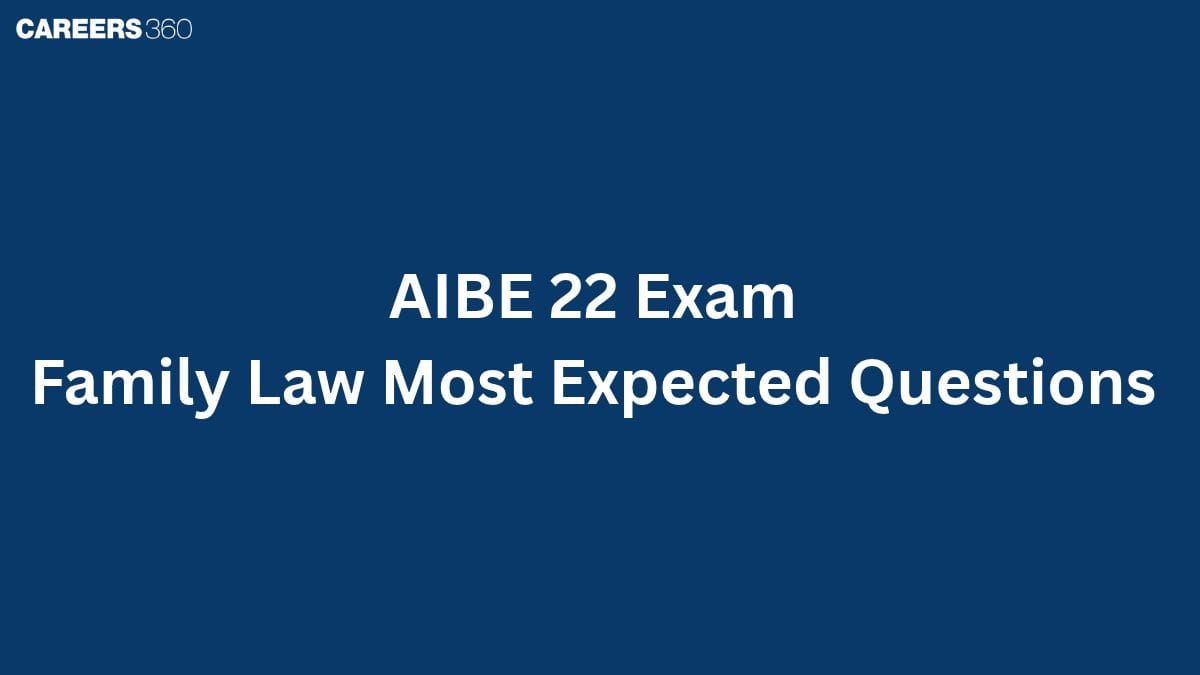
In the AIBE 19 question papers, family law appeared as a block of about 8 to 9 questions, which is roughly 8 to 9% of the paper. The topics covered are the Hindu Marriage Act (sapinda relationships, remarriage after divorce, cruelty as a ground for divorce and restitution of conjugal rights), sources of Hindu law such as Dayabhaga, child custody under the Guardians and Wards Act, 1890, and Muslim personal law (maintenance during iddat and for children, along with landmark cases like Shayara Bano). Practising these important questions with answers is the fastest way to revise before AIBE 22 exam day.
The Bar Council of India (BCI) has released the AIBE 22 admit cards on 14 November 2026.
The admit cards are available to all registered candidates.
Download yours from the official website: allindiabarexamination.com.
The exam will be held offline at centres across the country.
Exam date: 22 November 2026.
Get the AIBE previous year question papers here
Family law is one of the steadiest scoring areas of the All India Bar Examination, and the numbers show it. Family Law carries 8 of the 100 questions. With AIBE 22 on 29 November 2026, that is 8% of the paper, and the topics are direct and concept-based.
Q1. Where is "sapinda relationship" defined under the Hindu Marriage Act, 1955?
(A) Section 3(f)
(B) Section 3(g)
(C) Section 5(iv)
(D) Section 7
Answer: (A). The relationship runs to the third generation through the mother and the fifth through the father, counting the person.
Q2. Under Section 5(v), a marriage between sapindas is valid only if:
(A) both parties consent
(B) the court permits it
(C) a custom governing at least one party permits it
(D) the parents agree
Answer: (C). Otherwise, the marriage is void under Section 11. Section 18(b) punishes it with simple imprisonment up to one month or a fine up to ₹1,000, or both.
Q3. Restitution of conjugal rights is provided under:
(A) Section 7
(B) Section 9
(C) Section 10
(D) Section 13
Answer: (B). It applies when a spouse withdraws from the other's society without reasonable excuse. The burden of proving the excuse lies on the spouse who withdrew.
Q4. Aarti seeks divorce from Rajesh on grounds of continuous mental and physical abuse. Which statement is correct?
(A) Cruelty is not a ground for divorce
(B) Aarti can seek divorce on cruelty if she proves mental or physical cruelty
(C) Aarti must prove that the cruelty was intentional
(D) Aarti can seek divorce only on adultery
Answer: (B). Cruelty is a ground under Section 13(1)(ia). Intention need not be proved.
Q5. In custody proceedings under the Guardian and Wards Act, 1890, the court primarily considers:
(A) the gender of the child
(B) which parent is richer
(C) the welfare and best interests of the child
(D) the claim of the primary earner
Answer: (C). Welfare is the paramount test under Section 17 of that Act and Section 13 of the Hindu Minority and Guardianship Act, 1956.
Q6. Under Section 15 of the Hindu Marriage Act, a divorced person may marry again:
(A) immediately after the decree, whatever the appeal position
(B) after one year from the decree
(C) after the time for appeal has expired without an appeal being filed, or after an appeal has been dismissed
(D) only with the leave of the court
Answer: (C). This is the statutory rule. The AIBE 19 keys disagree on this question (six months in one set, immediate remarriage in others), so go by the wording of the options and the bare act.
Q7. Fatima, divorced by talaq, claims maintenance for herself and her two minor children. Imran says she has remarried. What is the position?
(A) She gets nothing because she remarried
(B) She gets maintenance for the iddat period, and the children get it until they are self-supporting
(C) She gets maintenance for life
(D) She gets maintenance for only three months, and nothing for the children
Answer: (B). Remarriage ends her own claim after iddat. The father's duty to maintain the children continues.
Q8. In Islamic jurisprudence, "Sunnat-ul-Taqrir" refers to:
(A) the spoken words of the Prophet
(B) the Prophet's silence or tacit approval of what was done in his presence
(C) the Prophet's acts
(D) the consensus of jurists
Answer: (B). Match the others as follows: Sunnat-ul-Qaul is spoken words and Sunnat-ul-Fial is acts. Shayara Bano goes with triple talaq. Deepika vs. CAT goes with customary law, and Kaur vs. Kartar Singh with atypical relationships.
Q9. In Shayara Bano v. Union of India (2017), the Supreme Court held that:
(A) all forms of talaq are unconstitutional
(B) instant triple talaq (talaq-e-biddat) is unconstitutional
(C) personal laws cannot be tested against fundamental rights
(D) talaq-e-ahsan is void
Answer: (B). The 3:2 decision was followed by the Muslim Women (Protection of Rights on Marriage) Act, 2019, which makes instant triple talaq void and punishable with up to three years' imprisonment.
Q10. Under Section 13B, divorce by mutual consent requires a second motion after:
(A) 30 days
(B) 3 months
(C) 6 months
(D) 2 years
Answer: (C). The parties must also have lived apart for at least one year. In Amardeep Singh v. Harveen Kaur (2017), the Supreme Court held that the six-month period is directory and can be waived.
AIBE Law of Contract, Specific Relief, Property Laws & Negotiable Instruments PYQs
AIBE Professional Ethics & Cases of Professional Misconduct Under BCI Rules PYQs
These are the 10 most expected Family Law topics for AIBE 22, based on past paper trends.
Download the Free AIBE 22 Sample Paper with Answer Key and Ace the All India Bar Examination
AIBE 22 Mock Test Series helps candidates practise important questions, revise key legal subjects and prepare for the upcoming AIBE 22 exam. Solve mock tests to check your preparation, improve accuracy and build confidence before the exam.
AIBE 22 Mock Test | Download Free PDF Here |
AIBE 22 Mock Test 1 | |
AIBE 22 Mock Test 2 | |
AIBE 22 Mock Test 3 |
Family law is one of the most dependable parts of the AIBE, because the same handful of ideas keep coming back. There are only a few days left before AIBE 22 on 29 November 2026, so don't try to cover everything. Go through the Hindu Marriage Act sections that keep appearing: sapinda relationships, remarriage after divorce, cruelty and restitution of conjugal rights. Then revise the custody rule that the child's welfare comes first, and the Muslim law basics on iddat, maintenance and the landmark cases.

On Question asked by student community
Hello student!
AIBE question papers in Kannada medium are not explicitly available. Meanwhile, you can check these resources for AIBE previous-year question papers and the AIBE 21 (2026) Set A and Set B papers for practice.
AIBE Previous-Year Question Papers:
https://law.careers360.com/articles/aibe-previous-year-question-papers
AIBE 21 Set B Question Paper 2026:
https://law.careers360.com/articles/aibe-21-set-b-question-paper-pdf-2026
AIBE
Hello Student,
You can check the relevant article below
https://law.careers360.com/download/ebooks/aibe-preparation-guide
Hope it helps!
Hello Student,
You can access the AIBE previous year question papers in Hindi by clicking on the relevant link given below.
https://law.careers360.com/hi/articles/aibe-previous-year-question-papers
Hey there,
No. If you are currently in the 5th semester of a 3-year LL.B., you generally cannot register for AIBE yet.
Under the current BCI rules, a 3-year LL.B. student must be in the final semester (6th semester) and have no backlogs from previous semesters to register for AIBE.
Hello Dear Student,
The All India Bar Examination (AIBE) covers 19 major legal subjects, carrying a high-weightage focus on Constitutional Law (8–12 questions) and Family Law including Hindu and Muslim law (6–8 questions)
You can check, find and access more information here:

Experiential Learning through Legal Aid Camps, Lok Adalats, Court Visits, Community Lawyering and regular Moot Court sessions
Ranked #18 amongst Institutions in India by NIRF | Get Upto 100% Scholarships | Spot Admissions via CUET
NAAC A++ Accredited | Avail up to 100% scholarship via MRNAT-Manav Rachna National Aptitude Test
NAAC A++ Approved | Curriculum Aligned with BCI & UGC
UG Scholar's Round Deadline: 1st Dec'26 | Earn upto 50% merit Scholarship + 10% for top performers | Highest CTC 18 LPA
Grade 'A+' Accredited by NAAC | Ranked 33rd in India by NIRF