Amity Law School, Noida
Experiential Learning through Legal Aid Camps, Lok Adalats, Court Visits, Community Lawyering and regular Moot Court sessions


Solving AIBE previous years' papers is one of the best ways to understand how the Bar Council of India actually tests candidates. AIBE 22 is on 29 November 2026, a pen-and-paper (OMR) exam conducted by the Bar Council of India, with 100 multiple-choice questions for 100 marks across 19 subjects and no negative marking. Going by the AIBE 19, 20 and 21 papers, focus your last few days of revision on Constitutional Law, Criminal Law, Civil Procedure, Evidence Law and Family Law, since these recur most often.
The Bar Council of India (BCI) has released the AIBE 22 admit cards on 14 November 2026.
The admit cards are available to all registered candidates.
Download yours from the official website: allindiabarexamination.com.
The exam will be held offline at centres across the country.
Exam date: 29 November 2026.
An analysis of the AIBE 19 (2024), AIBE 20 (2025) and AIBE 21 (2026) question papers shows that Constitutional Law, Civil Procedure, Criminal Law and Evidence Law continue to receive significant coverage. In AIBE 19, Constitutional Law, BNSS and CPC accounted for 10 questions each, while BNS, Evidence Law and Family Law carried 8 questions each. In AIBE 21, Constitutional Law accounted for about 15 questions, followed by CPC with 13 and Criminal Procedure with 9. The AIBE 20 paper also tested both the old criminal laws and the new criminal codes, along with statement-conclusion and assertion-reason questions.
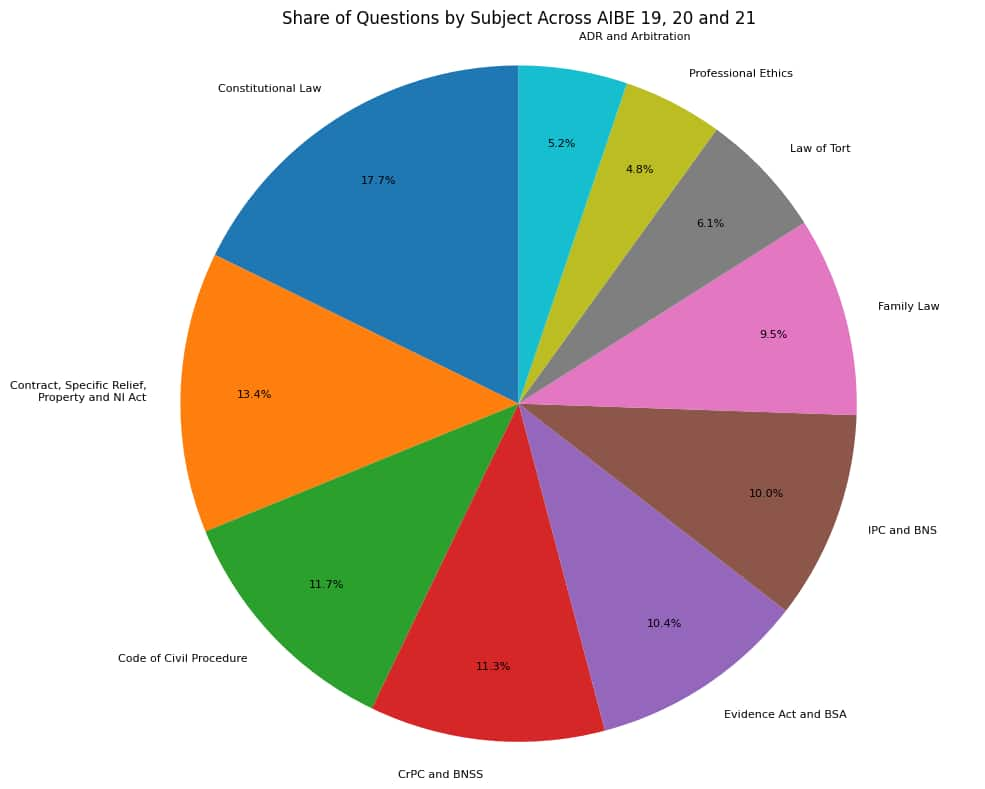
The following table compares the number of questions classified under each subject in the three previous sessions.
Subject | AIBE 19 | AIBE 20 | AIBE 21 | Total |
Constitutional Law | 12 | 15 | 14 | 41 |
Contract, Specific Relief, Property and NI Act | 11 | 12 | 8 | 31 |
Code of Civil Procedure | 10 | 8 | 9 | 27 |
CrPC and BNSS | 9 | 7 | 10 | 26 |
Evidence Act and BSA | 8 | 8 | 8 | 24 |
IPC and BNS | 7 | 8 | 8 | 23 |
Family Law | 6 | 8 | 8 | 22 |
Law of Tort | 5 | 4 | 5 | 14 |
Professional Ethics | 3 | 4 | 4 | 11 |
ADR and Arbitration | 4 | 4 | 4 | 12 |
Students can also check other topic-wise Most Repeated PYQs,
Based on the recurring subject areas and topic trends in recent AIBE papers, candidates should focus on the following topics:
Subject | Most Important and Repeated Topics |
Constitutional Law | Fundamental Rights (Articles 12–35), DPSPs, writs, judicial review, constitutional amendments and Seventh Schedule |
Criminal Law (IPC/BNS) | General exceptions, criminal liability, offences against the human body, theft, robbery and punishments |
Criminal Procedure (CrPC/BNSS) | Arrest, bail, FIR, cognizable and non-cognizable offences, investigation and trial procedures |
CPC | Jurisdiction, res judicata, execution of decrees, written statements, temporary injunctions and appeals |
Evidence Law (Evidence Act/BSA) | Admissions, confessions, relevancy of facts, burden of proof, expert opinion and documentary evidence |
Family Law | Marriage, divorce, maintenance, adoption, succession and guardianship |
Contract Law | Offer and acceptance, consideration, breach of contract, indemnity, guarantee and specific performance |
Professional Ethics | Duties of advocates, professional misconduct, Bar Council rules and disciplinary proceedings |
Law of Tort | Negligence, nuisance, defamation, vicarious liability and strict liability |
ADR | Arbitration agreements, arbitral awards, conciliation and Lok Adalats |
Here are some key tips for AIBE 22 aspirants to solve previous-year question papers effectively.
Take a full paper like a real exam. Pick one paper, say AIBE 21, and solve it in one sitting with a timer. It shows you where you really stand.
Analyse weak areas. Don't stop at the score. Figure out whether you missed a question because you didn't know the law or because you misread it.
Compare AIBE 19, 20 and 21 together. You'll see the same articles, sections and landmark cases coming back in slightly different forms.
Start with the AIBE's most repeated subjects. Constitutional Law, Criminal Law, Civil Procedure, Evidence Law and Family Law give the most dependable marks.
Fix every wrong answer at the source. Open the bare act section or article behind each mistake instead of just memorising the correct option.
Get quick at finding provisions. The exam is open book, so tab your bare acts and get comfortable with the index. Speed on exam day matters.
Do one last mock in the final days. It tells you whether your weak areas have actually improved.
Keep the last days calm. Don't start new topics. Re-solve your old mistakes, revise lightly and sleep well.
With only a few days left before 29 November, previous year papers are the best use of your time, and the way you use them matters. Start by solving one full paper, say AIBE 21, in a single sitting with a timer running. This gives you an honest picture of where you stand and how you handle 100 questions back to back. Once you check your answers, don't just look at the score. Note which subjects cost you the most marks, and whether you lost them because you didn't know the law or because you misread the question.

On Question asked by student community
Hello student!
AIBE question papers in Kannada medium are not explicitly available. Meanwhile, you can check these resources for AIBE previous-year question papers and the AIBE 21 (2026) Set A and Set B papers for practice.
AIBE Previous-Year Question Papers:
https://law.careers360.com/articles/aibe-previous-year-question-papers
AIBE 21 Set B Question Paper 2026:
https://law.careers360.com/articles/aibe-21-set-b-question-paper-pdf-2026
AIBE
Hello Student,
You can check the relevant article below
https://law.careers360.com/download/ebooks/aibe-preparation-guide
Hope it helps!
Hello Student,
You can access the AIBE previous year question papers in Hindi by clicking on the relevant link given below.
https://law.careers360.com/hi/articles/aibe-previous-year-question-papers
Hey there,
No. If you are currently in the 5th semester of a 3-year LL.B., you generally cannot register for AIBE yet.
Under the current BCI rules, a 3-year LL.B. student must be in the final semester (6th semester) and have no backlogs from previous semesters to register for AIBE.
Hello Dear Student,
The All India Bar Examination (AIBE) covers 19 major legal subjects, carrying a high-weightage focus on Constitutional Law (8–12 questions) and Family Law including Hindu and Muslim law (6–8 questions)
You can check, find and access more information here:

Experiential Learning through Legal Aid Camps, Lok Adalats, Court Visits, Community Lawyering and regular Moot Court sessions
Ranked #18 amongst Institutions in India by NIRF | Get Upto 100% Scholarships | Spot Admissions via CUET
NAAC A++ Accredited | Avail up to 100% scholarship via MRNAT-Manav Rachna National Aptitude Test
NAAC A++ Approved | Curriculum Aligned with BCI & UGC
UG Scholar's Round Deadline: 1st Dec'26 | Earn upto 50% merit Scholarship + 10% for top performers | Highest CTC 18 LPA
Grade 'A+' Accredited by NAAC | Ranked 33rd in India by NIRF