Amity Law School, Noida
Experiential Learning through Legal Aid Camps, Lok Adalats, Court Visits, Community Lawyering and regular Moot Court sessions


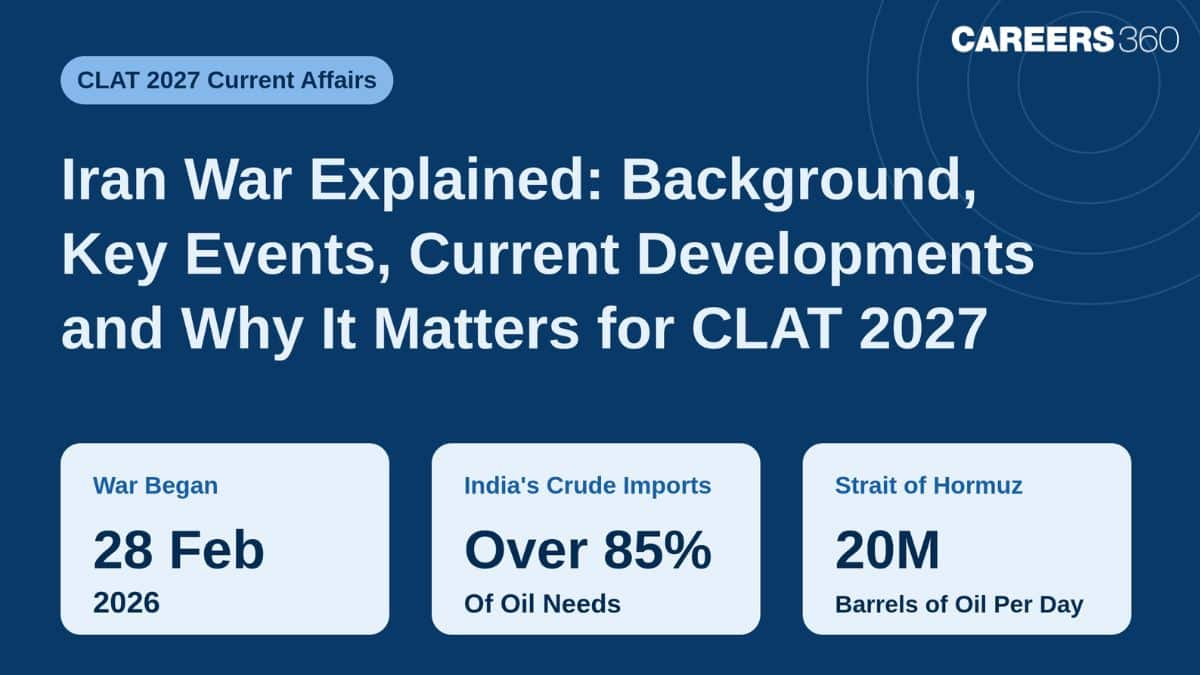
The US-Israel war with Iran is one of the most consequential developments of the year. With the Strait of Hormuz closed for over eight months, its implications for global food and energy security, shipping, and security alliances have reached well beyond West Asia, including India. CLAT 2027 passage-based questions are directly framed on such topics. For example, the Russia-Ukraine conflict was first asked in UG CLAT 2022 and then in CLAT PG 2023. BRICS and SCO Summits are also asked in CLAT 2027 Current Affairs. In this context, aspirants should understand why this war began and what its broader implications are for CLAT 2027 Preparation. This article covers everything about the US-Iran war that CLAT 2027 aspirants must read.
US-Iran relations swung from close partnership to open hostility within a single decade. In 1953, a coup backed by the CIA and Britain's MI6 toppled Prime Minister Mohammad Mossadegh and restored Shah Mohammad Reza Pahlavi to power. Through the 1960s and 1970s, the Shah was Washington's key Gulf ally. He bought American arms, and the US even helped start Iran's civilian nuclear programme. His "White Revolution" modernised Iran on Western lines, but his rule relied on the secret police (SAVAK), and the oil boom widened inequality.
Discontent against the Pahlavi monarchy, led by clerics, students and the bazaar, turned into the 1979 Islamic Revolution. The Shah fled, and Ayatollah Ruhollah Khomeini founded the Islamic Republic. In November 1979, students seized the US embassy in Tehran and held 52 Americans for 444 days. Washington cut diplomatic ties in 1980, and the two states have had none since. Iran began to back anti-Israel groups across West Asia, and the US layered sanctions on Iran.
The nuclear issue became the central dispute. The 2015 nuclear deal (JCPOA) eased sanctions in return for limits on enrichment. The US withdrew in 2018 under President Trump. In June 2025, Israel and Iran fought a 12-day war that the US briefly joined. That set the stage for the present conflict.
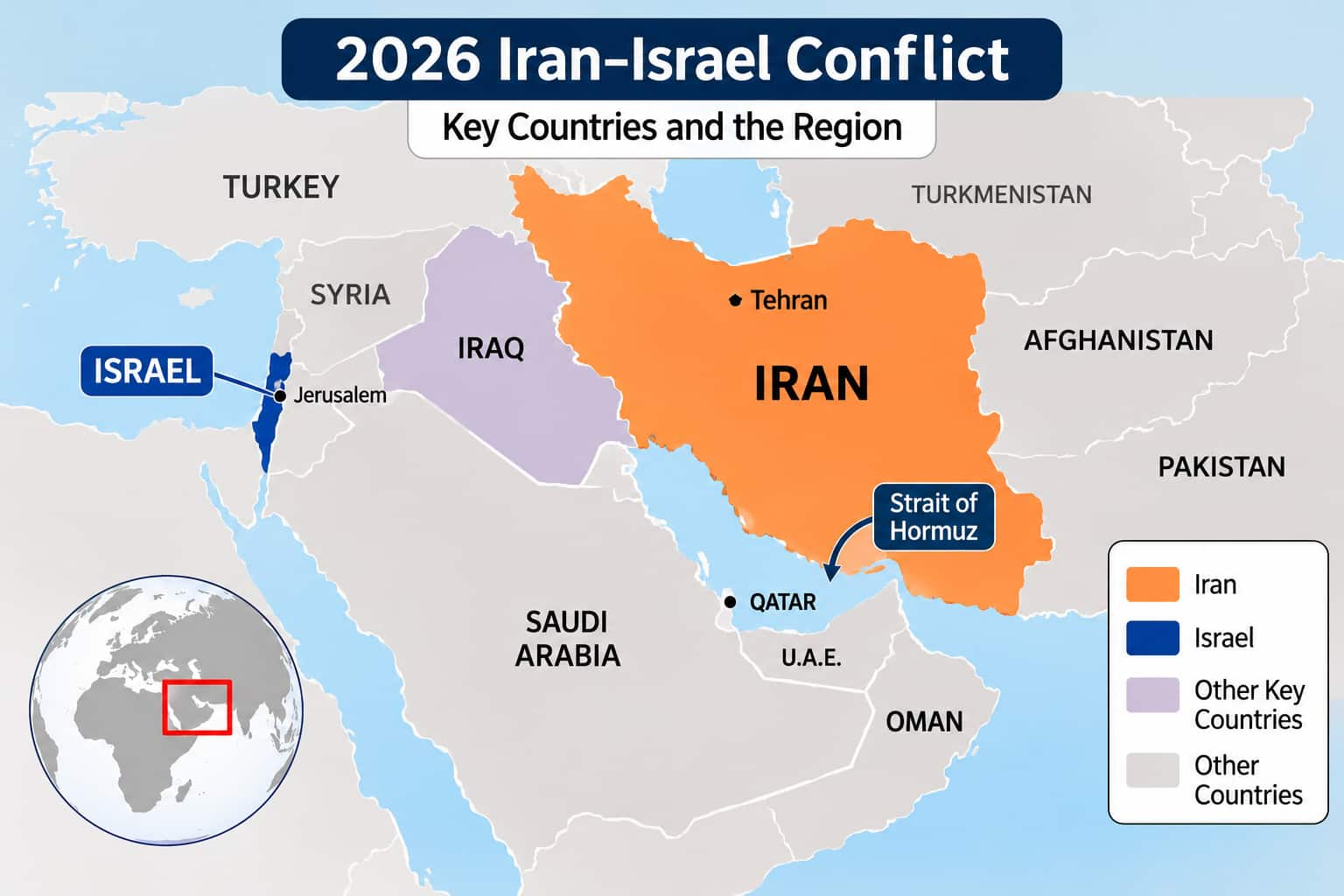
Washington and Jerusalem pointed mainly to Iran's nuclear programme, but the attack also sits on a wider Israel-Iran rivalry across West Asia.
Nuclear enrichment allegations: Before the June 2025 strikes, the IAEA estimated Iran held about 440.9 kg of uranium enriched to 60%, close to weapons-grade and enough for roughly 10 bombs if enriched further. Since the June 2025 war, Iran has blocked inspectors from damaged sites, so the stockpile's fate is unknown. Iran says its programme is peaceful. Critics of the war argue the evidence showed capability, not a proven rush to build a bomb.
Israel-Iran rivalry across the region: Israel sees Iran as an existential threat. Iran backs armed groups in several countries: Hezbollah in Lebanon, the Houthis in Yemen, militias in Iraq, and Hamas in Gaza. Most of these allies are Shia or Shia-aligned, though Hamas is Sunni. Iran is also the leading Shia-majority state and a rival of Sunni Saudi Arabia, which adds a sectarian layer to the power contest.
A coordinated US-Israel attack: On 28 February 2026, the two countries launched joint strikes, a day after Oman said US-Iran talks in Geneva had made "significant progress". Israel called the strikes pre-emptive, and President Trump said the aim was to remove imminent threats and urged Iranians to overthrow the Islamic Republic.
Top leaders killed: Supreme Leader Ayatollah Ali Khamenei, in power since 1989, was killed on the first day, along with senior adviser Ali Shamkhani and Revolutionary Guards chief Gen. Mohammad Pakpour. Mojtaba Khamenei is now the Supreme Leader.
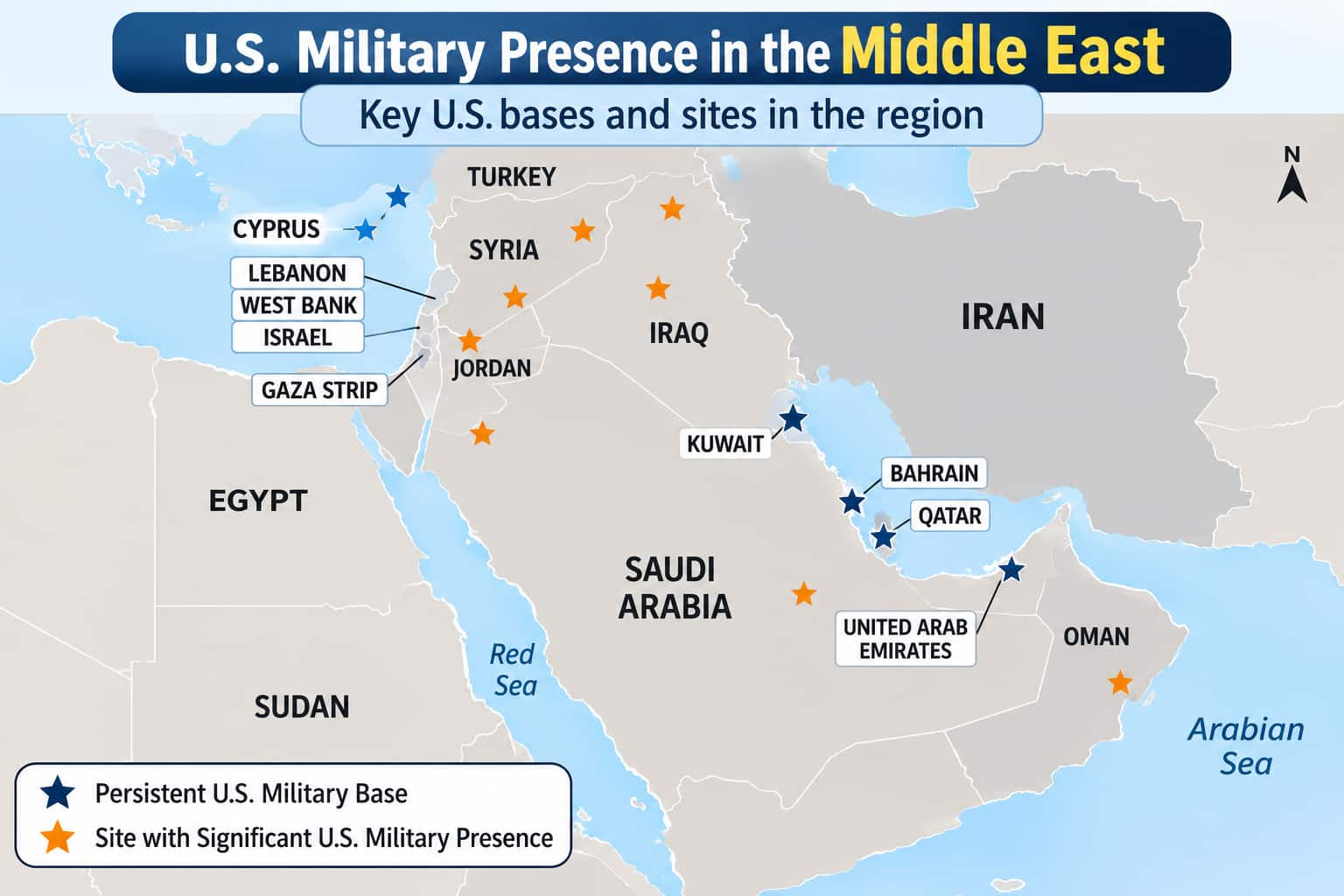
Iran's response: Missile and drone strikes on Israel and on US bases in Bahrain, the UAE, Kuwait, Qatar and Jordan, and an effective closure of the Strait of Hormuz.
Why Hormuz matters: The Strait of Hormuz is a narrow sea route between Iran and Oman. Before the war, about one-fifth of the world's oil passed through it, along with a large share of LNG and fertilisers. Iran has kept it effectively closed since February.
India's problem: India imports over 85% of its crude oil, and a big part of it comes from Gulf countries. With Hormuz closed, India faces two crises:
Energy crisis: shortages of LPG and fuel, and a rising import bill.
Fertiliser shortage: Indian fertiliser plants depend heavily on Gulf gas, so less fertiliser threatens crops and food security.
India's position: India is walking a tightrope. It has not condemned either side, and it keeps talking to Iran, the US, Israel and the Gulf states. It is also buying oil from other suppliers, such as Russia, and pushing for safe passage of Indian ships.
Beyond India: The war has disrupted global supply chains. Europe, China and South Asian countries are hit by soaring energy prices.
Scholars’ Round Deadline: 14th Nov’26 | Earn upto 50% merit Scholarship + 10% for top performers | EFMD Accredited | AACSB (USA) & AMDISA Member | Highest CTC 28 LPA
BA LLB, BBA LLB, or BCom LLB and LLB | LLM 1 Year – 4 Specializations | Approved by BCI | Highest CTC 9 LPA
There is no settled ceasefire today. The first ceasefire came on 7-8 April 2026, mediated by Pakistan, but the US struck Qeshm Island, which sits at the mouth of Hormuz, several times afterwards. A second, 60-day US-Iran memorandum followed in mid-June, collapsed by mid-July, and the US blockade resumed. The latest US strikes on Qeshm came on 2 November, while Qatar-led indirect talks were under way.
Date | Event |
2 Nov | US "limited defensive strikes" on Qeshm after Iran's Revolutionary Guards fired on a US aircraft; Trump says a deal "could happen" |
14 Jul | US blockade of Iranian ports restarts; Trump declares the June truce over |
26-27 Jun | US strikes near Geruk and on Qeshm after ship attacks; Iran hits US bases in Bahrain and Kuwait |
14-17 Jun | Deal announced 14 June, memorandum signed 17 June, to reopen Hormuz; only about 28 ships a day transit afterwards |
2-3 Jun | US strikes a drone control station on Qeshm; Iran targets US bases in Kuwait and Bahrain |
7 May | US strikes Bandar Abbas and Qeshm |
7-8 Apr | Two-week ceasefire agreed, with Pakistan as mediator |
28 Feb | US and Israel launch the war; Khamenei killed |
Where talks stand: Qatar and Pakistan are mediating. Iran's proposal asks the US to release frozen assets, lift its blockade and sanctions, and end fighting on all fronts, including Lebanon and Gaza. In return, Iran would reopen Hormuz and discuss its nuclear programme. Iran has offered to shorten the implementation period from seven days to two. Reports say Israel's Prime Minister Netanyahu is pressing Trump for new strikes after the US midterm elections, while Trump says the war will end soon "one way or the other".
The economic risk: In April, the IMF cut its 2026 global growth forecast to 3.1% and warned that a longer war keeping oil above $110 could push growth towards 2%, which it called a close call for a global recession. If the standoff continues for several more months, high energy and fertiliser prices could tip weaker economies into recession and push inflation up worldwide.
CLAT 2027 aspirants can refer to the following facts and important points for a quick revision of the topic.
Conflict Timeline: War began on 28 February 2026, followed by ceasefire efforts in April and renewed tensions in July.
Strait of Hormuz: A major global oil shipping route connecting the Persian Gulf with international markets.
Economic Impact: Disruptions in oil and LNG supplies can increase fuel prices, fertiliser costs, food prices and inflation.
Important Terms: JCPOA, IAEA, naval blockade, chokepoint, uranium enrichment and strategic petroleum reserves.
Legal Aspects: Article 2(4) of the UN Charter prohibits the use of force, while Article 51 recognises the right to self-defence.
UNCLOS: Provides for transit passage through international straits. Iran has signed but not ratified the Convention; the US is not a party.
India's Position: India called for restraint, diplomacy and safe navigation through the Strait of Hormuz.
India's Energy Dependence: India imports over 85% of its crude oil requirements.
Global Oil Supply: Around 20 million barrels of oil pass through the Strait of Hormuz daily under normal conditions.
IMF Forecast: The IMF projected global economic growth of 3.1% for 2026 in its April 2026 outlook.
CLAT Focus Areas: International relations, international law, energy security, India's foreign policy and global economic impact.
CLAT 2027 aspirants can access these monthly current affairs compilations for regular revision. Use these resources to stay updated with important events and topics for CLAT 2027.
Particular | Download PDF |
CLAT Current Affairs- October Month (2026) | |
CLAT Current Affairs- September Month (2026) | |
CLAT Current Affairs- August Month (2026) | |
CLAT Current Affairs- July Month (2026) | |
CLAT Current Affairs- June Month (2026) | |
CLAT Current Affairs- May Month (2026) | |
CLAT Current Affairs- April Month (2026) | |
CLAT Current Affairs- March Month (2026) |
CLAT 2027 aspirants can read the following current affairs topics to stay updated on key national and international events and strengthen their CLAT 2027 GK and Current Affairs preparation.
Delhi CJP Protest Explained: Preventive Detention, Article 22 and the NSA for CLAT 2027
SIR Controversy Explained: Election Commission Powers, Voter Rights For CLAT 2027
New Zealand FTA Explained for CLAT 2027: Key Facts, Benefits and Legal Implications
CLAT 2027 Current Affairs: Right to Internet Access as a Fundamental Right

On Question asked by student community
Hello Student,
The full form of the CLAT exam is the Common Law Admission Test. You can check the link related to the CLAT exam
https://law.careers360.com/articles/what-is-clat-full-form-all-about-nlus-entrance-exam
Hello Student,
Here are the Careers360 CLAT 2027 Mock Test Resources for your exam preparation.
1. Online CLAT Mock Test
2. CLAT Mock Tests and Solutions
Hello student,
CLAT 2027 aspirants can access these monthly current affairs compilations for regular revision. Use these resources to stay updated with important events and topics for CLAT 2027.
|
Particular |
Download PDF |
|
CLAT Current Affairs- August Month (2026) |
|
|
CLAT Current Affairs- |
If you have only two months, use a highly structured plan: daily current affairs, English reading, legal reasoning practice, logical reasoning sets, basic quantitative practice and regular full-length mocks. Spend as much time analysing incorrect questions as taking the mock itself. Consistency during these two months can make a substantial
You can download the CLAT previous years' question papers from here:
https://law.careers360.com/articles/clat-previous-year-question-papers
https://law.careers360.com/download/clat-sample-papers-previous-years

Experiential Learning through Legal Aid Camps, Lok Adalats, Court Visits, Community Lawyering and regular Moot Court sessions
Ranked #18 amongst Institutions in India by NIRF | Get Upto 100% Scholarships | Spot Admissions via CUET
Scholars’ Round Deadline: 14th Nov’26 | Earn upto 50% merit Scholarship + 10% for top performers | EFMD Accredited | AACSB (USA) & AMDISA Member | Highest CTC 28 LPA
BA LLB, BBA LLB, or BCom LLB and LLB | LLM 1 Year – 4 Specializations | Approved by BCI | Highest CTC 9 LPA
Grade 'A+' Accredited by NAAC | Ranked 33rd in India by NIRF
Moot Court | Mock trials | Legal Aid Clinic | Recruiting Partners: FICCI, TCS, Adani, Trilegal, and many others