School of Law, UPES, Dehradun
Ranked #18 amongst Institutions in India by NIRF | Get Upto 100% Scholarships | Spot Admissions via CUET


If you’re preparing for CLAT 2027, the official mock tests are the closest thing you’ll get to a preview of the real paper. The Consortium of NLUs released CLAT 2027 Official Mock Test 1 on 10 November and CLAT 2027 Official Mock Test 2 on 20 November, and together they give a clear picture of how the CLAT 2027 exam is likely to look: the kind of passages you’ll face, how questions are framed, and how much time you’ll actually have for each section.
We went through both mocks carefully, section by section. In this article, we break down the pattern, the difficulty level, and the question types you should expect in CLAT 2027 English, Current Affairs, Legal Reasoning, Logical Reasoning, and Quantitative Techniques. We also point out what has changed from earlier years, so you can adjust your strategy instead of preparing blindly.
Whether you’re just starting out or already attempting full-length CLAT 2027 mock tests, this guide will help you understand where to focus, what to practise, and how to approach CLAT 2027 with more confidence.
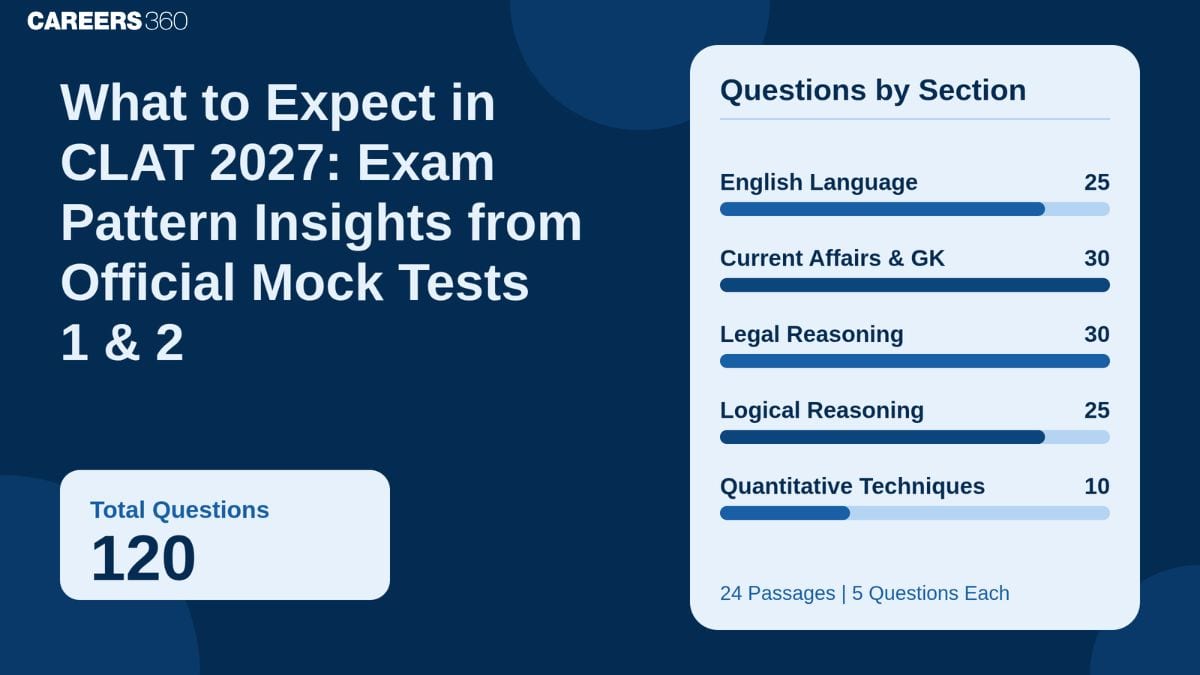
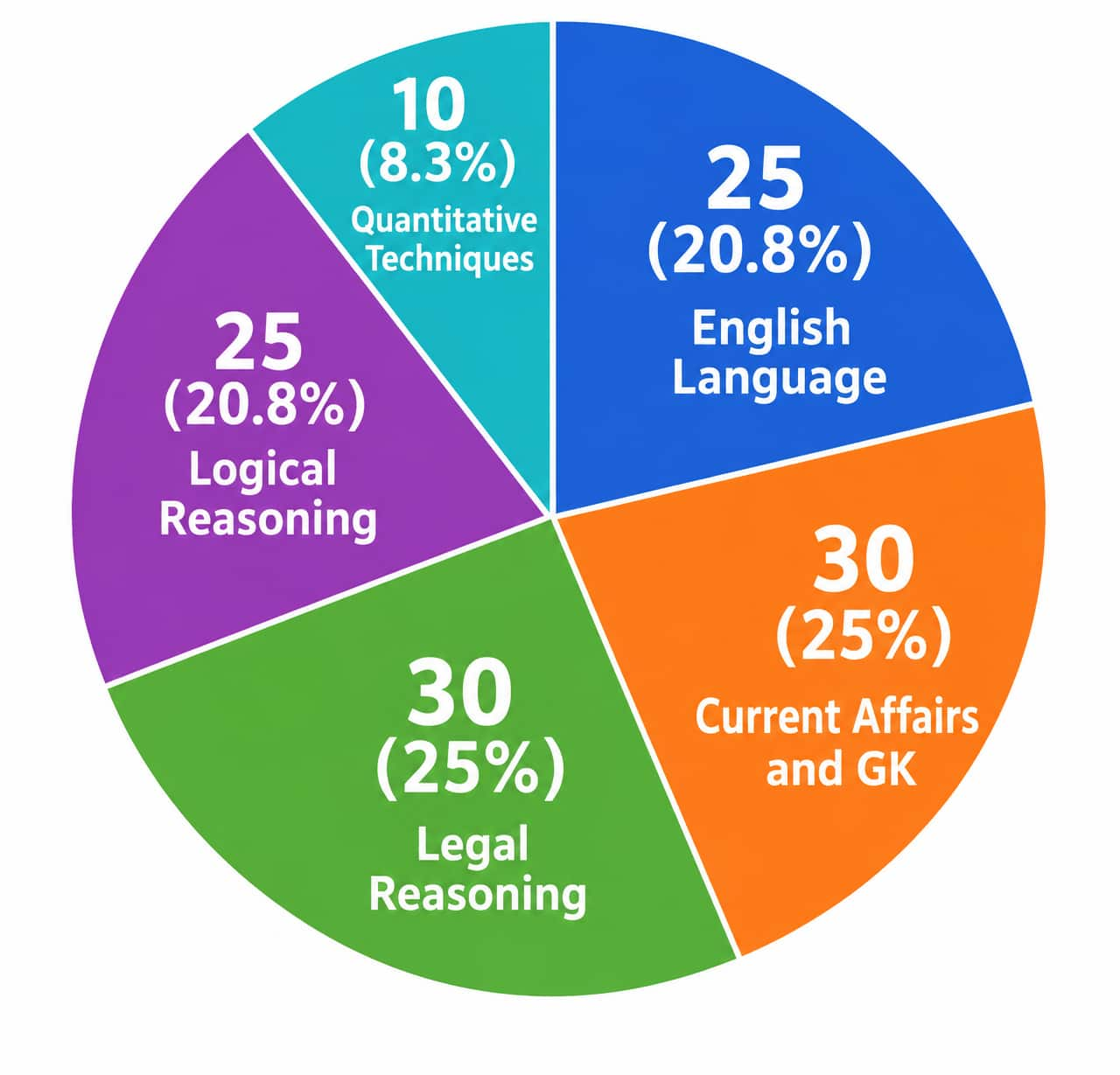
Both official mocks follow the same structure & CLAT 2027 exam pattern: 120 questions, five sections, and every question is passage-based. There are 24 passages in total, each followed by five questions. Here’s how the questions are split:
Section | Passages | Questions |
English Language | 5 | 25 |
Current Affairs and GK | 6 | 30 |
Legal Reasoning | 6 | 30 |
Logical Reasoning | 5 | 25 |
Quantitative Techniques | 2 | 10 |
CLAT 2027 Current Affairs and Legal Reasoning carry the most weight, 30 questions each. Quant is the smallest section, but it is also the only one that needs calculation.
Attempt Free Official Practice Test & Solutions and Ace the CLAT Exam 2026
CLAT 2027 Aspirants can download the CLAT 2027 Official mock test through the link provided below:
| CLAT 2027 Official Mock Test 1 with Answer Key | Download Free PDF Here |
| CLAT 2027 Official Mock Test 2 with Answer Key | Download Free PDF Here |
In CLAT 2027 official mock tests, four of the five sections are reading-heavy. English, Current Affairs, Legal and Logical Reasoning all give you passages of roughly 250 to 350 words, usually in three paragraphs. Quant gives you data-based passages and asks for calculations. The common thread is that the passage supplies almost everything you need. Even the Current Affairs section works this way: each passage explains the topic, and the questions test whether you’ve understood it. The mocks reward careful reading more than memorised facts. Still, background knowledge helps you read faster and with more confidence.
Get the CLAT UG previous year question papers here
Across the sections, the question types repeat from passage to passage:
Main idea or central argument, usually the first question
Direct detail, where the answer is stated in the passage
Inference and meaning of a phrase, such as what “particular window” means
Tone and attitude of the author, which appears in almost every English passage
Strengthen, weaken and assumption, mainly in Logical Reasoning
Percentages, averages and ratios, in Quant
Notably, the mocks have no standalone vocabulary, grammar or puzzle questions. Each passage follows a similar template, so once you recognise the pattern, the sets become easier to handle.
The five CLAT English Language Passages 2027 cover public parks as urban infrastructure, the value of diaries as historical evidence, language preservation, how scientific trust is built, and food labelling. All are analytical, non-fiction pieces with a balanced, argumentative style.
Each passage carries a mix of main-idea, detail, phrase-meaning and tone questions. Tone and attitude questions are frequent, with answers like “analytical and persuasive” or “carefully appreciative”. Practise reading editorials and opinion essays, and train yourself to notice whether the author is arguing, explaining or warning.
The six passages in this section cover:
Aditya-L1 and the Sun
The G20
India’s parliamentary system
The RBI and monetary policy
The International Solar Alliance
The Right to Information framework
CLAT 2027 aspirants can read the following current affairs topics to stay updated on important national and international events and strengthen their preparation for the CLAT 2027 GK and Current Affairs section.
OCI vs Indian Citizen: Bombay High Court Clarifies Rights for CLAT 2027
Iran War Explained: Background, Key Events, Current Developments and Why It Matters for CLAT 2027
October 2026 Legal Current Affairs: 10 Topics CLAT 2027 Aspirants Must Read
Supreme Court on Right to Internet Access: Articles 19 and 21 Explained for CLAT 2027
Delhi CJP Protest Explained: Preventive Detention, Article 22 and the NSA for CLAT 2027
SIR Controversy Explained: Election Commission Powers, Voter Rights For CLAT 2027
New Zealand FTA Explained for CLAT 2027: Key Facts, Benefits and Legal Implications
These are topics tied to institutions, science and governance, written in explanatory form. The questions test what the passage says, such as “Who leads the Union government?” or “What does the policy rate influence?” You don’t have to recall obscure facts.
The six CLAT 2027 Official mock test Legal Reasoning passages cover:
Writ of certiorari
Negligence (duty of care, breach, causation, contributory negligence)
Free consent in contracts (coercion, undue influence, fraud, misrepresentation)
Use of reasonable force against a trespasser
Unfair terms in consumer contracts
Criminal liability (the act and the mental element, including strict liability)
In both mocks, the questions test whether you’ve understood the principle in the passage. Few ask you to apply it to a new set of facts. Read the principle carefully, note its exceptions and limits, and don’t bring in outside legal knowledge. The passages often stress limits, such as “not automatically invalid” or “not unlimited”, and those details are where the answers tend to sit.
Logical Reasoning here means evaluating arguments. The five passages cover a congestion charge, project-based assessment in schools, a four-day workweek, LED streetlights and automated hiring tools.
The questions ask you to:
Find the author’s main position
Choose evidence that strengthens or weakens a claim
Spot the assumption behind an argument
Describe the author’s approach
A recurring idea is that correlation isn’t causation: the four-day workweek passage, for instance, notes that other changes happened at the same time. Practise separating what the passage claims from what it merely suggests.
Quant is a 10-question section built on two data passages. One covers worker wages across four districts, and the other covers a family budget with percentage changes over two months.
The topics tested are percentages, averages, ratios, total amounts and percentage increase or decrease. The arithmetic is mostly simple, but the data is packed into the passage. You have to pull out the relevant numbers carefully and work through several steps. Practise setting up the calculation quickly and double-checking figures, because small slips can change the answer.
Overall, the difficulty comes from reading volume rather than from hard concepts. With 24 passages, speed and concentration matter as much as knowledge. The passages are clear, and the language is accessible, but the answer options can be close together.
In many questions, two options say almost the same thing in different words. You’ll need to pick the one that matches the passage most precisely, so read every option fully before choosing. Quant is the one place where calculation errors can cost marks, so work carefully there.
These are the patterns that stand out in the mocks:
Fully passage-based format. Even Current Affairs and Quant are built on passages.
Reasoning is about evaluating arguments, not solving puzzles or syllogisms.
Legal Reasoning leans on principles, with the passage doing most of the work.
Balanced, analytical writing runs through all the verbal sections.
Remember that mock tests show the likely direction, not a guarantee. Check the official CLAT notification for the final pattern, duration and marking scheme.
Build reading speed. Read editorials and analytical articles daily, and practise summarising them in one or two lines.
Practise passage-based sets. Solve five questions per passage under time limits instead of isolated questions.
Understand institutions and policies such as the RBI, the G20 and RTI, not just headlines.
Learn core legal principles like negligence, free consent, certiorari and mens rea, then practise applying only what the passage gives you.
Revise percentages, averages and ratios and practise data-based questions.
Review your mistakes. Note whether each one came from misreading, haste or a concept gap.
If the exam keeps its two-hour duration (confirm this in the official notification), you have about one minute per question and around five minutes per passage. A few habits will help:
Start with your strongest section to build momentum.
Skim the questions first, then read the passage with them in mind.
Don’t spend too long on one passage. Move on and return if time remains.
Take Quant carefully, since it has fewer questions but needs accurate calculation.
Eliminate wrong options first. When two options look alike, choose the one closest to the passage wording.
Keep a few minutes at the end to recheck the questions you flagged.

On Question asked by student community
Hello Student,
You can refer to the following Careers360 resources to study Law of Contracts for CLAT Legal Reasoning:
Contract Law – Chapter-wise Study Material:
https://www.careers360.com/legal-studies/contract-law-chapter-pge
Contract Law and Tort Basics for CLAT 2027:
https://law.careers360.com/articles/contract-law-and-tort-basics-for-clat-2027-legal-reasoning
Hello Lavina,
For CLAT 2028 preparation, students should choose an online coaching programme that offers comprehensive study material, regular mock tests, current affairs updates, doubt-solving sessions and expert guidance. Compare course features, faculty experience and student reviews before selecting a coaching programme.
Hello Miruthula,
For CLAT PG 2027, you need to focus on the core subjects of your LLB curriculum, particularly the following:
Constitutional Law
Jurisprudence
Administrative Law
Law of Contract
Law of Torts
Family Law
Criminal Law
Property Law
Company Law
Public International Law
Tax Law
Environmental Law
Labour and Industrial
Hello Student,
The full form of the CLAT exam is the Common Law Admission Test. You can check the link related to the CLAT exam
https://law.careers360.com/articles/what-is-clat-full-form-all-about-nlus-entrance-exam
Hello Student,
Here are the Careers360 CLAT 2027 Mock Test Resources for your exam preparation.
1. Online CLAT Mock Test
2. CLAT Mock Tests and Solutions

Ranked #18 amongst Institutions in India by NIRF | Get Upto 100% Scholarships | Spot Admissions via CUET
NAAC A++ Approved | Curriculum Aligned with BCI & UGC
UG Scholar's Round Deadline: 1st Dec'26 | Earn upto 50% merit Scholarship + 10% for top performers | Highest CTC 18 LPA
Grade 'A+' Accredited by NAAC | Ranked 33rd in India by NIRF
Moot Court | Mock trials | Legal Aid Clinic | Recruiting Partners: FICCI, TCS, Adani, Trilegal, and many others
NAAC A++ Accredited | Avail up to 100% scholarship via MRNAT-Manav Rachna National Aptitude Test