Amity Law School, Noida
Experiential Learning through Legal Aid Camps, Lok Adalats, Court Visits, Community Lawyering and regular Moot Court sessions


Constitutional Law is one of the most predictable subjects in AIBE 22. It usually brings 10-12 questions out of 100, about 10% of the AIBE Certificate of Practice (COP) paper, and most are direct, recall-based, and tied to article numbers or landmark cases. The AIBE 22 highest-yield areas are Fundamental Rights (Arts. 12-35), Writs (Arts. 32 and 226), Emergency (Arts. 352-360), and Amendment (Art. 368) with the Basic Structure doctrine. In contrast, DPSPs, Fundamental Duties, the powers of the President of India and the Governor, and Centre-State relations also appear regularly. Revise these areas and the questions below, and these marks are well within reach.
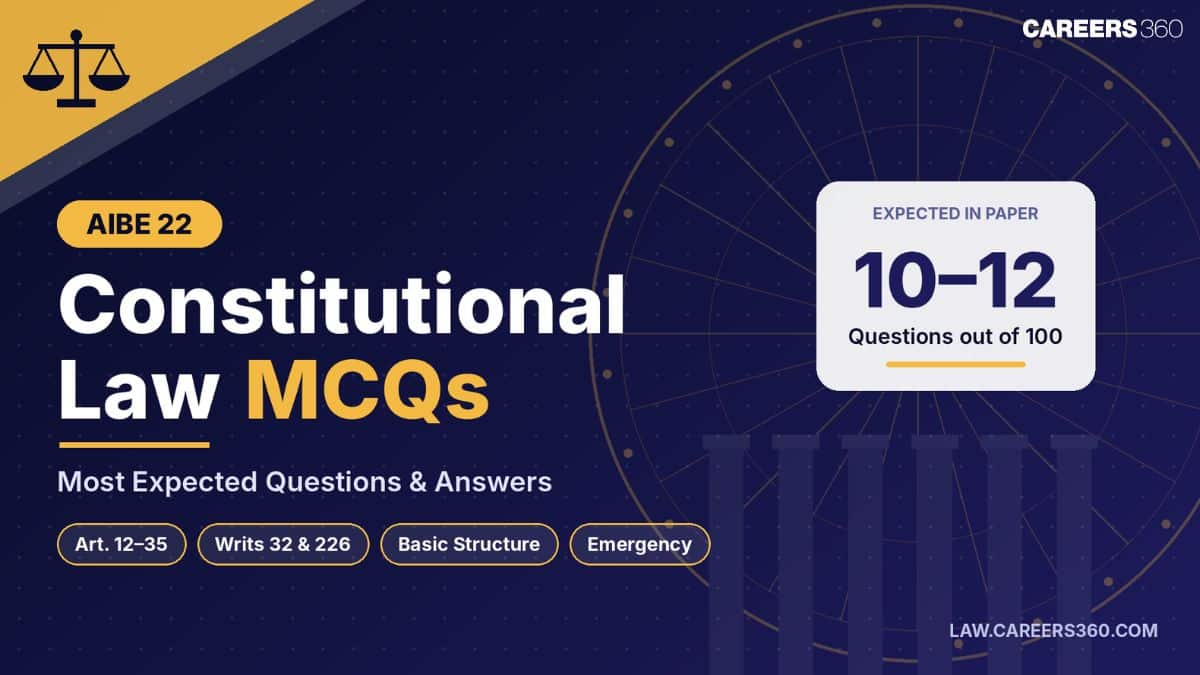
AIBE 22 Constitutional Law is a compact, predictable and high-scoring subject, which makes it one of the best places to secure marks in AIBE 22 preparation. Here are the reasons to study it:
Steady scoring share: about 10-12 questions out of 100 (roughly 10%)
Predictable pattern: the same core areas return every year.
Compact syllabus: a few article clusters and landmark cases cover most questions.
Recall-based questions: direct article numbers and case-matching
Foundation for other subjects: Arts. 14 and 21 feed into Criminal Law and Procedure.
Practical value: writs under Arts. 32 and 226 are central to court practice
Easy last-week revision: tables and one-line holdings work well.
The Constitution of India is the single most important subject in AIBE 22, consistently contributing 10% of the entire AIBE 22 exam pattern. Questions are direct, factual, and largely repeated from previous years.
Q1. Which case laid down the test of “financial, functional and administrative dominance” for deciding whether a body is “State” under Article 12, overruling Sabhajit Tewary?
(A) Ajay Hasia v. Khalid Mujib
(B) Pradeep Kumar Biswas v. Indian Institute of Chemical Biology
(C) R.D. Shetty v. International Airport Authority
(D) Rajasthan SEB v. Mohan Lal
Answer: B
Q2. In which case was the Doctrine of Eclipse applied to a pre-Constitution law inconsistent with fundamental rights?
(A) Keshavan Madhava Menon v. State of Bombay
(B) Deep Chand v. State of U.P.
(C) Bhikaji Narain Dhakras v. State of M.P.
(D) Behram Khurshed Pesikaka v. State of Bombay
Answer: C
Q3. The right to free and compulsory education under Article 21A was inserted by which Constitutional Amendment?
(A) 42nd
(B) 44th
(C) 86th
(D) 93rd
Answer: C
Q4. Which Article, inserted by the 106th Constitutional Amendment Act, provides for reservation of seats for women in the House of the People?
(A) Article 330A
(B) Article 332A
(C) Article 334A
(D) Article 243D
Answer: A
Q5. A State legislature enacts a money-lending law. Its pith and substance falls
under a State List entry, but it incidentally affects “promissory notes”, a Union List subject. The Supreme Court upholds the law. Which doctrine did the Court apply?
(A) Doctrine of Colourable Legislation
(B) Doctrine of Pith and Substance
(C) Doctrine of Eclipse
(D) Doctrine of Repugnancy
Answer: B
Q6. Which Article of the Constitution provides for the Comptroller and Auditor General of India?
(A) Article 148
(B) Article 149
(C) Article 150
(D) Article 151
Answer: A
Q7. Which Article declares the High Court to be a court of record?
(A) Article 214
(B) Article 215
(C) Article 226
(D) Article 227
Answer: B
Q8. Which Article deals with the powers, privileges and immunities of the State Legislatures and their members?
(A) Article 188
(B) Article 194
(C) Article 199
(D) Article 212
Answer: B
Q9. Which Constitutional Amendment Act gave constitutional status to the National Commission for Backwards Classes (Article 338B)?
(A) 101st
(B) 102nd
(C) 103rd
(D) 105th
Answer: B
Q10. Under Article 61, a resolution to impeach the President must be passed by:
(A) A simple majority of the House
(B) Two-thirds of the members present and voting
(C) Not less than two-thirds of the total membership of the House
(D) Three-fourths of the total membership of the House
Answer: C
Fundamental Rights, amendments with Basic Structure, and the Union Executive, Parliament and Judiciary carry the most marks, so revise them first.
Sr.no | Topic | Focus |
1 | Fundamental Rights | Art. 12 cases, Art. 21 |
2 | Amendments, Basic Structure | Kesavananda, Minerva Mills |
3 | Union Executive, Parliament | Art. 61, 105, 123 |
4 | Judiciary | Arts. 129, 215, writs |
5 | Federalism | Pith and substance, Art. 356 |
6 | DPSP, Fundamental Duties | Art. 39A, 44, 51A |
7 | Emergency | Arts. 358, 359 |
8 | Others | Art. 311, ECI, Parts IX, IXA |
AIBE 22 Mock Test Series helps candidates practise important questions, revise key legal subjects and prepare for the upcoming AIBE 22 exam. Solve mock tests to check your preparation, improve accuracy and build confidence before the exam.
AIBE 22 Mock Test | Download Free PDF Here |
AIBE 22 Mock Test 1 | |
AIBE 22 Mock Test 2 | |
AIBE 22 Mock Test 3 |
Impeachment of the President (Art. 61) needs a notice signed by one-fourth of the House, 14 days' notice, and two-thirds of the total membership to pass.
Remember the Art. 12 case progression: Rajasthan SEB, Sukhdev, R.D. Shetty, Ajay Hasia, Pradeep Kumar Biswas.
AIBE 19 had a fact-pattern question on severability, so practise doctrine questions (eclipse, severability, pith and substance, colourable legislation).
Amendment numbers are free marks: learn them with the article each one is inserted into.
Learn article numbers in Union and State pairs, as these are often asked together.

On Question asked by student community
Hello student!
AIBE question papers in Kannada medium are not explicitly available. Meanwhile, you can check these resources for AIBE previous-year question papers and the AIBE 21 (2026) Set A and Set B papers for practice.
AIBE Previous-Year Question Papers:
https://law.careers360.com/articles/aibe-previous-year-question-papers
AIBE 21 Set B Question Paper 2026:
https://law.careers360.com/articles/aibe-21-set-b-question-paper-pdf-2026
AIBE
Hello Student,
You can check the relevant article below
https://law.careers360.com/download/ebooks/aibe-preparation-guide
Hope it helps!
Hello Student,
You can access the AIBE previous year question papers in Hindi by clicking on the relevant link given below.
https://law.careers360.com/hi/articles/aibe-previous-year-question-papers
Hey there,
No. If you are currently in the 5th semester of a 3-year LL.B., you generally cannot register for AIBE yet.
Under the current BCI rules, a 3-year LL.B. student must be in the final semester (6th semester) and have no backlogs from previous semesters to register for AIBE.
Hello Dear Student,
The All India Bar Examination (AIBE) covers 19 major legal subjects, carrying a high-weightage focus on Constitutional Law (8–12 questions) and Family Law including Hindu and Muslim law (6–8 questions)
You can check, find and access more information here:

Experiential Learning through Legal Aid Camps, Lok Adalats, Court Visits, Community Lawyering and regular Moot Court sessions
Ranked #18 amongst Institutions in India by NIRF | Get Upto 100% Scholarships | Spot Admissions via CUET
NAAC A++ Approved | Curriculum Aligned with BCI & UGC
UG Scholar's Round Deadline: 1st Dec'26 | PG Early Decision Round Deadline: 24th Dec'26 | Earn upto 50% merit Scholarship + 10% for top performers | AACSB (USA) & AMDISA Member | Highest CTC 28 LPA
India's Largest University | NAAC A++ Accredited | THE-2027 Ranked 4th in India | Highest CTC: INR 2.5 Cr | Top 25% Average Salary: INR 10.2 LPA | 2225+ Recruiters
Grade 'A+' Accredited by NAAC | Ranked 33rd in India by NIRF