School of Law, UPES, Dehradun
Ranked #18 amongst Institutions in India by NIRF | Get Upto 100% Scholarships | Spot Admissions via CUET


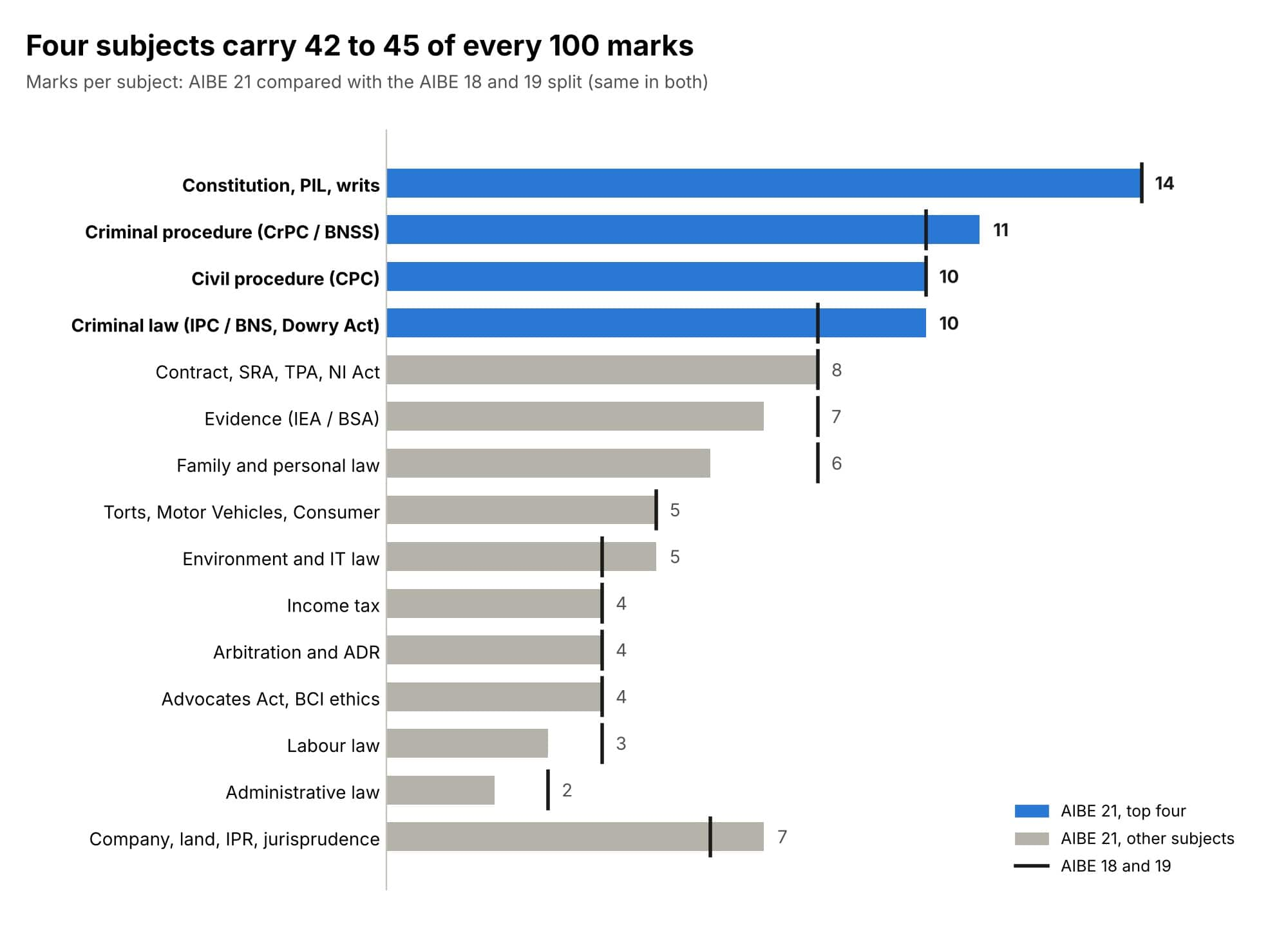
AIBE 22 is only days away, and you don’t need another 500-page book right now. You need the questions that actually repeat. The AIBE 22 paper has 100 multiple-choice questions to finish in 3 hours; it’s open-book, and you need 45% to pass (40% for SC/ST candidates). AIBE previous years’ papers show constitutional law as the steadiest scorer, usually 10 to 12 questions. It is followed closely by CrPC/BNSS, CPC and Evidence/BSA, with roughly 6 to 10 questions each. Substantive criminal law (IPC/BNS), contract law, property and professional ethics fill most of the remaining marks. The same articles and landmark cases keep recurring, with new wording.
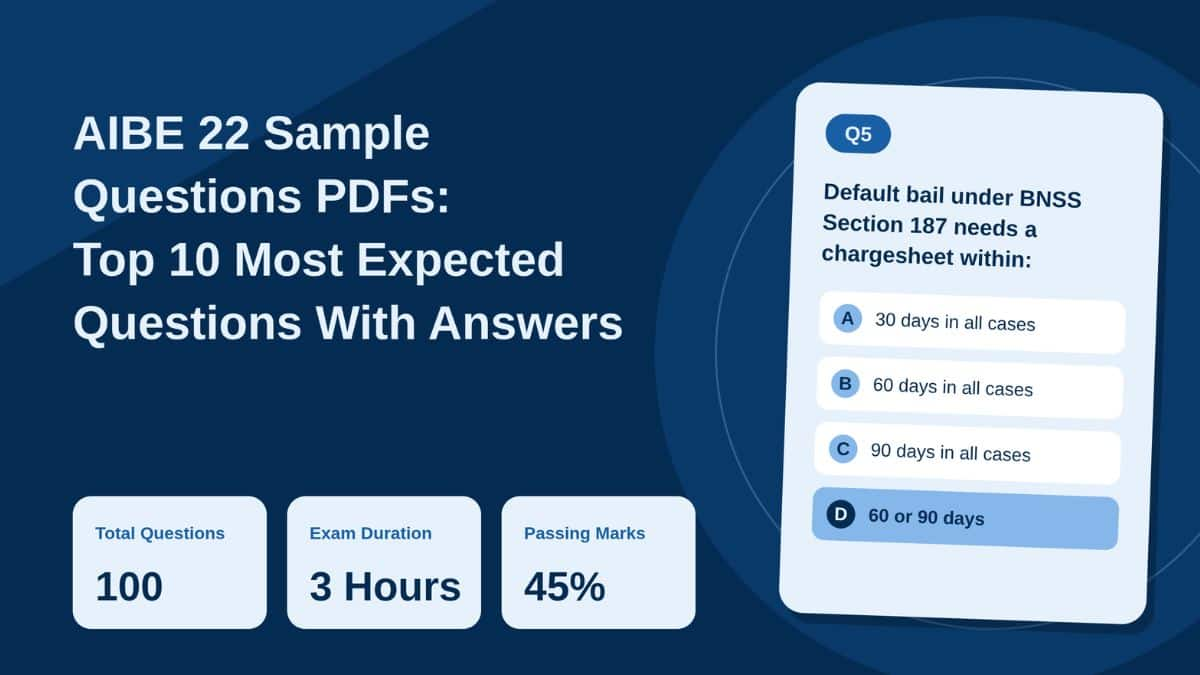
The Bar Council of India (BCI) will issue the AIBE 22 admit cards to all registered candidates on November 14. The admit card can be downloaded from the official website: allindiabarexamination.com. The AIBE 22 exam will be held on November 22, in offline mode, across the country.
Here are the 10 most expected questions for AIBE 22, each with a short answer and the exact provision to flip to in your Bare Acts.
Q1. Under the Bharatiya Nyaya Sanhita, 2023, the right of private defence of the body extends to voluntarily causing death where the assault is made with the intention of:
(A) causing simple hurt
(B) kidnapping or abducting a person
(C) committing criminal trespass by day
(D) committing theft of a small item
Answer: (B).
BNS s.38 (IPC s.100) lists the cases: reasonable apprehension of death or grievous hurt; rape; unnatural lust; kidnapping or abduction; wrongful confinement with no recourse to public authorities; acid attack.
Limits sit in BNS s.37 (IPC s.99): no right against a public servant acting in good faith, and no more harm than necessary.
For property, death may be caused under BNS s.41 (IPC s.103) for robbery, house-breaking by night, arson and similar cases.
Seen in: AIBE 18 Q92, AIBE 19 Q13, AIBE 21 Q97. It appeared in all three.
Q2. Under Section 144 BNSS (Section 125 CrPC), a wife is NOT entitled to maintenance where:
(A) her husband keeps a mistress, and she lives apart
(B) she is living in adultery
(C) her husband has taken a second wife
(D) she was forcibly removed from the matrimonial home
Answer: (B).
Disqualifying grounds (s.144(4) BNSS; s.125(4) CrPC): living in adultery, refusing to live with the husband without sufficient reason, or living apart by mutual consent.
It is a summary, quick remedy against destitution. Claimants are a wife (including a divorced wife who has not remarried), minor children, a disabled adult child, and parents. There is no cap on the amount.
Rajnesh v. Neha (2020) requires an affidavit of assets from both sides.
Seen in: AIBE 18 Q99, AIBE 21 Q6.
Q3. In which case did the Supreme Court hold that the rules of natural justice apply to administrative as well as quasi-judicial functions?
(A) A.K. Kraipak v. Union of India
(B) Ram Jawaya Kapur v. State of Punjab
(C) Maneka Gandhi v. Union of India
(D) Sonik Industries v. Municipal Corporation, Rajkot
Answer: (A).
Kraipak (decided 1969, AIR 1970 SC 150) held that the line between administrative and quasi-judicial functions has blurred. It also applied the rule against bias: a member of the selection board was himself a candidate.
Maneka Gandhi (1978) later tied fair procedure to Articles 14 and 21.
Definitions are a favourite: H.W.R. Wade, "the law relating to the control of governmental power"; K.C. Davis, "the law concerning the powers and procedures of administrative agencies".
Seen in: AIBE 18 Q41 and Q43, AIBE 21 Q73 and Q79.
Q4. Which is considered the first reported PIL case in India?
(A) S.P. Gupta v. Union of India
(B) Hussainara Khatoon v. State of Bihar
(C) M.C. Mehta v. Union of India
(D) Kalyaneshwari v. Union of India
Answer: (B).
Hussainara Khatoon (1979) dealt with undertrial prisoners and the right to speedy trial under Article 21.
Justice P.N. Bhagwati (with Justice V.R. Krishna Iyer) is called the father of PIL.
The term "public interest litigation" came from the US, used by Prof. Abram Chayes (AIBE 21).
Related cases: Sunil Batra (a prisoner's letter treated as a writ), Bandhua Mukti Morcha (bonded labour and Article 21), PUDR (Asiad workers, Article 23).
Watch the wording. AIBE 19 gave Sunil Batra for the "letter as writ petition" question.
Seen in: every paper has four PIL questions: AIBE 18 Q37 to 40, AIBE 19 Q59 to 62, AIBE 21 Q15, Q85 and Q94.
Q5. An accused is entitled to default (statutory) bail under Section 187 BNSS (Section 167(2) CrPC) if the chargesheet is not filed within:
(A) 30 days in all cases
(B) 60 days in all cases
(C) 90 days in all cases
(D) 60 days or 90 days, depending on the maximum punishment
Answer: (D).
90 days if the offence is punishable with death, life imprisonment or at least 10 years. 60 days for every other offence.
The right is indefeasible once the accused is ready to furnish bail (Uday Mohan Lal Acharya; Rakesh Kumar Paul).
Companion fact: an arrested person must be produced before a Magistrate within 24 hours, excluding travel time (BNSS s.58; CrPC s.57). AIBE 21 asked it by the CrPC number.
Seen in: AIBE 21 Q45 and Q13.
Q6. A defendant against whom an ex parte decree was passed because summons were never duly served should apply under:
(A) Order IX Rule 2 CPC
(B) Order IX Rule 13 CPC
(C) Order IX Rule 8 CPC
(D) Order XXII Rule 9 CPC
Answer: (B).
The application is made on proof that summons were not duly served, or on sufficient cause for non-appearance. The limit is 30 days from the decree (Article 123, Limitation Act).
Neighbouring rules that get swapped in options: Order IX Rule 2 (suit dismissed because the plaintiff did not pay for service; a fresh suit is allowed), Rule 8 (plaintiff absent; Rule 9 then bars a fresh suit), Order XXII Rule 9 (setting aside abatement for sufficient cause), Order I Rule 10 (adding or substituting parties), Order XXXVII (summary suits).
Seen in: AIBE 21 Q12, Q37, Q48, Q57 and Q80; AIBE 18 Q11 (fresh suit barred); AIBE 19 Q30 (Order I Rule 10) and Q35 (Order XXXVII).
Q7. Which decision overruled State (NCT of Delhi) v. Navjot Sandhu and held that a Section 65B certificate is mandatory for admitting electronic records?
(A) Shafhi Mohammad v. State of H.P.
(B) Anvar P.V. v. P.K. Basheer
(C) State of Maharashtra v. Natwarlal Damodardas Soni
(D) State of Punjab v. Jagir Singh
Answer: (B).
Anvar (2014) was reaffirmed by a larger bench in Arjun Panditrao Khotkar (2020).
Under the Bharatiya Sakshya Adhiniyam, 2023, the certificate sits in s.63 (old s.65B). It is in a prescribed form, signed by the person in charge and an expert, and carries hash values. s.63(4) was tested in AIBE 21.
Definition of "electronic record": IT Act s.2(1)(t).
Section 66A of the IT Act was struck down in Shreya Singhal.
Seen in: AIBE 18 Q22 and Q52; AIBE 21 Q36, Q49, Q50; AIBE 19 Q42 (secondary evidence).
Q8. Under Section 16 of the Arbitration and Conciliation Act, 1996, a plea that the tribunal has no jurisdiction must be raised not later than:
(A) filing of the statement of claim
(B) submission of the statement of defence
(C) the final hearing
(D) 90 days from the tribunal's constitution
Answer: (B).
This is the Kompetenz-Kompetenz principle: the tribunal rules on its own jurisdiction. A party is not barred merely because it appointed the arbitrator.
A plea that the tribunal is exceeding its authority must be raised as soon as the matter is raised in proceedings. A later plea can be admitted if the delay is justified.
Section map to learn: s.5 (minimal judicial intervention), s.7 (agreement must be in writing, so the "oral agreement" option is the incorrect one), s.11 (appointment), s.12 (challenge; Seventh Schedule), s.20 (place of arbitration), s.25 (respondent's default is not an admission), s.34 (setting aside), s.36 (enforcement).
Seen in: AIBE 21 Q25, Q55, Q89, Q100; AIBE 19 Q48 and Q50; AIBE 18 Q27 and Q28.
Q9. Which Article empowers Parliament to legislate for the whole or part of India to implement international treaties and conventions, even on State List subjects?
(A) Article 249
(B) Article 252
(C) Article 253
(D) Article 254
Answer: (C).
Article 253 is the basis of the Air Act, 1981 (Stockholm Conference) and the Environment (Protection) Act, 1986.
Learn the cluster: Art. 248 with Entry 97 of List I (residuary power, Parliament); Art. 249 (Rajya Sabha two-thirds resolution, national interest); Art. 250 (during a proclamation of Emergency); Art. 252 (States' consent; the Water Act, 1974 rests on it); Art. 254 (repugnancy; Centre prevails unless a State law has Presidential assent).
Seen in: AIBE 21 Q19, Q35, Q87 (Art. 253 twice) and Q96; AIBE 18 Q84 (Art. 254). AIBE 21 also asked Art. 143 (advisory, not binding) and the Ninth Schedule (I.R. Coelho).
Q10. An advocate agrees to take 30% of the amount recovered, payable only if the suit succeeds. This is:
(A) permitted if the client consents in writing
(B) permitted if the fee is reasonable
(C) professional misconduct, as contingency fees are prohibited
(D) permitted in money-recovery suits only
Answer: (C).
Advocates Act s.49(1)(c) and BCI Rule 20 bar fees contingent on the result. Client consent does not cure it.
Punishments under s.35: reprimand, suspension, or removal from the State roll. Misappropriating client money ordinarily means removal (Harish Chandra Tiwari v. Baiju).
Appeal chain: State Bar Council disciplinary committee, then BCI (s.37), then Supreme Court (s.38).
A disciplinary committee has three members: two elected from the Council and one co-opted advocate (s.9).
Illegal practice in court is punishable with up to six months' imprisonment (s.45).
Seen in: AIBE 18 Q44 to 47; AIBE 19 Q66 to 69; AIBE 21 Q1, Q21, Q41, Q43.
Students can also check other topic-wise Most Repeated PYQs,
These are the 10 most expected topics for AIBE 22, based on past paper trends.
AIBE 22 Mock Test Series helps candidates practise important questions, revise key legal subjects and prepare for the upcoming AIBE 22 exam. Solve mock tests to check your preparation, improve accuracy and build confidence before the exam.
AIBE 22 Mock Test | Download Free PDF Here |
AIBE 22 Mock Test 1 | |
AIBE 22 Mock Test 2 | |
AIBE 22 Mock Test 3 |
AIBE 22 rewards candidates who revise smart. The 10 questions given above cover the articles, cases and provisions that are asked repeatedly, so go through them once to understand the framing and concepts and again for speed. Mark the ones you got wrong, keep your Bare Act tabbed and ready, and spend your last few days on constitutional law, BNSS, CPC and Evidence - the topics that carry the highest weightage. Stay calm, manage your time across the 100 questions, and trust your preparation.

On Question asked by student community
Hello student!
AIBE question papers in Kannada medium are not explicitly available. Meanwhile, you can check these resources for AIBE previous-year question papers and the AIBE 21 (2026) Set A and Set B papers for practice.
AIBE Previous-Year Question Papers:
https://law.careers360.com/articles/aibe-previous-year-question-papers
AIBE 21 Set B Question Paper 2026:
https://law.careers360.com/articles/aibe-21-set-b-question-paper-pdf-2026
AIBE
Hello Student,
You can check the relevant article below
https://law.careers360.com/download/ebooks/aibe-preparation-guide
Hope it helps!
Hello Student,
You can access the AIBE previous year question papers in Hindi by clicking on the relevant link given below.
https://law.careers360.com/hi/articles/aibe-previous-year-question-papers
Hey there,
No. If you are currently in the 5th semester of a 3-year LL.B., you generally cannot register for AIBE yet.
Under the current BCI rules, a 3-year LL.B. student must be in the final semester (6th semester) and have no backlogs from previous semesters to register for AIBE.
Hello Dear Student,
The All India Bar Examination (AIBE) covers 19 major legal subjects, carrying a high-weightage focus on Constitutional Law (8–12 questions) and Family Law including Hindu and Muslim law (6–8 questions)
You can check, find and access more information here:

Ranked #18 amongst Institutions in India by NIRF | Get Upto 100% Scholarships | Spot Admissions via CUET
NAAC A++ Approved | Curriculum Aligned with BCI & UGC
Scholars’ Round Deadline: 14th Nov’26 | Earn upto 50% merit Scholarship + 10% for top performers | EFMD Accredited | AACSB (USA) & AMDISA Member | Highest CTC 28 LPA
BA LLB, BBA LLB, or BCom LLB and LLB | LLM 1 Year – 4 Specializations | Approved by BCI | Highest CTC 9 LPA
Grade 'A+' Accredited by NAAC | Ranked 33rd in India by NIRF
Moot Court | Mock trials | Legal Aid Clinic | Recruiting Partners: FICCI, TCS, Adani, Trilegal, and many others