Amity University-Noida Law Admissions 2026
Among top 100 Universities Globally in the Times Higher Education (THE) Interdisciplinary Science Rankings 2026


Symbiosis Law Admission Test (SLAT) is one of the law admission tests that has many applicants aspiring to join BA LLB and BBA LLB courses at Symbiosis International (Deemed University). Preparing for SLAT gets much easier when students become familiar with the kind of questions that appear often and not all topics equally.
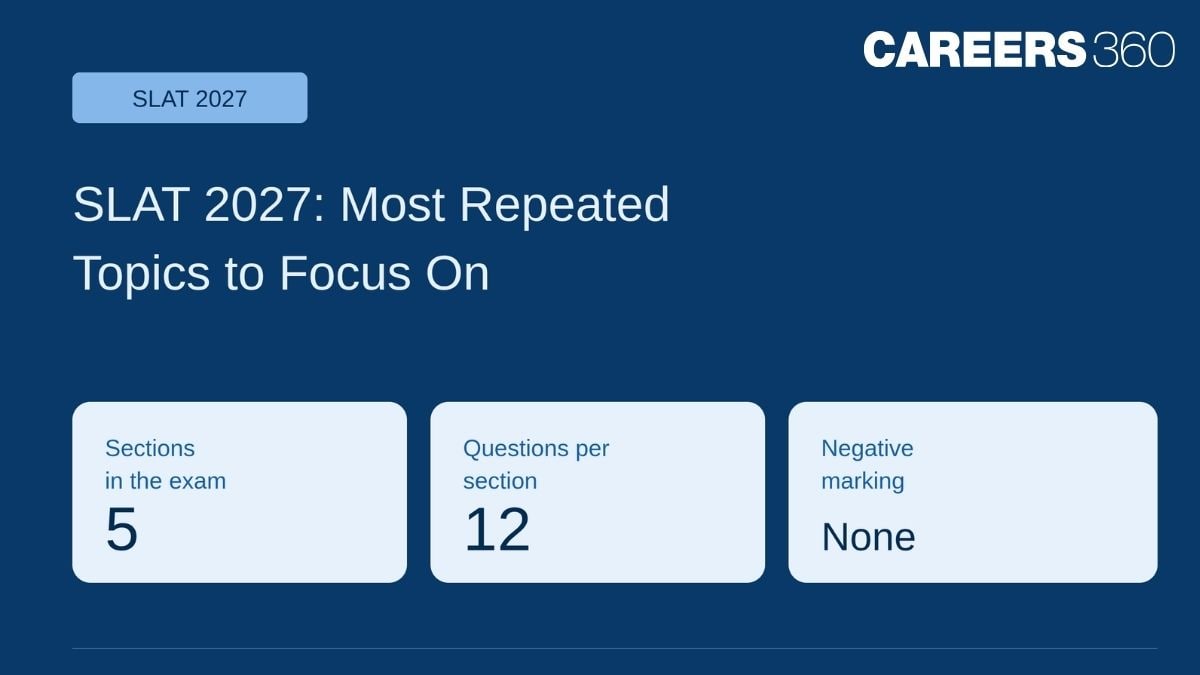
There are five sections in SLAT 2027, which include Logical Reasoning, Legal Reasoning, Analytical Reasoning, Reading Comprehension and General Knowledge. In the current pattern, the number of questions is 60, with each section having 12 questions. There is no negative marking.
Though it is impossible to predict the questions, the SLAT 2027 previous years' question papers reveal that some kinds of questions appear again and again. The following are the key topics for SLAT 2027 preparation.
It becomes easy to prepare for SLAT 2027 when aspirants know about those areas that need more emphasis. Students will not have to spend an equal amount of time on all topics. Students should give more focus to those topics or question types that have frequently been asked in SLAT previous year question papers. Even if the pattern of the exam may change every year, there are certain topics that must be prepared by the candidates. These include:
SLAT exam Logical Reasoning measures your understanding of information and deriving a logical conclusion from the information provided. This is one topic that carries maximum marks if prepared well.
Some of the topics that can be prepared for this section are:
Statements and conclusions
Statements and assumptions
Cause and effects
Course of action
Strong and weak arguments
Syllogism
Analogies
Coding and decoding
Logical consistency
These topics have already appeared in previous SLAT papers in one way or the other.
In the case of SLAT exam, apart from remembering rules, you should work hard on different types of questions and also learn how to make connections between statements in a short span of time.
Legal Reasoning is especially significant for aspiring lawyers, though students do not require any specialised knowledge in law to succeed in the section. Generally, questions will determine your ability to comprehend the legal principle and apply it to a particular scenario.
Cover the following areas:
Tort Law
Contract Law
Constitutional Law
Criminal Law
Fundamental Rights
Legal principles and their application
Basic legal terminology
Legal maxims
Principle and facts questions carry special significance. In the last SLAT papers, the topics covered include damages, torts, provisions in the Constitution, contract law, and procedural law.
While studying, first study the principle before looking at the facts. The answer should be mostly based on the principle provided in the question rather than your personal opinion about the law.
Analytical Reasoning demands a combination of logical, observational, and basic mathematical skills. Many students miss scores in this part because they tend to spend an excessive amount of time on one particular question.
The main concepts to practice include:
Number series
Alphabet series
Coding-decoding
Blood relations
Directions
Seating arrangement
Puzzles
Analogies
Odd man out
Basic arithmetic reasoning
Time, Speed and Distance
Percentages and ratios
Modern SLAT exams contain questions about directions, seating arrangements, coding-decoding, blood relations, and number and alphabet series.
The most effective method of preparation in this case is practice. The recommended strategy is to start with easy tasks, learn the technique and then practice under time pressure.
In Reading Comprehension, fast reading is not all that matters. Understanding the content of the passage is required, as well as answering the questions without making any assumptions not supported by the text.
Key aspects to consider are:
Main idea of the passage
Direct questions
Inference questions
Tone of the author
Vocabulary
Synonyms and antonyms
Grammar
Meaning of words in context
Recently, SLAT exams have included both passage-based questions and questions on grammar, vocabulary, and synonyms/antonyms.
The development of a regular reading routine will make a real difference. Read newspapers, editorials, magazines, or high-quality articles and try to find out their main idea and tone.
General Knowledge can be capricious; thus, one must not prepare only on certain topics. But certain themes are common in all past papers.
Some important topics are:
National and international current affairs
Significant government schemes
Indian Polity
History
Geography
Sports
Awards & honours
Books & their authors
Art & culture
Environment
Significant organizations
Important Legal & Constitutional matters
Analysis of past SLAT papers reveals the high presence of current affairs questions along with GK from topics like history, culture & environment. For SLAT 2027, keep making short notes on current affairs every month rather than trying to mug up hundreds of random facts before the SLAT 2027 exam.
Knowing repeatedly appearing topics does not imply that you should disregard the other topics in the syllabus. This is because the SLAT might decide to vary the composition of the questions in different years. For instance, a topic that had frequently been asked in the previous papers could be asked less often, or not at all, in one particular year. For instance, there were no syllogism questions in the 2026 paper, although syllogism is a topic that had frequently been practised.
So, treat the repeatedly appearing topics as your priority list, and not as a prediction of the actual paper. One easy approach is to first cover the fundamentals of the topics, followed by solving previous-year questions on each topic. Then you must take the SLAT mock 2027 test in full length.
The first and foremost benefit of working on repeated topics is that it enables you to utilise your preparation time well. Here is the SLAT 2027 Preparation strategy:
Begin with Logical Reasoning topics like statements, assumptions, conclusions, arguments, and syllogisms. In case of Legal Reasoning, pay particular emphasis on torts, contracts, constitutional law and principal facts.
For Analytical Reasoning, prepare topics like series, coding-decoding, blood relations, directions and arrangements. Increase your reading speed and comprehension by reading every day, and revise current affairs regularly.
Above all, attempt previous year papers and mock tests. This will enable you to identify the pattern of the questions and figure out where you are going wrong and why you are not getting marks. In this way, SLAT preparation is not about learning everything at once.
Rather, you can go through a systematic and focused process accompanied by continuous practice and revisions.

On Question asked by student community
Yes, the shortlisted list of candidates for the SLAT 2026 Personal Interview (PI) has been released by the respective Symbiosis Law Schools (Pune, Noida, Hyderabad, Nagpur).
Hello,
Symbiosis International University conducts the SLAT (Symbiosis Law Admission Test) entrance examination for admission to the 5 year LLB course. Four Law Schools participate in this process. They select the students after they go through the SLAT and personal interview.
Practicing the previous year questions will help you get
Hi,
You can check the SLAT previous year question papers for Slot 1 and Slot 2 on the Careers360 website. Here's the link :
https://law.careers360.com/articles/slat-2025-question-paper
Hello
The Symbiosis Law Admission Test (SLAT) 2025 results were declared on December 26, 2024 .
While the official cutoffs for Symbiosis Law Schools (SLS) have not been released yet , previous years data suggests that the expected cutoffs for SLS Pune are approximately :
BA LLB (Hons) : 45

Among top 100 Universities Globally in the Times Higher Education (THE) Interdisciplinary Science Rankings 2026
Admissions open for B.A. LL.B. (Hons.), B.B.A. LL.B. (Hons.) and LL.B Program (3 Years) | School of Law, MRU ranked No. 1 in Law Schools of Excellence in India by GHRDC (2023)
NAAC A+ Accredited | Among top 2% Universities Globally (QS World University Rankings 2026)
Ranked #18 amongst Institutions in India by NIRF | Get Upto 100% Scholarships | Spot Admissions via CUET
Approved by BCI | Ranked #4 among Law Institutes in UP | NAAC A+ Accredited
In-house judicial coaching | Proven success in National Moot Court Competitions