School of Law, UPES, Dehradun
Ranked #18 amongst Institutions in India by NIRF | Get Upto 100% Scholarships | Spot Admissions via CUET


Delhi University has released the round 2 cut-offs for its 5-year BA LLB and BBA LLB programs. In round 2 admissions for 2026, the BA LLB general category cut-off closed at 90.25 CLAT marks, while the BBA LLB cut-off closed at 89.75. Last year, the BA LLB cut-off was 88.50 marks. The 5-year LLB courses were introduced in 2023 in response to the changing nature of the legal profession. The DU 5-year LLB have immediately grabbed attention as admission cutoffs are close to those of tier 2 NLUs. DU doesn’t have a proven internship and placement record; however, the university’s reputation remains strong. This brings us to the question of whether DU should be preferred over tier 2 or tier 3 NLUs.
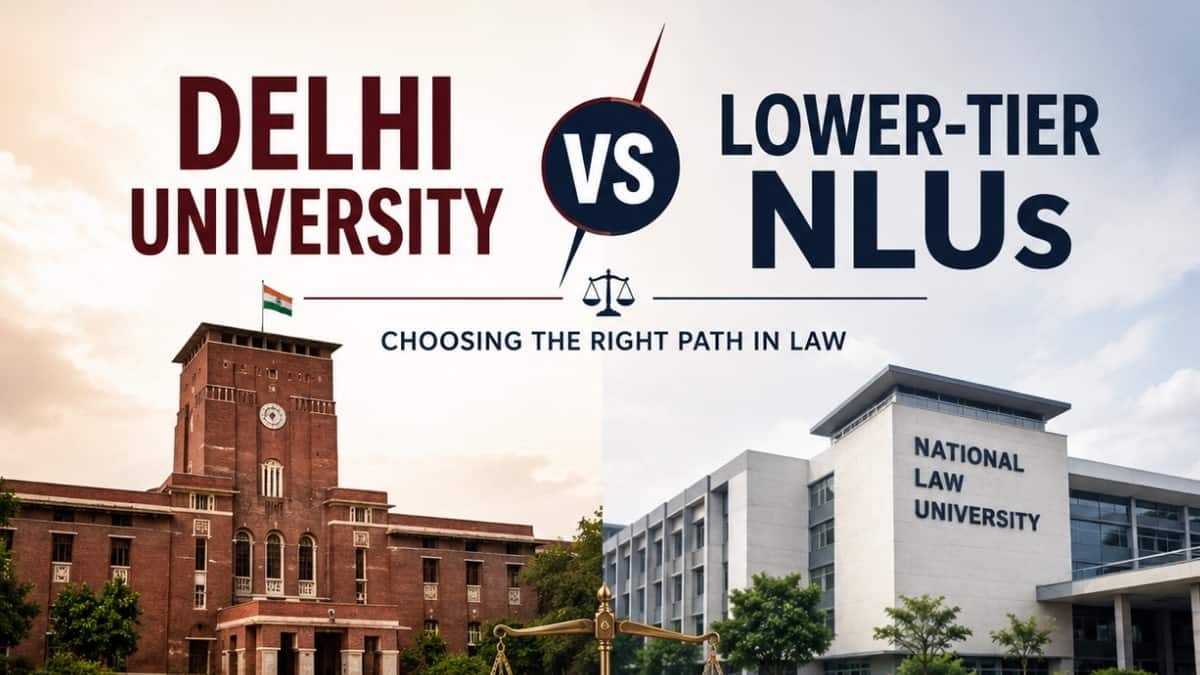
DU 5-year LLB is a typical case of a university's overall reputation drawing the students away from NLUs. The 3-year LLB placements data of DU do not back the decision to opt for the university over tier 1 and tier 2 NLUs. The lack of placements, especially corporate jobs in its 3-year LLB course and inclination towards judiciary, litigation and civil services shape the identity of DU's law courses.
Not all NLUs are equal. When compared with institutions such as MNLU Nagpur, HPNLU Shimla, and NLU Sonipat, DU's 5-year LLB deserves serious consideration because of its location advantage, alumni network, affordability, and institutional reputation. The case becomes even stronger when DU is compared with newer NLUs such as NLU Tripura, RPNLU Prayagraj, MNLU Sambhajinagar, and MPDNLU Jabalpur, which are still building their alumni base, recruiter network, and institutional visibility. DU's access to Delhi's courts, policy ecosystem, and legal community can outweigh the benefits of the NLU tag in many cases.
Ranked #18 amongst Institutions in India by NIRF | Get Upto 100% Scholarships | Spot Admissions via CUET
Scholars’ Round Deadline: 14th Nov’26 | Earn upto 50% merit Scholarship + 10% for top performers | EFMD Accredited | AACSB (USA) & AMDISA Member | Highest CTC 28 LPA
Location
One of the key reasons why many students prefer Delhi University is its central location. The university is very close to Tees Hazari Court. Supreme Court and High Courts are in proximity. While this may not help much in academics, students gain direct exposure to the Courts and political networks through internships. This practical experience is invaluable, considering that many law schools in India still rely on theoretical learning. Delhi is also a hub of many non-governmental organisations, think tanks, consultancy firms and corporate houses.
Affordability
At INR 2.15 Lakh per annum, a 5-year degree at DU costs close to 11 Lakh. This is affordable, considering that DU is a premier university in the country. NLUs charge around INR 15 to 25 Lakh for the same 5-year LLB degree. However, DU does not provide hostel accommodation to 5-year LLB students, which means one should take into account the additional costs, such as rent, electricity and food.
Litigation
DU has a strong litigation culture in its 3-year LLB program. The university’s proximity to the Courts is one of the biggest factors contributing to this. Advocates are always on the lookout for interns, and DU has tried to capitalise on this by providing an internship and placement portal.
Diversity and multidisciplinary exposure
Delhi University is rightly called a melting pot of different cultures. The university draws students from all corners of the country. With numerous courses and diversity, DU offers learning opportunities beyond classrooms. The university also has a strong, proactive political environment. Students who enjoy such an academic setting may consider DU.
Great alumni base
With over 100 years of academic history, the Faculty of Law, DU enjoys one of the strongest alumni bases. The DU alumni are everywhere — law and judiciary, administration, politics and activists. The prominent DU alumni include former IPS Kiran Bedi, former Chief Justices of India D. Y. Chandrachud and Ranjan Gogoi, Arun Jaitley, former Union Finance Minister, and Union Minister Kiren Rijiju.
No NLU-tag
DU doesn't provide the prestigious NLU tag. Many students consider having an NLU tag advantageous in the early years of their career, especially for placements, internships, and recruiter perception. The strong demand for DU's 5-year LLB has brought it into direct competition with several Tier-2 NLUs. However, students should understand that choosing DU often comes at the cost of institutions such as HNLU Raipur, NLU Odisha, RMLNLU Lucknow, and CNLU Patna, all of which offer an established NLU brand and a documented placement record.
New course and unproven
DU's 5-year LLB courses are new, with no graduating batch yet. The first batch will graduate only in 2028, and it remains to be seen how law firms, corporates, chambers, and other legal employers respond to the programme. The university has historically struggled to attract corporate recruiters for its flagship 3-year LLB course. Students should keep this uncertainty in mind before choosing DU over established NLUs.
Lack of placements
The Faculty of Law, DU, has no placement record to showcase for its 5-year LLB programme yet. Since the course was introduced only in 2023 and has not produced a graduating batch, there are no placement reports, recruiter lists, median salary figures, or internship outcomes available. As a result, students have no reliable benchmark to assess how law firms, corporates, chambers, or other legal employers value the programme.
This uncertainty becomes important because the programme is competing directly with established Tier-2 NLUs such as HNLU Raipur, NLU Odisha, and RMLNLU Lucknow. These NLUs may not match DU's overall brand value, but they have years of placement records and a proven recruiter network. Choosing DU's 5-year LLB, therefore, requires students to place their faith in the university's reputation rather than in employment outcomes.
Lack of corporate law culture
The Faculty of Law, DU has historically been built around litigation, judicial services and public law. The university's alumni network and internship ecosystem naturally push students towards courts rather than corporate law firms.
Corporate law requires a different ecosystem. Top firms recruit through established campuses such as NLSIU, NALSAR, NUJS, NLU Jodhpur and GNLU. These institutions have spent decades building recruiter relationships and placement systems. DU's 5-year LLB programme has no such track record yet.
Faculty and infrastructure
The DU 5-year LLB classes are currently being conducted at Maharshi Kanad Bhawan, separate from the established Law Centre campuses. Unlike NLUs, which are dedicated law schools with residential campuses, DU's integrated law programme has yet to develop its own academic identity and infrastructure. There is limited data on faculty strength, student-faculty ratio, mentorship systems, infrastructure quality, or student outcomes.
Non-immersive legal environment focused
NLUs offer a highly concentrated legal ecosystem. Students live together, moot together, intern together, and build professional networks for five years. This environment creates a strong legal education culture and internships, placements and career pathways. DU is a large, multi-disciplinary university, and the Faculty of Law is one department among dozens. It provides greater diversity and exposure beyond law, but often lacks the immersive legal environment found at NLUs. For the 5-year LLB programme in particular, the university is yet to create its own culture, peer networks, and career outcomes.
The decision should not be based on prestige alone. Students targeting corporate law should generally prefer Tier 1 and strong Tier 2 NLUs. The placement ecosystem, recruiter networks, alumni presence in law firms, and NLU brand value are established and proven. DU's 5-year LLB programme makes a stronger case for students interested in litigation, judicial services, policy, and public law, where its location advantage and legal ecosystem can be a meaningful differentiator.
At the same time, the NLU tag is not everything. Students receiving offers from lower-tier NLUs should also look beyond the label. Institutions such as GLC Mumbai, ILS Pune, SLS Pune, Nirma University, and Panjab University offer strong alumni networks, recruiter visibility, and established legal ecosystems. The NLU tag remains valuable, but factors such as career opportunities, alumni strength, location, and long-term outcomes are equally important while choosing a law school.

On Question asked by student community
If you are referring to CUET UG, the 2026 examination was scheduled to be conducted in May 2026. The exact subjects and dates depend on the CUET schedule and the university/course requirements.
For law admissions, also check whether the particular university accepts CUET for its 5-year integrated law programme, because
Hello,
For Hindi medium law study materials, you can explore several options:
- Online Platforms: Websites like careers360, Unacademy, and YouTube offer video lectures and notes in Hindi.
- Books: Look for Hindi law textbooks by authors such as R. K. Gupta or B. B. Dutta.
- Local Libraries: Visit
Hey,
CUET LLB Entrance Exam 2024 - Syllabus
For detailed information please visit : https://law.careers360.com/articles/cuet-llb-syllabus
The KLEE exam syllabus includes the following topics:

Ranked #18 amongst Institutions in India by NIRF | Get Upto 100% Scholarships | Spot Admissions via CUET
Scholars’ Round Deadline: 14th Nov’26 | Earn upto 50% merit Scholarship + 10% for top performers | EFMD Accredited | AACSB (USA) & AMDISA Member | Highest CTC 28 LPA
Moot Court | Mock trials | Legal Aid Clinic | Recruiting Partners: FICCI, TCS, Adani, Trilegal, and many others
Law Admissions 2026 Open | Avail Merit-Based Scholarships
NAAC A++ Accredited | Ranked #11 by NIRF
Law Admissions Open 2026 | #2nd in India by The World University Rankings for Innovation | 200+ Collaborations | 700+ Industry Recruiters