Amity University-Noida Law Admissions 2026
Among top 100 Universities Globally in the Times Higher Education (THE) Interdisciplinary Science Rankings 2026


The Consortium of National Law Universities (NLUs) has released the CLAT 2027 notification on its official website, consortiumofnlus.ac.in. The CLAT 2027 application process began on August 3, 2026, at 10:00 AM. Candidates can submit their applications till October 31, 2026. The CLAT 2027 examination will be conducted on December 6, 2026, in offline (pen-and-paper) mode. The consortium will also announce the detailed notification, including CLAT 2027 eligibility, application fees, participating NLUs and other details soon for undergraduate and postgraduate law programmes.
The Consortium has also confirmed that there will be no changes to the CLAT 2027 syllabus or exam pattern. The CLAT 2027 syllabus will continue to have five sections: English language, general knowledge, current affairs, legal, logical, and maths. The question paper will have 120 MCQs to be attempted in two hours. The consortium will also release two CLAT 2027 sample papers in due course, which the candidates can access only after completing the application process. Candidates can find the complete details on the CLAT 2027 exam, syllabus, pattern, participating NLUs, seat intake, previous-year statistics, and counselling process below.
Also Check | How many candidates appear in CLAT, success rate
What is CLAT Exam?
The Common Law Admission Test, also known as CLAT, is a national-level law entrance exam conducted by the Consortium of National Law Universities (CNLUs). The CLAT scores are accepted for admission to undergraduate and postgraduate law programs offered by 25 national law universities, one off-campus of GNLU Gandhinagar in Silvassa and IIULER Goa and over 60 affiliated colleges.
The biggest development for CLAT 2027 is the release of the CLAT Expert Committee Report, which proposes major reforms for the CLAT UG and PG examinations. The report recommends replacing the existing five-section CLAT UG paper with a three-section format. It also proposes removing the GK and Current Affairs section, merging Legal Reasoning with Logical Reasoning, introducing new sections in CLAT PG and implementing several institutional reforms.
However, at its Governing Body meeting held on July 18, 2026, the Consortium of National Law Universities resolved that CLAT 2027 will continue with the existing syllabus, sections and exam pattern. The report has now been published for public feedback till August 31, 2026. The recommendations will undergo further review and may be considered for implementation from CLAT 2028.
Another major change introduced from the previous admission cycle is that candidates are no longer required to submit their NLU preferences during CLAT registration. Instead, they will fill their college preferences at the time of counselling after the declaration of the CLAT result.
The number of institutions accepting CLAT scores has also expanded in recent years. Along with 25 National Law Universities, the GNLU Silvassa campus, IIULER Goa, and more than 60 affiliated law colleges now use CLAT scores for admissions to LLB and LLM programmes.
Unless the Consortium of NLUs announces any changes, the CLAT syllabus is expected to remain similar to the previous session. The CLAT UG exam tests a candidate's reading comprehension, legal aptitude, logical reasoning, current affairs awareness and basic quantitative techniques. The section-wise distribution of questions is given below.
| Sections | Approximate number of questions | Weight |
|---|---|---|
| English Language | 22-26 | 20% |
| Current Affairs, including General Knowledge | 28-32 | 25% |
| Legal Reasoning | 28-32 | 25% |
| Logical Reasoning | 22-26 | 20% |
| Quantitative Techniques | 10-14 | 10% |
| CLAT 2027 - Events | Details |
|---|---|
| CLAT 2027 official notification | The Consortium of NLUs has released the CLAT 2027 notification on July 22, 2026. |
| CLAT application form 2027 | August 3, 2026 - October 31, 2026 |
| CLAT 2027 admit card | The CLAT admit card 2027 is expected to be released in November 2026, around two weeks before the examination. |
| CLAT 2027 exam date | The CLAT 2027 examination will be conducted on December 6, 2026 (2 PM - 4 PM) in offline (pen-and-paper) mode for both UG and PG programmes. |
| CLAT answer key 2027 | The provisional answer key is expected to be published within a few days after the examination in December 2026. |
| CLAT 2027 result | The consortium of NLUs will publish the CLAT result 2026, likely in the second or third week of December 2026. The results will be declared as per the CLAT 2027 final answer key. |
| CLAT 2027 counselling | All candidates who have a valid score in CLAT 2027 will be able to register for counselling in due course. There will be five rounds of counselling. The CLAT 2027 seat allotment will be done as per the candidate's rank and preferences. |
Being conducted at a national level, thousands of candidates attend the CLAT entrance exam every year. It is one of the most competitive law entrance exams in India at present. Mentioned below are the details of the CLAT exam in previous years.
| Year | Registration (UG + PG) | Appeared (UG + PG) | CLAT UG | CLAT PG | ||
|---|---|---|---|---|---|---|
| Registered | Appeared | Registered | Appeared | |||
| 2026 | 92,344 | 88,657 | 75,009 | 72,631 | 17,335 | 16,026 |
| 2025 | 78,914 | 75,361 | 62,832 | 60,544 | 16,082 | 14,817 |
| 2024 | 67,590 | 65,185 | 54,808 | 53,180 | 12,782 | 12,005 |
| 2023 | 54,253 | 51,469 | 44,763 | 42,766 | 9,490 | 8,703 |
| 2022 | - | 59,443 | - | 53,226 | - | 6,217 |
| 2021 | 70,277 | 62,106 | - | 53,532 | - | 8,574 |
| 2020 | 75,183 | 59,443 | - | 53,226 | - | 6,217 |
| Particular | 2026 | 2025 | 2024 | 2023 | 2022 | 2021 | 2020 |
|---|---|---|---|---|---|---|---|
| Number of seats offered | CLAT UG - 3,300+ CLAT PG - 1300+ | CLAT UG - 3,300+ CLAT PG - 1300+ | CLAT UG - 3,200+ CLAT PG - 1,300+ | CLAT UG - 2,860+ CLAT LLM - 1,160+ | CLAT UG - 2,801 CLAT LLM - 1,072 | CLAT UG - 2622 seats LLM program - 808 seats | CLAT UG - 2622 seats LLM program - 808 seats |
| Participating institutes | 25 NLUs, GNLU off campus in Silvassa, IIULER Goa | 24 NLUs, GNLU off campus in Silvassa, IIULER Goa | 23 NLUs + GNLU Silvassa | 23 NLUs | 22 NLUs | ||
| CLAT Colleges (Updated) - List of NLUs and Affiliated Law Colleges | |||||||
| Highest marks | CLAT UG - 112.75 CLAT PG - 104.25 | 103 | CLAT UG - 108 CLAT PG - 95.25 | CLAT UG - 116.75 CLAT PG - 95.25 | CLAT UG - 121 CLAT PG - 94 | CLAT UG - 125.5/150 CLAT PG - 85.75/120 | CLAT UG - 127.25/150 CLAT PG - 72/120 |
CLAT 2027 scores will be accepted by 25 National Law Universities (NLUs) across India, along with the GNLU Silvassa campus, IIULER Goa, and over 60 affiliated law colleges. NLU Delhi and NLU Meghalaya conduct separate entrance examinations and do not participate in CLAT admissions. Candidates can check the complete list of NLUs participating in CLAT below, along with courses and seat intake offered by each of them.
| NLU Name | Course | CLAT Seats | Supernumerary Seats | |
|---|---|---|---|---|
NRI / Foreign national seats | Other Category Seats | |||
BA LLB (Hons.) | 310 | - | - | |
BA LLB (Hons.) | 132 | - | - | |
BA LLB (Hons.) | 134 | 18 (NRI/ NRI sponsored), 5 (FN) | 12 (EWS) | |
BSc LLB (Cyber Security) | 68 | 9 (NRI/NRI sponsored) 5 (FN) | - | |
BA LLB (Hons.) | 100 | 20 (NRI/ NRI sponsored) | 0 (J&K) | |
B.Sc LLB (Hons.) | 52 | 10 (NRI/NRI sponsored) | 0 (J&K) | |
BA LLB (Hons.) | 130 | 16 (NRI / NRI sponsored) | 16 (EWS) | |
BBA LLB (Hons.) | 66 | |||
BA LLB (Hons.) | 170 | 8 (NRI), 2 (FN) | 5 (Wards of Kashmir Migrants), 2 (Students of J&K) | |
5-year LLB (BA LLB(Hons.); BCom LLB(Hons.); BSc LLB (Hons.); BBA LLB(Hons) and BSW LLB(Hons) | 207 | 16 (NRI), 8 (FN) | 2 (J&K residents), 5 (North East India) | |
BA LLB (Hons) | 66 | - | - | |
BA LLB (Hons) | 169 | 20 (NRI/NRI Sponsored/ FN) | 2 (Wards of Kashmiri Migrants/ Kashmiri Pandits/ Kashmiri Hindu Families (Non-Migrants) | |
BA LLB (Hons) | 180 | 5 (NRI) | 18 (EWS), 9 (Wards of Kashmir Migrants), 2 (J&K residents) | |
BA LLB (Hons) | 69 | 5 (NRI) 5 (FN) | - | |
BBA LLB (Hons) | 69 | - | ||
BA LLB (Hons) | 60 | 6 (NRI sponsored), 2 (FN) | 6 (EWS), 2 (Transgenders), 2 (J&K Migrants) | |
BA LLB (Hons) | 106 | 10 (NRI/NRIS/PIO/OCI ), 4 (FN) | - | |
BBA LLB (Hons) | 53 | 5 (NRI/NRIS/PIO/OCI ), 2 (FN) | - | |
BA LLB (Hons) | 120 | - | 12 (EWS), 2 (J&K) | |
BBA LLB (Hons) | 60 | - | 6 (EWS), 1 (J&K) | |
BA LLB (Hons) | 60 | - | - | |
BA LLB (Hons) | 120 | 12 (NRI / NRI Sponsored/ FN) | 6 (Wards of Kashmiri Migrants and Kashmiri Pandits / Kashmiri Hindu Families (Non-Migrants)) | |
BA LLB (Hons) | 56 | 3 (NRI/OCI guardian) | 1 (Wards of Kashmiri Migrants and Kashmiri Pandits / Kashmiri Hindu Families (Non-Migrants) | |
BCom LLB (Hons) | 56 | 3 (NRI/OCI guardian) | 1 (Wards of Kashmiri Migrants and Kashmiri Pandits / Kashmiri Hindu Families (Non-Migrants) | |
BA LLB (Hons) | 100 | 20 (NRI/NRI sponsored/ FN) | 2 (Permanent Residents of J&K) | |
BA LLB (Hons) | 120 | - | - | |
BA LLB (Hons in Adjudication and Justicing) | 60 | - | - | |
BBA LLB (Hons) | 60 | - | - | |
BA LLB (Hons.) | 60 | - | - | |
BBA LLB (Hons) | 60 | - | - | |
BA LLB (Hons) | 120 | 18 (NRI/ FN) | 6 (Kashmiri Migrants), 2 (Residents of J&K) | |
BBA LLB (Hons) | 60 | 9 (NRI/ FN) | 3 (Kashmiri Migrants), 2 (Residents of J&K) | |
BA LLB (Hons) | 120 | - | 12 (EWS), 2 (J&K) | |
BA LLB (Hons) | 120 | - | - | |
BA LLB (Hons) | 60 | - | - | |
| RPNLU Prayagraj | BA LLB (Hons) | 60 | 3 (J&K) | |
| IIULER Goa | BA LLB (Hons.) BBA LLB (Hons.) | 120 (BA LLB) 60 (BBA LLB) | ||
Total | 3649 | 257 | 148 | |
The consortium has released the CLAT 2027 admission notification and exam schedule. The detailed CLAT 2027 information brochure will be released anytime soon on its official website, consortiumofnlus.ac.in. The CLAT 2027 information brochures for NLUs will contain important details about the NLU admission process, their seat intake, courses offered and fees.
The inception of CLAT as the common test has its roots in the 2007 case, Varun Bhagat v. Union of India, in which a parent of a law aspirant argued for a centralised test. Following this, the first Common Law Admission Test (CLAT) was organised in 2008 for seven national law universities.
In 2014, seven other national law universities joined CLAT. The exam was conducted online this time. However, a permanent secretariat for the CLAT consortium was still elusive. In 2015, A PIL was filed by Professor Shamnad Bashir seeking an institutionalised system with a permanent secretariat for the conduct of CLAT. The case eventually led to the setting up of the CLAT Consortium in Bengaluru in 2018. The mode of the CLAT exam was also changed from online to offline.
Earlier, the CLAT was being conducted by national law universities on a rotation basis. Now, with a permanent secretariat, CLAT is conducted by a seven-member executive committee consisting of a convenor, president, vice-president, secretary-treasurer and other members.
CLAT scores are currently accepted by 25 National Law Universities, along with the GNLU Silvassa campus, IIULER Goa and several affiliated law colleges. NLU Delhi conducts the All India Law Entrance Test (AILET), while NLU Meghalaya has its own exam, MEG-UAT and MEG-PAT, for admissions to UG and PG courses.

| Full Exam Name | Common Law Admission Test |
| Short Exam Name | CLAT |
| Conducting Body | Consortium of NLUs |
| Frequency Of Conduct | Once a year |
| Exam Level | National Level Exam |
| Languages | English |
| Mode Of Application | online |
| Mode Of Exam | offline |
| Mode Of Counselling | online |
| Participating Colleges | 166 |
| Exam Duration | 2 Hours |
| No Of Seats | 3361 |
CLAT Common Law Admission Test (session 2027)
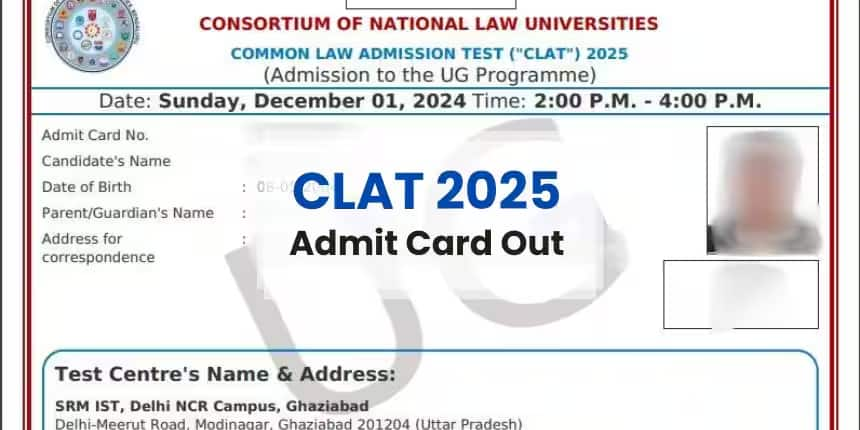
The Consortium of NLUs will issue the CLAT 2027 admit card tentatively in the last week of November at consortiumofnlus.ac.in. The CLAT admit card is a mandatory document for appearing in the examination. Candidates will be able to download it using their registered mobile number/email ID and password. The consortium will also release detailed exam day instructions along with the admit card.
Further, the admit card mentions various details such as the candidate's roll number, application number, exam centre name, address, CLAT exam reporting time and instructions. One must download and take a printout of the admit card to the designated CLAT exam centre on the exam day.
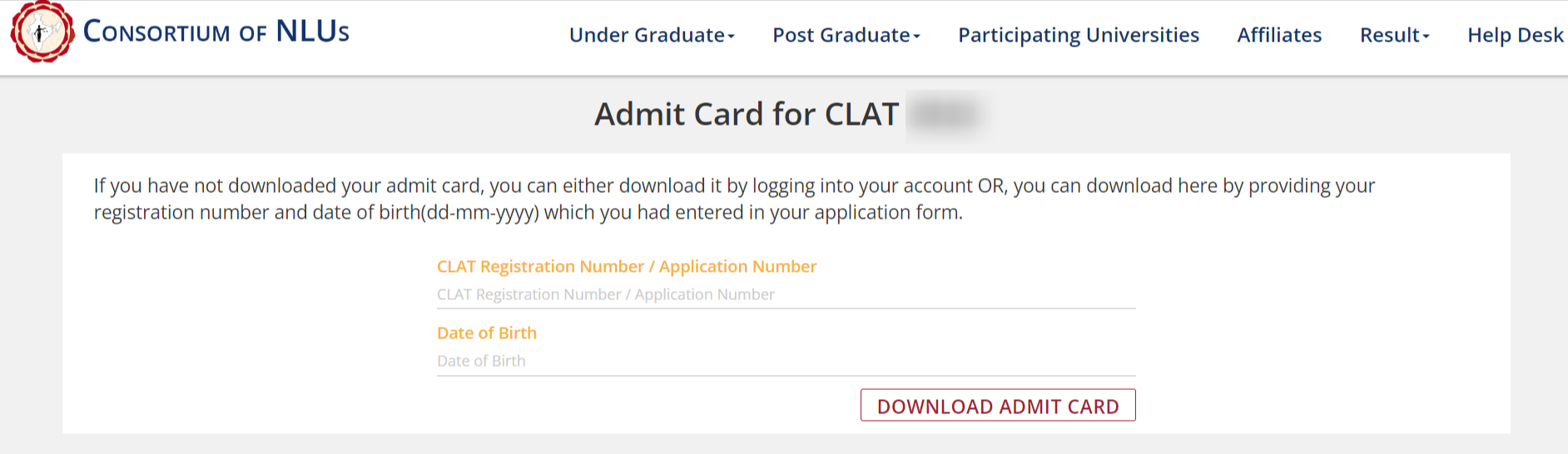
How to download CLAT admit card 2027?
Candidates can follow the steps mentioned below to download their admit card for CLAT 2027.
As per the previous year CLAT exam guidelines, the candidate has to report to the CLAT 2027 exam centre at least one hour before the commencement of the exam. Also, no candidate will be allowed fresh entry 15 minutes after the CLAT exam.
To take the test, the candidate has to display a printout of the admit card and a valid and original photo ID proof.
There will be no baggage counter at the exam venue and candidates will be solely responsible for the safe keep of their belongings. So, it is advisable not to carry non-essential items to the centre.
If the candidate wants, they may visit the exam centre to check out the location, travel route, distance and traffic situation. However, no candidate will be allowed beyond the main entrance gate, except on exam day and that too is only on producing the admit card and photo ID.
Blue/Black Ball Pen
Admit Card
Any original photo ID proof issued by the Government.
Transparent water bottle.
Own mask, gloves and personal hand sanitiser.
Self-health declaration
Disability certificate for PWD candidates
Candidates may also note that the consortium or the security staff at the exam centre will not be held responsible for the loss and damage of any property/gadgets of candidates.
The CLAT 2027 eligibility criteria are published by the consortium through an official notification. However, the eligibility rules have remained largely unchanged over the years. Candidates appearing in the CLAT exam 2027 must meet the eligibility criteria prescribed by the Consortium of National Law Universities (NLUs). Since the Common Law Admission Test (CLAT) is conducted for both UG and PG programmes, the eligibility criteria are also different for each level. The details of CLAT UG and CLAT LLM eligibility criteria are given below.
| Particular | UG-CLAT | PG-CLAT |
|---|---|---|
| Educational qualification | Class 12th or equivalent | LLB graduation |
| Minimum marks required | General candidates - 45% SC/ST - 40% | General candidates - 50% SC/ST - 45% |
Candidates have to meet the following conditions;
The eligibility criteria for LLM-CLAT are given below;
There is no age limit for appearing in CLAT 2027. Further, there are no restrictions on the number of attempts.
The Consortium of NLUs started the CLAT 2027 application process on August 3, 2026. Eligible candidates can complete the registration process online through the official website - consortiumofnlus.ac.in. The deadline to fill out the CLAT 2026 application form is October 31, 2026. The application process includes registration, filling the application form, uploading documents, payment of the application fee and final submission. The consortium will also provide a CLAT application correction window 2027. Registered candidates can edit their details in the application forms and update their test city preferences.
Candidates have to follow the steps mentioned below to fill out the application form of CLAT 2027.
| Documents | Size | Format |
|---|---|---|
Photograph | 500 KB | jpg/jpeg |
Signature | 100 KB | jpg/jpeg |
State domicile certificate | 2 MB |
| Candidate Category | Base Application Fee | Fee with Previous Year Question Papers (PYQs) |
|---|---|---|
| General / OBC / PwD / NRI / PIO / OCI | ₹4,000 | ₹4,500 |
| SC / ST / BPL | ₹3,500 | ₹4,000 |
The CLAT 2027 application correction window will open after the registration process concludes. Candidates can make changes or correct the test location preferences in the application form during this period. Candidates will be able to make corrections in the CLAT application form 2027 through login on the official website: consortiumofnlus.ac.
Download CLAT 2027 sample paper PDF with the latest exam pattern. Practice descriptive questions, improve accuracy, and strengthen your preparation for the upcoming CLAT exam.
Download Ebook| State | City |
| Uttar Pradesh | Allahabad Ghaziabad Kanpur Lucknow Noida Varanasi Meerut Gorakhpur Greater Noida Jhansi Agra Bareilly |
| Karnataka | Bangalore Dharwad Mangalore Hubli Mysore |
| Madhya Pradesh | Bhopal Indore Jabalpur Gwalior |
| Odisha | Bhubaneswar Cuttack |
| Chandigarh | Chandigarh |
| Tamil Nadu | Chennai Tiruchirapalli Salem Tirunelveli Coimbatore Madurai |
| Uttarakhand | Dehradun Haldwani |
| Delhi | New Delhi |
| Haryana | Faridabad Gurugram Hisar Kurukshetra Sonepat |
| Gujarat | Gandhinagar Vadodara Rajkot Surat |
| Assam | Guwahati |
| Telangana | Hyderabad |
| Rajasthan | Jaipur Jodhpur Kota |
| Jammu and Kashmir | Jammu Srinagar |
| West Bengal | Kolkata Siliguri Hooghly Kharagpur Malda Asansol Barrackpore |
| Maharashtra | Mumbai Nagpur Pune Amravati Navi Mumbai Thane Aurangabad |
| Punjab | Patiala Jalandhar Mohali Amritsar |
| Bihar | Patna Muzaffarpur |
| Chhattisgarh | Raipur Durg Bilaspur |
| Jharkhand | Ranchi Jamshedpur |
| Himachal Pradesh | Shimla |
| Kerala | Thiruvananthapuram Kottayam Ernakulam Calicut |
| Andhra Pradesh | Vijayawada Visakhapatnam Rajahmundry Tirupati Kurnool Chittoor |
| Puducherry | Puducherry |
| Daman and Diu | Diu |
| Sikkim | Gangtok |
| Manipur | Imphal |
| Meghalaya | Shillong |
| Dadra and Nagar Haveli | Silvassa |
| Tripura | Agartala |
Candidates preparing for CLAT exam should be well-versed with the exam pattern and syllabus. The CLAT exam pattern informs the candidates about the test structure, number of questions and their types, marking scheme and several other test modalities.
As per the CLAT 2027 exam pattern, it is an offline-based exam, with OMR sheets and question papers. CLAT 2027 question paper comprises 120 multiple-choice type questions in CLAT UG and 120 questions in CLAT LLM. All questions are based on comprehension passages. The details of the exam pattern are mentioned below.
| Particulars | Details |
|---|---|
| Language | English |
| Type of questions | Objective type test |
| Total number of questions | CLAT UG - 120 MCQs |
| CLAT PG - 120 MCQs | |
| Maximum marks | CLAT UG - 120 CLAT PG - 120 |
| Exam duration | 2 hours |
| Marking scheme | 1 mark for each correct answer |
| Negative marking | 0.25 marks will be deducted for each incorrect answer |
English language: Unit 01
Current affairs including general knowledge: Unit 01
Legal reasoning: Unit 01
Quantitative techniques: Unit 01
Quantitative techniques: Unit 02
Candidates who wish to appear in CLAT 2027 can solve a good number of mock tests during their preparation. There are multiple benefits of taking the CLAT mock test 2027. The Consortium of NLUs will also release CLAT 2027 sample papers in due course. Registered candidates can access the sample paper through their login.
Sometimes the candidate may need a little assistance in their CLAT exam preparation to get over the line. Like the candidate may want to know about some tools that can assist them to improve accuracy or improve speed.
| CLAT sample papers for quantitative ability | Download here |
| CLAT Logical reasoning sample papers | Download here |
| CLAT Sample Paper for General Knowledge and English | Download here |
| CLAT Legal Reasoning Sample Paper | Download here |
When preparing for CLAT exam 2027, it is important to have dependable and high-quality study material. The CLAT best books 2027 will be those that are easy to understand and contain few to no errors, including problem sets and instructions.
| Subject | Recommended books |
|---|---|
English language | Word Power Made Easy by Norman Lewis, High School English Grammar and Composition by Wren & Martin, Objective General English by RS Aggarwal, Barron’s Pocket Guide to Vocabulary |
Legal Reasoning | Universal’s CLAT Guide, Bare Acts of Indian Constitution, Legal Awareness and Legal Aptitude by AP Bhardwaj, LexisNexis Butterworths |
Quantitative Techniques | Quantitative Aptitude by RS Aggarwal, Class 10th NCERT Textbook |
Current affairs, including general knowledge | Lucent’s GK, Manorama Year Book, Competition Success Review India Year Book, and Pratiyogita Darpan. Also read leading newspapers like Hindu, Indian Express |
Logical Reasoning | Analytical Reasoning by MK Pandey, Analytical and Logical Reasoning by R.S. Aggarwal, Verbal and Non-Verbal Reasoning by RS Aggarwal |
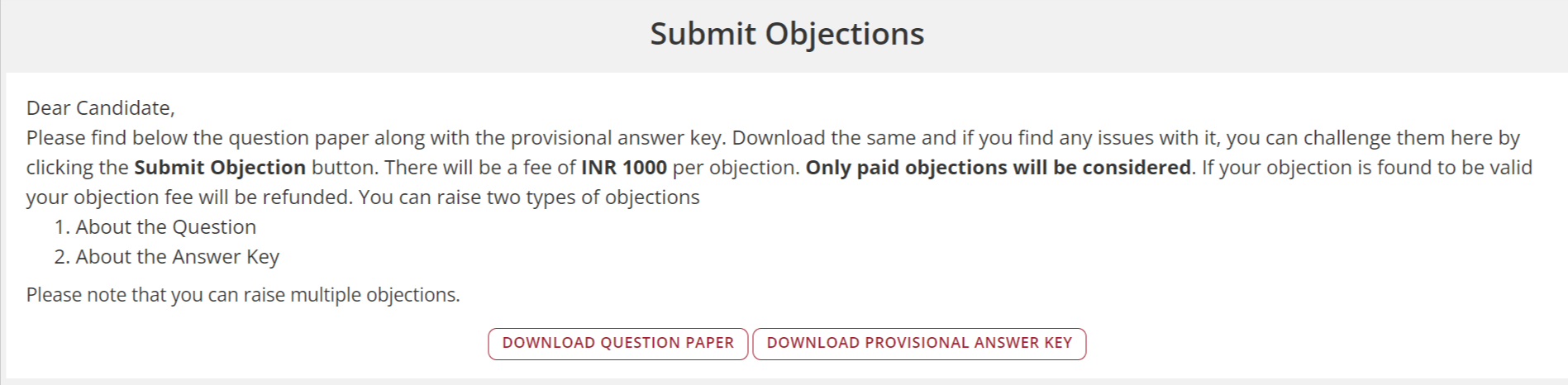
The Consortium of National Law Universities will release the CLAT 2027 provisional answer key a few days after the examination on its official website, consortiumofnlus.ac.in. Candidates will be allowed to raise objections against the provisional answer key by paying the prescribed objection fee. After examining all valid objections, the consortium will publish the CLAT 2027 final answer key. The CLAT 2027 result will be prepared on the basis of the final answer key.
Candidates can download the CLAT 2027 answer key PDF from the table below.
CLAT 2027 Provisional Answer Key | TBA |
As per the official marking scheme of CLAT 2027, every correct answer will fetch 1 mark, while for an incorrect answer 0.25 marks will be deducted. Use the following formula to calculate probable scores.
CLAT Scores = Total numbers of Correct options*1 - Total number of incorrect responses*0.25 |
For e.g. If the number of correct answers is 100 and incorrect answers is 40 then the total marks will be calculated as-
Total CLAT Marks = (100*1) - (40*0.25)
Therefore; Total marks = 100 - 10 = 90
Candidates will be given around two days to raise their objections against the key. The CLAT objection fee is Rs. 500 per question, reduced from the past years' objection fee of Rs. 1000. In case the objections are accepted, the objection fee will be refunded.
| Question Paper | Answer Key (Final) | Question paper | Answer Key (Provisional) | Answer Key (Final) |
| 5-year Law Programme | Series A | Click here | Click here | Click here |
| Series B | Click here | Click here | Click here | |
| Series C | Click here | Click here | Click here | |
| Series D | Click here | Click here | Click here | |
| LLM Programme | Series A | Click here | Click here | Click here |
| Series B | Click here | Click here | Click here | |
| Series C | Click here | Click here | Click here | |
| Series D | Click here | Click here | Click here |
The Consortium of NLUs is expected to declare the CLAT 2027 result within a few days after the examination in December 2026. Candidates can download their CLAT 2027 scorecards from the official website using their application number and date of birth. Along with the results, the consortium will also publish the counselling invitation list for eligible candidates.
The list of CLAT toppers for the previous sessions has been given below. The CLAT toppers list comprises the names of candidates who topped the exam along with their AIRs and scores.
All India Rank | Name |
AIR 1 | Geetali Gupta |
AIR 2 | Parv Jain |
AIR 3 | Rohan Joshi |
AIR 4 | Arshnoor Singh |
AIR 6 | Riddhi Agarwal |
AIR 7 | Gauransh Vats |
AIR 9 | Manvi Yadav |
AIR 10 | Arav Tikkoo |
AIR 11 | Parth Jede |
AIR 13 | Rishi Agrawal |
AIR 14 | Prathmesh Gaurav |
AIR 15 | Sanvi Mussadi |
AIR 16 | Asmita Joshi |
AIR 17 | Parthiva |
AIR 18 | Pranay Bansal |
AIR 19 | Asit Chauhan |
AIR 20 | Shravan Subbaraman |
AIR 23 | Ojas Dixit |
AIR 25 | Vidhita Dhamija |
AIR 27 | Navya Chaturvedi |
AIR 29 | Rohan Sen Gupta |
AIR 30 | Aarav Sachdeva |
AIR 31 | Pranav Dhawan |
AIR 37 | Vaishnavi Bhatia |
AIR 43 | Lakshit Kuvera |
AIR 44 | Yajvin Mahajan |
AIR 45 | Samiksha Singh |
AIR 47 | Chhavi Poplani |
AIR 49 | Rohan Goklaney |
AIR 50 | Garvit Kaushik |
AIR 54 | Raghavendra Singh |
AIR 69 | Zunaira Zafar |
AIR 73 | Sandeep Agarwala |
AIR 77 | Ishaan |
AIR 81 | Pratishtha |
AIR 82 | Drishti Rao |
AIR 88 | Vandita |
AIR 94 | Tanmay |
AIR 96 | Kiratana Yanganti |
AIR 103 | Yamya Alag |
AIR 106 | Arnav Jain |
AIR 115 | Ishita Shitlani |
AIR 116 | Akshat Pathak |
AIR 117 | Mayra Desai |
AIR 122 | Abhyudyaya Singh |
AIR 123 | Keshav Parashar |
AIR 124 | Radhika |
AIR 127 | Fiona Agarwal |
AIR 137 | Daiwik Khattar |
AIR 137 | Samarath Kumar |
AIR 138 | Siddhant Rohit |
AIR 139 | Medhini Srinath |
AIR 150 | Karan |
AIR 158 | Suraj |
AIR 160 | Arwa |
AIR 163 | Aarav Srivastav |
AIR 167 | Saksham |
AIR 173 | Manasvi |
AIR 180 | Yatharth Bansal |
AIR 187 | Aryan Gupta |
AIR 197 | Achintya Singh |
AIR 198 | Aryan Singh |
AIR 203 | Shreya Sharma |
AIR 216 | Dhruv Singh |
AIR 219 | Yatharth Tyagi |
AIR 225 | Rudraveer |
AIR 230 | Arnav |
AIR 256 | Shriyanshi Joshi |
AIR 333 | Hardik Gajraj |
| All India Rank | Name | Marks |
|---|---|---|
AIR 1 | Saksham Gautam | 103.5 |
AIR 2 | Anirudh Pathak | - |
AIR 3 | Ananya Tamaskar | - |
| AIR 6 | Nikhilesh Mukherjee | - |
| AIR 8 | Shantanu | - |
| AIR 9 | Vidit Rawat | 100 |
| AIR 10 | Sanchith Rau | - |
| AIR 18 | Tejaswi Giridhar | 98.5 |
| AIR 37 | Aditya Rao | 97.5 |
| AIR 70 | Devansh Agarwal | 96 |
| AIR 135 | Anirban Dutta | 94 |
| AIR 137 | Rohan Yadav | 94 |
| AIR 318 | Divya Negi | 91.5 |
| AIR 793 | Pranjal Tripathi | 87.25 |
CLAT Topper Interview Links:
| AIR | Name | Score | Percentile |
|---|---|---|---|
| 1 | Jai Bohara | 108 | 100 |
| 2 | Pradyot Shah | - | 99.99 |
| 3 | Rahul Palakurthy | - | 99.99 |
| 4 | Amireddy Sai Pragnya | - | 99.99 |
| 5 | TBA | - | 99.99 |
| 6 | TBA | - | 99.99 |
| 7 | Arijit Bansal | - | 99.99 |
| 8 | TBA | - | 99.98 |
| 9 | Jigyasa | - | 99.98 |
| 10 | Ashutosh Kar | - | 99.98 |
| 11 | Pawan Kumar Pandey | 103.25 | 99.98 |
| Name | Ranks (AIRs) | Scores |
|---|---|---|
| Abhinav Somani | AIR 1 | 116.75 |
| Gnanankit (SC category) | AIR 1 | 94.50 |
| Sahil Gupta | AIR 2 | 112 |
| Shubham Thakare | AIR 3 | - |
| Arnav Maheshwari | AIR 4 | - |
| Navya Nair | AIR 6 | - |
| Piyush Gupta | AIR 8 | 107.75 |
| Upmanyu Chatterjee | AIR 10 | - |
| Kshitika Tyagi | AIR 12 | 106.75 |
| Shruti Bhukar | AIR 16 in general, AIR 2 in OBC | - |
| Ayesha Khan | AIR 17 | 105.75 |
| Arunav Ghosh (To read full interview - Click here) | AIR 40 | 101.75 |
CLAT 2022 Toppers
| CLAT Toppers 2022 | Ranks (AIRs) | Scores | Read Interview |
| Rishabh | 1 | - | - |
| Menal | 2 | - | - |
| Shivaansh | 3 | - | - |
| Harshit | 4 | 117.75 | Click here |
| Akshat Aggarwal | 5 | 117.25 | - |
| Akarsh Bhafna | 6 | 117.00 | - |
| Sanjana Rao | 7 | - | - |
| Jahnvi Joshi | 8 | - | Read here |
| Khushi Aggarwal | 9 | - | - |
| Oorja Newatia | 10 | - | - |
| Varun Deval | 11 | - | - |
| Shivaraman Raghuraman | 12 | - | - |
| Rahul Malviya | 13 | - |
| Name of candidate | Rank | Marks obtained | Interview |
| Samriddhi Mishra | 1 | 94 | Click here |
| To be notified | 2 | - | |
| To be notified | 3 | - |
CLAT Toppers 2021 | Ranks (AIRs) | Scores | Read Interview |
Manhar Bansal | 1 | 125.5 | |
Nidhi Agarwal | 2 | 117 | Click Here |
Karthik J Lal | 3 | 117 | Click Here |
Shwetha Ramachandran | 4 | 115.5 | Click Here |
| Utkarsh Panda | 53 | 105.75 | Click Here |
| Shristy Chhaparia | 57 | 105.5 | Click Here |
CLAT toppers 2020 | Interview |
Jai Singh Rathor, AIR-3 | |
Anand Kumar, AIR-5 | |
Shailja Beria AIR - 6 | |
Ishan Thakur, AIR-19 |
Consortium will release the CLAT 2027 merit list after the declaration of results. Candidates included in the merit list will be eligible to participate in the CLAT 2027 counselling process. The CLAT 2027 merit list will mention important details such as the candidate's roll number, marks obtained and All India Rank (AIR). The merit rank is used for counselling, seat allotment and admissions to participating NLUs.
 Know your chances
The CLAT 2027 cut off is released in online mode. The consortium releases the cut-off for all five rounds of CLAT 2027 counselling. The cut off is the minimum marks required for admission to a national law university participating in the counselling. CLAT cut off 2027 will be different for each NLU, depending on the number of seats offered by NLU, the number of applicants and the reservation policy.
Check in details - CLAT 2026 Cut off
Candidates can check the CLAT NLU cut-offs for the previous years in the tables given below to get an idea of what to expect this year.
| NLU / Program | General | OBC | EWS | SC | ST |
| NLSIU Bengaluru | - | - | - | - | - |
| NALSAR Hyderabad | 168 | - | - | - | - |
| NLIU Bhopal (BA LLB Hons) | 459 | - | - | - | 10159 |
| NLIU Bhopal (BSc LLB Hons Cyber Security) | 698 | - | - | - | - |
| WBNUJS Kolkata (BA LLB Hons) | - | - | - | - | 8937 |
| WBNUJS Kolkata (BSc LLB Hons) | 598 | - | - | 7138 | 13759 |
| NLU Jodhpur (BA LLB Hons) | 364 | - | - | - | - |
| NLU Jodhpur (BBA LLB Hons) | - | - | - | - | - |
| HNLU Raipur | 806 | - | - | 7216 | - |
| GNLU Gandhinagar | 398 | - | - | - | - |
| GNLU Silvassa | 1500 | - | 2343 | - | - |
| RMLNLU Lucknow | 798 | 3152* | - | 11094* | - |
| RGNUL Punjab | 1141 | - | - | 10156 | - |
| CNLU Patna (BA LLB Hons) | 1235 | - | 2375* | - | - |
| CNLU Patna (BBA LLB Hons) | 1368 | - | 2597* | - | - |
| NUALS Kochi | - | - | - | - | - |
| NLUO Cuttack (BA LLB) | 848 | - | - | 9292 | 17359 |
| NLUO Cuttack (BBA LLB) | 892 | - | - | 10619 | 20828 |
| NUSRL Ranchi (BA LLB Hons) | 1440 | 2829 | - | 11301 | - |
| NUSRL Ranchi (BBA LLB Hons) | 1543 | 2963 | - | 11863 | 22575 |
| NLUJA Assam | 2049 | 3865 | 3078 | 12828 | 21460 |
| DSNLU Visakhapatnam | 1400 | - | 2478 | 11482 | - |
| TNNLU Tiruchirappalli (BA LLB Hons) | 1528 | 3252 | - | 12188 | - |
| TNNLU Tiruchirappalli (BCom LLB Hons) | 1734 | 3889 | - | 12426 | - |
| MNLU Mumbai | - | - | - | - | - |
| MNLU Nagpur (BA LLB Hons) | 1404 | - | 10802* | - | - |
| MNLU Nagpur (BBA LLB Hons) | 1491 | 18678* | 13387* | 27895* | - |
| MNLU Chhatrapati Sambhajinagar (BA LLB Hons) | 1784 | - | 17325 | - | - |
| MNLU Chhatrapati Sambhajinagar (BBA LLB Hons) | 2020 | - | - | 28567* | - |
| HPNLU Shimla (BA LLB Hons) | 2108 | - | 3188 | 12661 | 22118 |
| HPNLU Shimla (BBA LLB Hons) | 2275 | - | 3271 | 13896 | 23985 |
| DNLU Jabalpur | 2045 | 3476 | 2995 | 13479 | - |
| NLU Sonepat (DBRANLU) | 1810 | 3780 | 2717 | 13130 | - |
| NLUT Agartala | 2410 | - | - | 70385* | - |
| RPNLUP Prayagraj | 2268 | 4899* | - | 14648* | - |
| IIULER Goa (BA LLB Hons) | 2646 | 4788 | 3512 | 15315 | 25555 |
| IIULER Goa (BBA LLB Hons) | 2802 | 5170 | 3873 | 15461 | 28599 |
| NLU | General | OBC | EWS | SC | ST | Total Allotments |
| NLSIU Bengaluru | - | 1177 | - | - | - | 5 |
| NALSAR Hyderabad | 164 | - | - | - | - | 6 |
| WBNUJS Kolkata (BA LLB) | 343 | - | - | - | - | 3 |
| WBNUJS Kolkata (BSc LLB) | - | - | - | - | - | 0 |
| NLIU Bhopal (BA LLB) | - | 1966 | - | - | - | 5 |
| NLIU Bhopal (BSc LLB) | - | - | - | - | - | 1 |
| NLU Jodhpur (BA LLB) | 355 | 1427 | - | 4281 | - | 4 |
| NLU Jodhpur (BBA LLB) | 406 | 1657 | - | 5541 | - | 4 |
| GNLU Gandhinagar | 397 | 1952 | - | - | - | 6 |
| GNLU Silvassa | 1354 | - | - | - | - | 6 |
| HNLU Raipur | - | 2152 | - | - | - | 4 |
| MNLU Mumbai | 500 | - | - | 11433* | - | 5 |
| RMLNLU Lucknow | 792 | - | - | - | - | 6 |
| RGNUL Patiala | 1105 | - | - | 9852 | 14067 | 11 |
| CNLU Patna (BA LLB) | 1181 | - | - | - | - | 2 |
| CNLU Patna (BBA LLB) | - | - | - | - | - | 1 |
| NUALS Kochi | 1156 | - | - | - | - | 2 |
| NLU Odisha (BA LLB) | 835 | - | - | 8874 | 16781 | 11 |
| NLU Odisha (BBA LLB) | 875 | - | - | 9978 | 20414 | 7 |
| NUSRL Ranchi (BA LLB) | 1373 | 2784 | - | 10930 | 17445 | 10 |
| NUSRL Ranchi (BBA LLB) | 1453 | 2893 | - | 22061 | 8 | |
| NLUJA Assam | 1911 | 3787 | - | 12019 | 21090 | 14 |
| DSNLU Visakhapatnam | 1360 | 2382 | 8367* | 11094 | - | 6 |
| TNNLU Tiruchirappalli (BA LLB) | 1499 | 3172 | - | 12082 | - | 8 |
| TNNLU Tiruchirappalli (BCom LLB) | - | 3756 | - | - | - | 6 |
| MNLU Nagpur (BA LLB) | 1308 | - | - | 19271* | - | 8 |
| MNLU Nagpur (BBA LLB) | 1417 | - | - | - | - | 5 |
| MNLU Chhatrapati Sambhajinagar- B.A. LL.B. (Hons.) | - | - | - | 24729* | - | 7 |
| MNLU Chhatrapati Sambhajinagar- B.B.A. LL.B. (Hons.) | 1844 | - | - | 25629* | - | 6 |
| HPNLU Shimla (BA LLB) | 1999 | - | 39239* | 12622 | 21247 | 12 |
| HPNLU Shimla (BBA LLB) | 2127 | - | 40483* | - | 23605 | 15 |
| MPDNLU Jabalpur | 1813 | 3272 | - | 12966 | 22701 | 15 |
| RPNLUP, Prayagraj | - | - | - | 14390* | - | 5 |
| IIULER Goa (BA LLB) | 2519 | 4370 | - | - | 24614 | 22 |
| IIULER Goa (BBA LLB) | 2631 | 4760 | - | 15047 | 27540 | 26 |
| DBRANLU Sonepat | 1737 | 3748 | - | 12970 | - | 10 |
| NLUT, Agartala | 2346 | - | - | 66229* | - | 8 |
NLU | General | SC | ST | OBC/SEBC | EWS |
NLSIU Bengaluru | 108 | 3142 | 5227 | 1111 | 740 |
NALSAR Hyderabad | 162 | 3335 | 5810 | 915 | 713 |
NLIU Bhopal - BA LLB (Hons.) | 451 | 5970 | 9595 | 1894 | 1380 |
NLIU Bhopal - BSc LLB (Hons.) Cyber Security | 695 | 8400 | 12196 | 2388 | 2283 |
WBNUJS Kolkata | 327 | 3833 | 8675 | 6526 | N/A |
WBNUJS Kolkata - BSc LLB (Hons.) Crim & For | 582 | 6980 | 9937 | 6642 | N/A |
NLU Jodhpur | 5543 | 4072 | N/A | 1411 | 942 |
NLU Jodhpur - BBA LLB (Hons.) | 405 | 4947 | 9220 | 1560 | 1167 |
HNLU Raipur | 770 | 7065 | N/A | 2111 | N/A |
GNLU Gandhinagar | 392 | 5446 | 8797 | 1944 | 1261 |
GNLU Silvassa | 1348 | 9890 | 15676 | 2638 | 1836 |
RMLNLU Lucknow | 779 | 10623 | N/A | 3077 | 2381 |
RGNUL Punjab | 1094 | 9695 | 13806 | N/A | N/A |
CNLU Patna - BA LLB (Hons.) | 1172 | 13020 | 18875 | N/A | N/A |
CNLU Patna - BBA LLB (Hons.) | 1339 | 17550 | 30407 | N/A | 2470 |
NUALS Kochi | 1154 | 16941 | 53163 | 23476 | 28372 |
NLUO - BA LLB | 832 | 8442 | 15462 | 12629 (SEBC-OD) | N/A |
NLUO - BBA LLB | 866 | 9688 | 20246 | N/A | N/A |
NUSRL Ranchi - BA LLB (Hons.) | 1353 | 10664 | 17433 | 2705 | 2193 |
NUSRL Ranchi - BBA LLB (Hons.) | 1446 | 11628 | 20414 | 2710 | N/A |
NLUJA Assam | 1869 | 12006 | N/A | 3693 | 2717 |
DSNLU Visakhapatnam | 1351 | 10813 | 16344 | 2731 | 2343 |
TNNLU Tiruchirappalli - BA LLB (Hons.) | 1495 | 430 | N/A | 414 | N/A |
TNNLU Tiruchirappalli - BCom LLB (Hons.) | 1658 | 12188 | N/A | 3623 | N/A |
MNLU Mumbai | 495 | 11386 | 32607 | 6085 | 6334 |
MNLU Nagpur - BA LLB (Hons.) | 1306 | 18815 | 58384 | 13776 | 10000 |
MNLU Nagpur - BBA LLB (Hons.) | 1406 | 24632 | 66593 | 17856 | 13172 |
MNLU Aurangabad (Chhatrapati Sambhajinagar) - BA LLB (Hons.) | 1573 | 24370 | 60165 | 16290 | 17121 |
MNLU Aurangabad - BBA LLB (Hons.) | 1820 | 25223 | 55620 | 18912 | 16479 |
HPNLU Shimla - BA LLB (Hons.) | 1988 | 11422 | 20346 | N/A | 2845 |
HPNLU Shimla - BBA LLB (Hons.) | 2077 | 13532 | 22701 | N/A | 3083 |
MPDNLU Jabalpur | 1807 | 12789 | 22445 | 3241 | 2937 |
DBRANLU Sonepat | 1721 | 12599 | 20400 | 3658 | 2608 |
NLUT Agartala | 2259 | 65214 (SC-TR) | 70636 (ST-TR) | N/A | N/A |
RPNLUP Prayagraj | 2053 | 13914 (SC-UP) | 32325 (ST-UP) | 4550 (OBC-UP) | 3436 (EWS-UP) |
IIULER Goa - BA LLB (Hons.) | 2489 | 14379 | N/A | 49057 | 3492 |
IIULER Goa - BBA LLB (Hons.) | 2566 | 15024 | 26117 | 4594 | 3533 |
| NLU | General | OBC | EWS | SC | ST |
| NLSIU Bengaluru | 108 | 1071 | 740 | 3142* | 5227* |
| NALSAR Hyderabad | 161 | 1366* | 713 | 3335* | 5716 |
| WBNUJS Kolkata (BA LLB) | 327 | 6624* | - | - | 7624 |
| WBNUJS Kolkata (BSc LLB) | 582 | 10560* | - | 6980 | 9937 |
| NLIU Bhopal (BA LLB) | 451 | 1894 | 1380 | 5541 | 9595 |
| NLIU Bhopal (BSc LLB) | 695* | 2382 | 2283 | 8400 | 11025* |
| NLU Jodhpur (BA LLB) | 340 | 1401 | 942 | 4072 | 6042 |
| NLU Jodhpur (BBA LLB) | 405 | 1493 | 1167 | 7589* | 9220 |
| GNLU Gandhinagar | 392 | 1944* | 1261 | 5343 | 8797 |
| GNLU Silvassa | 1264 | 2607 | 1817 | - | - |
| HNLU Raipur | 766 | 2110 | - | 7051* | 11738 |
| MNLU Mumbai | 495 | 6085* | 6334* | 11386* | 32607* |
| RMLNLU Lucknow | 776 | - | 2381* | 10445* | - |
| RGNUL Patiala | 1094 | - | - | 9650 | 13806 |
| CNLU Patna (BA LLB) | 1398 | 7359* | 1950* | 11590* | - |
| CNLU Patna (BBA LLB) | 1339 | - | 2470* | 17550* | - |
| NUALS Kochi | 1154 | - | - | - | - |
| NLU Odisha (BA LLB) | 832 | - | - | 8232 | 15462 |
| NLU Odisha (BBA LLB) | 866 | - | - | 9556 | 19327 |
| NUSRL Ranchi (BA LLB) | 1353 | 2669 | 2193 | 10623 | 17433 |
| NUSRL Ranchi (BBA LLB) | 1437 | 2761 | 2217 | 11301 | 20246 |
| NLUJA Assam | 1862 | 3669 | 2717 | 11777 | 17814 |
| DSNLU Visakhapatnam | 1351 | 2731 | 2343 | 10641 | 28015* |
| TNNLU Tiruchirappalli (BA LLB) | 1477 | 3110 | - | 11825 | - |
| TNNLU Tiruchirappalli (BCom LLB) | 1647 | 3543 | - | 12144 | - |
| MNLU Nagpur (BA LLB) | 1299 | 13527* | - | 18815* | 55543* |
| MNLU Nagpur (BBA LLB) | 1399 | 17589* | 10802* | 23042* | - |
| MNLU Chhatrapati Sambhajinagar- B.A. LL.B. (Hons.) | 1573 | 16290* | 17108* | 24370* | - |
| MNLU Chhatrapati Sambhajinagar- B.B.A. LL.B. (Hons.) | 1784 | 17856* | - | 24729* | - |
| HPNLU Shimla (BA LLB) | 1972 | - | 2845 | 11422 | 20346 |
| HPNLU Shimla (BBA LLB) | 2048 | - | 3083 | 13130 | 22580 |
| MPDNLU Jabalpur | 1789 | - | 2937 | 11941 | 21999 |
| RPNLUP, Prayagraj | 2032 | 4456* | 3088* | 13825* | - |
| IIULER Goa (BA LLB) | 2351 | 4224 | 3492 | 13849 | 23793 |
| IIULER Goa (BBA LLB) | 2448 | 4561 | 3510 | 14164 | 25138 |
| DBRANLU Sonepat | 1720 | 3658 | 3208* | 14789* | 20400 |
| NLUT, Agartala | 2221 | - | - | 65214* | 68937* |
*state reservation
| NLU / Program | General | OBC | EWS | SC | ST |
| NLSIU Bengaluru | 101 | 1018 | 702 | 3072 | 5000 |
| NALSAR Hyderabad | 148 | 915 | 630 | 3259 | 5200 |
| NLIU Bhopal (BA LLB Hons) | 432 | 1714 | 1315 | 5407 | 9461 |
| NLIU Bhopal (BSc LLB Hons Cyber Security) | 684 | 2326 | 2056 | 7996 | 10429 |
| WBNUJS Kolkata (BA LLB Hons) | 284 | - | - | 3833 | 6010 |
| WBNUJS Kolkata (BSc LLB Hons) | 550 | - | - | 6186 | 9615 |
| NLU Jodhpur (BA LLB Hons) | 310 | 1273 | 868 | 4042 | 5907 |
| NLU Jodhpur (BBA LLB Hons) | 386 | 1427 | 970 | 4985 | 8113 |
| HNLU Raipur | 736 | 1994 | - | 6464 | 11239 |
| GNLU Gandhinagar | 376 | 1834 | 1167 | 5340 | 7913 |
| GNLU Silvassa | 1259 | 2541 | 1836 | 9215 | 14278 |
| RMLNLU Lucknow | 747 | - | - | - | - |
| RGNUL Punjab | 1059 | - | - | 9118 | 13152 |
| CNLU Patna (BA LLB Hons) | 1141 | - | - | - | - |
| CNLU Patna (BBA LLB Hons) | 1287 | - | - | - | - |
| NUALS Kochi | 1076 | - | - | - | - |
| NLUO Cuttack (BA LLB) | 800 | - | - | 7833 | 14196 |
| NLUO Cuttack (BBA LLB) | 828 | - | - | 9202 | 17986 |
| NUSRL Ranchi (BA LLB Hons) | 1297 | 2585 | 2000 | 9826 | 15765 |
| NUSRL Ranchi (BBA LLB Hons) | 1356 | 2653 | 2189 | 10338 | 17445 |
| NLUJA Assam | 1764 | 3527 | 2597 | 11539 | 17399 |
| DSNLU Visakhapatnam | 1281 | 2508 | 2217 | 10433 | 15199 |
| TNNLU Tiruchirappalli (BA LLB Hons) | 1370 | 2713 | - | 11222 | - |
| TNNLU Tiruchirappalli (BCom LLB Hons) | 1517 | 3419 | - | 11652 | 19158 |
| MNLU Mumbai | 481 | - | - | - | - |
| MNLU Nagpur (BA LLB Hons) | 1225 | 12425 | 9418 | 18014 | 52882 |
| MNLU Nagpur (BBA LLB Hons) | 1307 | 13711 | 10620 | 21508 | 66593 |
| MNLU Chhatrapati Sambhajinagar (BA LLB Hons) | 1518 | 14588 | 13387 | 20072 | 60165 |
| MNLU Chhatrapati Sambhajinagar (BBA LLB Hons) | 1770 | 17523 | 15627 | 23626 | 55620 |
| HPNLU Shimla (BA LLB Hons) | 1824 | - | 2692 | 10935 | 19833 |
| HPNLU Shimla (BBA LLB Hons) | 1871 | - | 2937 | 12188 | 21090 |
| DNLU Jabalpur | 1740 | 3056 | 2575 | 11792 | 21749 |
| NLU Sonepat (DBRANLU) | 1665 | 3409 | 2594 | 11562 | 20080 |
| NLUT Agartala | 2015 | - | - | - | - |
| RPNLUP Prayagraj | 1930 | - | - | - | - |
| IIULER Goa (BA LLB Hons) | 2127 | 4093 | 3148 | 13475 | 22702 |
| IIULER Goa (BBA LLB Hons) | 2236 | 4289 | 3236 | 13737 | 23793 |
To decide what is a good score in CLAT 2027 you have to first identify the NLU you want to get admission into. And the last rank (or cutoff rank) for which admission is offered in that institute can be considered to be a good score. That said the cutoff fluctuates depending on a host of parameters like seat intake, the performance of candidates in CLAT 2027 total applicants, and the CLAT merit rank of these applicants. So, you will be in the safe zone only if you score a little higher than the past year's cutoff rank.
The consortium will conduct the CLAT 2027 counselling process after the declaration of results. The CLAT 2027 counselling will be conducted in five rounds in online mode. Only candidates who register for counselling within the prescribed deadline will be considered for seat allotment. Candidates included in the merit list of CLAT 2027 will be eligible for admission to the allotted National Law Universities.
As per the latest counselling process, candidates are required to submit a minimum of 15 NLU preferences for UG and 5 NLU preferences for PG programmes. The CLAT 2027 merit list for each counselling round will be prepared based on the candidate's CLAT score, merit rank and NLU preferences. After every round, the consortium will publish the CLAT seat allotment list for all participating National Law Universities.
The counselling fee of CLAT 2027 is Rs. 30,000. For SC and ST candidates, the counselling fee is Rs 20,000. Candidates can pay the counselling fee online while registering for the counselling. The counselling fee will be adjusted with the NLU course fee.
The CLAT seat allotment is made based on the merit rank of the candidate and NLU preference selected. The seat allotment of CLAT 2027 will be announced for each law school, in five rounds. After each round of seat allotment, candidates will have the following options;
Post Round 5 seat allotment, the candidate has two options before him:
To accept a seat, the candidate will have to pay the NLU fees and complete admission formalities. However, if the candidate is unhappy with the allotted seat, they may exit the admission process without paying the admission fee.
Top Law Universities in India
| UPES | SRM |
| ICFAI | BML |
| LPU | KL University |
| MIT WPU | Chandigarh University |
Candidates should also solve all previous year's CLAT papers, especially those based on the new exam pattern. The CLAT previous year's question papers would also be helpful in understanding the type of questions asked in the examination and topics that appear frequently in the test paper. While registering for CLAT, candidates may purchase the question papers on payment of Rs 500. However, the official question papers of CLAT at FREE of COST are provided below.
Contact Number:
06712338018
Relevant Links:
Official Website Link Click HereFrequently Asked Questions (FAQs)
CLAT 2027 exam will be held on December 06, 2026 (2 PM - 4 PM), in offline (pen-and-paper) mode.
The objection fee for CLAT has been reduced to INR 500 per question from last year's objection fee of INR 1000.
26 national law universities and IIULER Goa are participating institutes of CLAT. All 26 NLUs offer 5-year LLB courses, whereas 21 of them offer one-year LLM programme. Note that in addition to the NLUs, there are many other CLAT affiliated institutes and other colleges that offer admissions based on CLAT scores. The difference between then the NLUs is that they may also use other exam scores like AILET. Further, they don't take part in the CLAT counselling process conducted by the consortium of NLUs.
The CLAT 2027 application form was released on August 03, 2026 at 10:00 AM.
As per the eligibility criteria of CLAT, the candidate should have completed Class 12 from a recognized board with a minimum 45 per cent marks (40 per cent for SC/ST category candidates). There is no age limit for appearing in the CLAT examination.
The full form of CLAT is Common Law Admission Test. CLAT is conducted for admission to national law universities of India.
The changes in new CLAT exam pattern include reducing the number of questions from 150 to 120. The PG exam pattern remains unchanged with 120 multiple choice questions on different areas of law.
There are various UG and PG courses that are offered through CLAT. These include, BA LLB, BBA LLB, BCom LLB, BSc LLB, LLM specialisation etc.
Others
07 Jul, 2026 - 06 Jan, 2027
Exam Date
13 Dec, 2026 - 13 Dec, 2026
On Question asked by student community
Hello Dear Student,
Yes, an OBC candidate scoring around 60 marks can get admission into specific National Law Universities (NLUs) like MNLU Aurangabad and MNLU Nagpur, as general closing trends place a score of 60 roughly around a rank of 14,000 to 18,000.
You can find, check and get more
Hello Student,
Law is excellent career choice with diverse opportunities. if your son is interested in judicial career, he should first pursue either the 5-year Integrated LLB courses after class 12 or the 3-year LLB courses after graduation, after completing the law degree and meeting the eligibility criteria, he can
Hello Student,
Based on the information you have shared, you are eligible to appear for the CLAT exam if you have met the minimum percentage requirement prescribed by the Consortium of NLUs. However, for admission, you must have passed Class 12 without any pending compartment/RT (result to be declared or

Among top 100 Universities Globally in the Times Higher Education (THE) Interdisciplinary Science Rankings 2026
Ranked #18 amongst Institutions in India by NIRF | Get Upto 100% Scholarships | Spot Admissions via CUET
Approved by BCI | Ranked #4 among Law Institutes in UP | NAAC A+ Accredited
In-house judicial coaching | Proven success in National Moot Court Competitions
NAAC A+ Grade | Ranked 503 Globally (QS World University Rankings 2026)
Ranked 1 st among Top Law Schools of super Excellence in India - GHRDC | NAAC A+ Accredited | #36 by NIRF
College Available: 4
College Available: 4
College Available: 3
College Available: 2
