
Search Colleges, Exams, Schools & more


Login
Top 10 Repeated Topics in AIBE Question Papers: Last 3-year Analysis
Since AIBE 22 will be held on 29th November 2026, being aware of the recurring subjects in the previous year’s papers will assist in solving the question paper with ease. We have analysed the last 3 years of AIBE question papers and identified the Top 10 Most Repeated Topics in the AIBE 22 exam, which are high-weightage and frequently asked topics.
These insights help you to avoid unnecessary study overload and to focus on the legal concepts that matter most for qualification. Whether you want to increase your accuracy, reduce revision, or refine conceptual clarity, this 3-year AIBE trend analysis will help you prepare smarter and more strategically. Let’s uncover the must-study topics you simply cannot afford to miss for AIBE 22 Preparation.
AIBE 22 Mock Test Series
AIBE 22 Mock Test Series helps candidates practise important questions, revise key legal subjects and prepare for the upcoming AIBE 22 exam. Solve mock tests to check your preparation, improve accuracy and build confidence before the exam.
AIBE 22 Mock Test | Download Free PDF Here |
AIBE 22 Mock Test 1 | |
AIBE 22 Mock Test 2 | |
AIBE 22 Mock Test 3 | Download Here |
Most Scoring Areas in AIBE Based on Previous Papers
The AIBE syllabus comprises 19 core legal subjects with strategic weightage. Knowing this weightage is very important to prepare properly for the AIBE exam. Here are the Top 10 Most Repeated Topics in the AIBE Question Paper that appeared most frequently over the last three AIBE exams:
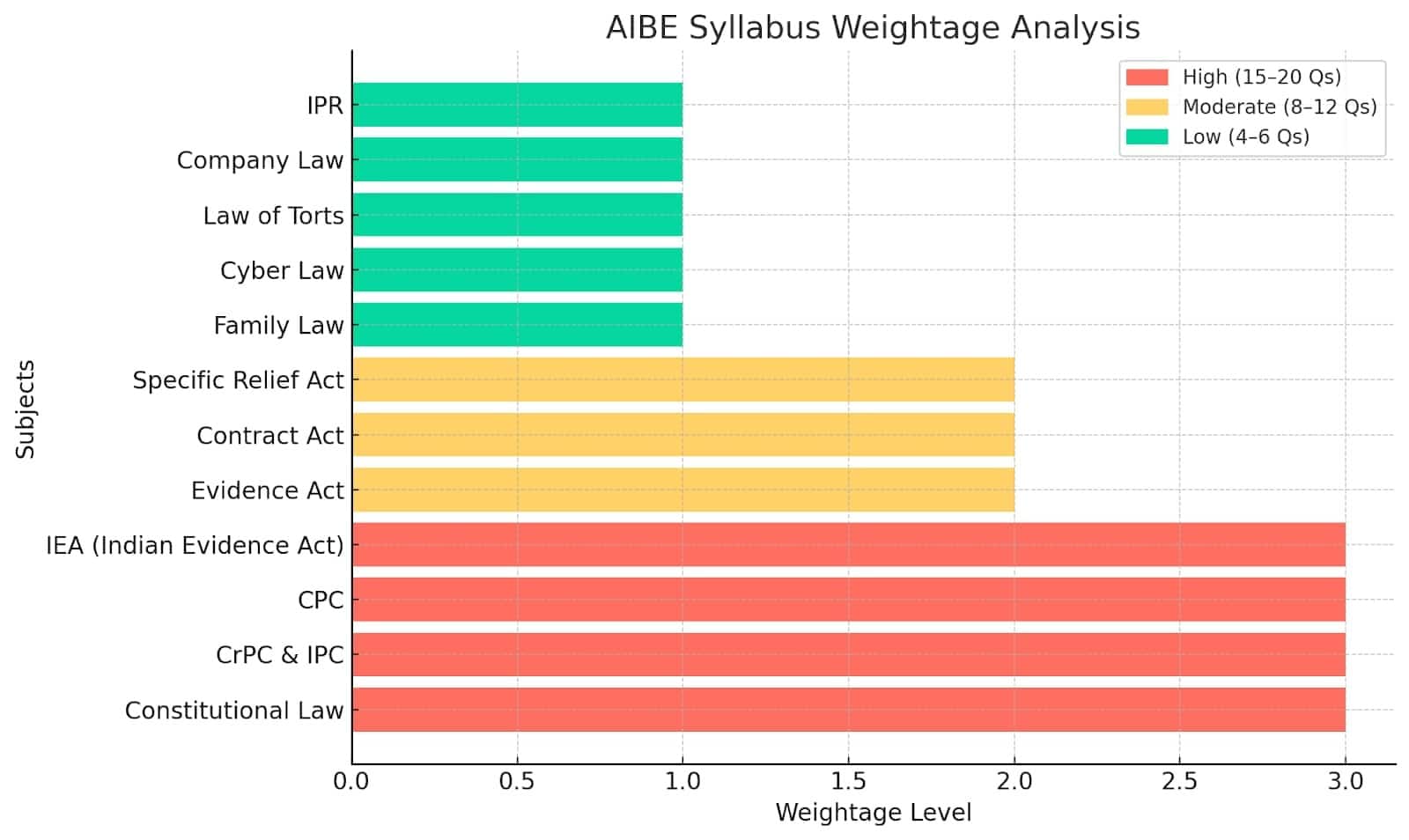
Topics You Must Prioritise to Clear AIBE on First Attempt
Subject | High-Yield Topics |
Constitution of India |
|
IPC |
|
CrPC |
|
CPC |
|
Evidence Act |
|
Professional Ethics |
|
Other Important Areas |
|
Strategy Based on Analysis |
|
Top 10 Most Repeated Topics in AIBE (3-Year Trend)
The subjects mentioned above keep on recurring and hold high importance from the perspective of marks, as per the latest AIBE 22 (2026) syllabus and also an analysis of the new criminal laws and the past three years' question papers.
Rank | Repeated Topic | Why It Repeats Every Year | High-Yield Focus Areas |
1 | Fundamental Rights & Constitutional Law | Highest weightage; FR & landmark SC rulings appear in every AIBE exam. | Articles 12–35, judicial review, emergency, Centre–State powers |
2 | New Criminal Laws – BNS, BNSS, BSA (2023) | AIBE now tests >90% procedural Qs from BNSS | Arrest, bail, police powers, digital evidence, terrorism, mob lynching |
3 | Evidence Law (Old + BSA 2023) | Consistently 6–8 Qs; digital evidence rising | Relevancy, admissibility, Sections 3, 5, 24, 32, 45–51 |
4 | CPC – Suits, Jurisdiction & Interim Relief | Procedural law always heavily tested | Institution of suits, pleadings, Orders I, VI, VII, XXI, XXXIX |
5 | IPC + New BNS Offences | Combination of classic IPC + new BNS areas | Crimes against person/property, women/children offences, terrorism, hit-and-run |
6 | Family Law | Appears every year; predictable concepts | HMA 5, 7, 9, 13, 13-B; succession; adoption; DV protections |
7 | Contract, Specific Relief & NIA | High scoring; concept-based | Offer-acceptance, breach, specific performance, negotiable instruments |
8 | Torts + Consumer & Motor Vehicle Law | Case-based Qs repeated yearly | Negligence, strict/absolute liability, MV Act claims, consumer rights |
9 | ADR & Arbitration | Quick-solve theory Qs; always 3–4 asked | Arbitration enforcement, mediation, conciliation, Lok Adalats |
10 | Professional Ethics & Misconduct | BCI rules are a permanent AIBE section | Duties of advocates, misconduct, client confidentiality, conflict of interest |
Practice Question Papers from Previous Years
This will allow candidates to better manage their time during the exam and understand the frequency of crucial questions within each section. A review of last year's paper found that some of its questions were based on significant and controversial judicial decisions from that year. The following are some previous year question papers for the AIBE exam on the first attempt.
Year | |
AIBE 21 Question Paper PDF | |
AIBE 20 Question Paper PDF | |
AIBE 19 Question Paper PDF | |
AIBE 19 SET A Question Paper PDF | |
AIBE 19 SET B Question Paper PDF | |
AIBE 19 SET C Question Paper PDF | |
AIBE 19 SET D Question Paper PDF | |
AIBE 18 Question Paper PDF | |
AIBE 17 Question Paper PDF | |
AIBE 16 question paper PDF with solutions | |
AIBE 15 question paper PDF with solutions | |
Frequently Asked Questions (FAQs)
Q: Why should I focus on repeated topics for AIBE 22 preparation?
A:
Focusing on repeated topics helps you prepare smarter by concentrating on concepts that have consistently appeared in previous AIBE papers. This improves revision efficiency and increases your chances of attempting familiar questions.
Q: Are repeated topics enough to crack AIBE 22?
A:
No. While repeated topics form an important part of preparation, candidates should also revise the full AIBE 22 syllabus to handle conceptual and application-based questions confidently.
Q: Can repeated topics help improve revision speed?
A:
Yes. Prioritising repeated topics helps streamline revision by allowing you to focus on high-yield areas instead of spending time equally across low-frequency topics.
Q: When is AIBE 22 scheduled?
A:
AIBE 22 is scheduled to be conducted on 29th November 2026. Candidates should prioritise repeated-topic revision during the final weeks of preparation.
Articles
Related Stories
|
Upcoming Law Exams

Certifications By Top Providers
Explore Top Universities Across Globe
Popular Courses and Specializations
Questions related to AIBE
On Question asked by student community
Have a question related to AIBE ?
Hello student!
AIBE question papers in Kannada medium are not explicitly available. Meanwhile, you can check these resources for AIBE previous-year question papers and the AIBE 21 (2026) Set A and Set B papers for practice.
AIBE Previous-Year Question Papers:
https://law.careers360.com/articles/aibe-previous-year-question-papers
AIBE 21 Set B Question Paper 2026:
https://law.careers360.com/articles/aibe-21-set-b-question-paper-pdf-2026
AIBE
Hello Student,
You can check the relevant article below
https://law.careers360.com/download/ebooks/aibe-preparation-guide
Hope it helps!
Hello Student,
You can access the AIBE previous year question papers in Hindi by clicking on the relevant link given below.
https://law.careers360.com/hi/articles/aibe-previous-year-question-papers
Hey there,
No. If you are currently in the 5th semester of a 3-year LL.B., you generally cannot register for AIBE yet.
Under the current BCI rules, a 3-year LL.B. student must be in the final semester (6th semester) and have no backlogs from previous semesters to register for AIBE.
Hello Dear Student,
The All India Bar Examination (AIBE) covers 19 major legal subjects, carrying a high-weightage focus on Constitutional Law (8–12 questions) and Family Law including Hindu and Muslim law (6–8 questions)
You can check, find and access more information here:
-
https://law.careers360.com/articles/aibe-important-topics
Hope it helps!

Applications for Admissions are open.
Ranked #18 amongst Institutions in India by NIRF | Get Upto 100% Scholarships | Spot Admissions via CUET
Woxsen University, Hyderabad
ApplyScholars’ Round Deadline: 14th Nov’26 | Earn upto 50% merit Scholarship + 10% for top performers | EFMD Accredited | AACSB (USA) & AMDISA Member | Highest CTC 28 LPA
Unitedworld School of Law, Karnavati University, Gandhinagar
ApplyMoot Court | Mock trials | Legal Aid Clinic | Recruiting Partners: FICCI, TCS, Adani, Trilegal, and many others
Chitkara University
ApplyNAAC A+ Accredited University
Parul Institute of Law, Vadodara
ApplyBA LLB, BBA LLB, or BCom LLB and LLB | LLM 1 Year – 4 Specializations | Approved by BCI | Highest CTC 9 LPA
Institute of Law, Nirma University, Ahmedabad
ApplyGrade 'A+' Accredited by NAAC | Ranked 33rd in India by NIRF
AIBE Notifications
Never miss AIBE update
Get timely AIBE updates directly to your inbox. Stay informed!