ICFAI University Sikkim Law Admissions 2026
Approved by BCI


The answers for the CLAT 2026 exam must be done on the Optical Mark Reader (OMR) sheet. It is a response sheet containing circles that must be highlighted for the chosen answer. Candidates must only use a black or blue ballpoint pen to fill in the OMR sheet. This sheet is then scanned under a machine to evaluate the answers. It is important to carefully fill the sheet by following the guidelines provided by the Consortium of National Law Universities (NLUs). This article details the CLAT 2026 guidelines to fill OMR sheet to avoid common mistakes.
Candidates will receive three pages in the OMR response sheet. The first page is the original sheet, and the last two pages are carbonized copies. After completing the CLAT 2026 exam, candidates can detach the OMR sheet and carbonized copy (third page) and submit it to the invigilator. They can carry the second page and the question booklet with them.
Also Read: CLAT 2026 Do's and Don'ts
The OMR sheet is an important document for candidates containing the answers to all the questions. It is highly important to understand how to fill out the OMR sheet. Here is a list of guidelines to correctly mark the answers.
Candidates must answer all the questions in the OMR sheet only.
Only use a black or blue ballpoint pen to mark the answers.
They must fill in their personal details carefully.
Candidates must sign the OMR sheet in the provided space only.
The first and third sheets of the OMR must be submitted to the invigilator after the exam.
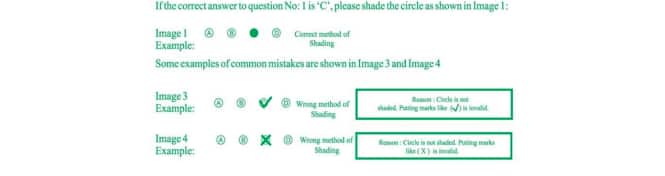
All circles must be shaded or darkened completely. Incomplete shading will not be counted as a response.
Shading more than one circle for a question is counted as a wrong answer and marks will be deducted accordingly.
Candidates must ensure that the Invigilator signs the OMR sheet.
Candidates are advised to carefully read the instructions about the CLAT OMR sheet filling to avoid common mistakes. The detailed list of mistakes to avoid is given below.
Stray marks: Avoid any stray marks, pen marks, or overwriting on the OMR sheet to avoid disqualification.
Marking Incorrectly: All circles on the OMR sheet must be shaded completely without leaving any gaps. Partially shaded bubbles are not counted as an answer.
Misalignment: The CLAT OMR sheet must be filled according to the sequence of the questions in the question booklet.
Multiple Markings: Candidates should give one answer per question. Shading more than one bubble is considered a wrong answer.
Using wrong pen: Only blue or black ballpoint pens are permitted in the CLAT exam 2026. Using an incorrect pen type might cause issues in evaluation.
Damaging the OMR: Candidates must not tear, damage, fold, or tamper with the OMR sheet.
Also Read

On Question asked by student community
Hello Student,
Here are the Careers360 CLAT 2027 Mock Test Resources for your exam preparation.
1. Online CLAT Mock Test
2. CLAT Mock Tests and Solutions
Hello student,
CLAT 2027 aspirants can access these monthly current affairs compilations for regular revision. Use these resources to stay updated with important events and topics for CLAT 2027.
|
Particular |
Download PDF |
|
CLAT Current Affairs- August Month (2026) |
|
|
CLAT Current Affairs- |
If you have only two months, use a highly structured plan: daily current affairs, English reading, legal reasoning practice, logical reasoning sets, basic quantitative practice and regular full-length mocks. Spend as much time analysing incorrect questions as taking the mock itself. Consistency during these two months can make a substantial
You can download the CLAT previous years' question papers from here:
https://law.careers360.com/articles/clat-previous-year-question-papers
https://law.careers360.com/download/clat-sample-papers-previous-years
For CLAT 2027 UG, candidates need to have passed Class 12/equivalent with at least 45% marks, or 40% for SC/ST/PwD candidates.
In your situation, having an RT in an additional subject but subsequently passing the required qualification through an improvement examination does not automatically make you ineligible. However, the important

Ranked #18 amongst Institutions in India by NIRF | Get Upto 100% Scholarships | Spot Admissions via CUET
Ranked 1 st among Top Law Schools of super Excellence in India - GHRDC | NAAC A+ Accredited | #36 by NIRF
NAAC A++ Accredited | Ranked #11 by NIRF
Bar Council of India (BCI) approved | Accredited by LAWASIA | Ranked 13th , among the Best Law Colleges (Private) in India by IIRF
Free Ebook - CLAT 2025 English Language questions with detailed solutions
Stay updated with current affairs & check your preparation with the CLAT General Knowledge Mock Tests Ebook